
The three most common fantasy scoring systems in U.S. leagues are standard (non-PPR), half-PPR, and full PPR. For new leagues and first-time commissioners, start with standard or half-PPR — those formats have the deepest pool of published rankings and the most stable player values.
Here is what each system means at a glance:
- Standard (non-PPR): No points for receptions. Scoring rewards big plays and touchdowns. Platforms like NFL Fantasy and ESPN use this as a baseline.
- Half-PPR: 0.5 points per reception. The most widely adopted middle ground in private leagues.
- Full PPR: 1 point per reception. Rewards volume receivers and pass-catching running backs heavily.
- IDP (Individual Defensive Players): Adds real defensive players to rosters instead of a team defense. Scored on tackles, sacks, and turnovers.
The math underneath all of these formats follows the same basic logic: yardage converts to points at rates like 1 point per 10 rushing/receiving yards or 1 point per 25 passing yards, touchdowns earn 4–6 points, and turnovers cost you 2.
Table of Contents
- What is standard (non-PPR) scoring and who does it favor?
- How does PPR scoring change player value?
- Why do so many leagues use half-PPR?
- How do yardage conversions and fractional scoring work?
- How do touchdowns, bonuses, and big-play rules affect outcomes?
- What are the most common negative scoring rules?
- How does IDP scoring work?
- What custom scoring options do commissioners use most?
- How do you choose the right scoring system for your league?
- Why do experts recommend standard or half-PPR for beginners?
- Key Takeaways
- The scoring format that actually trips up most commissioners
- Test scoring formats for free on Megasports-arena
- Sources and further reading
What is standard (non-PPR) scoring and who does it favor?
Standard scoring is the simplest format. Receptions earn zero points. A player's value comes entirely from yards gained and touchdowns scored.

NFL Fantasy's default settings are a clean reference point:
| Stat | Points |
|---|---|
| Passing yards | 1 pt per 25 yds |
| Rushing/receiving yards | 1 pt per 10 yds |
| Passing TD | 4 pts |
| Rushing/receiving TD | 6 pts |
| Interception thrown | -2 pts |
| Fumble lost | -2 pts |
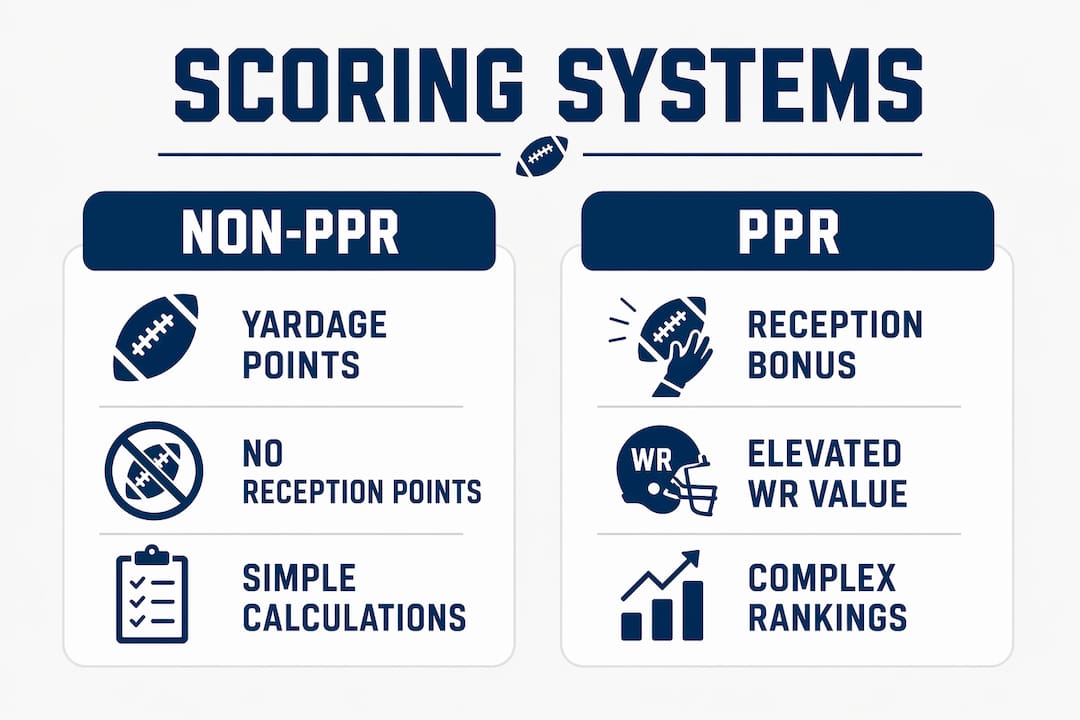
Quick example: A running back with 18 carries, 95 yards, and 1 TD scores 9.5 + 6 = 15.5 points under standard. Under full PPR, he adds nothing for those carries because receptions, not carries, earn the bonus. That same RB with 4 catches would score 15.5 under standard and 19.5 under full PPR.
Standard scoring naturally favors workhorse running backs and red-zone receivers over slot receivers who catch 6 passes for 40 yards. If your league wants to reward big plays and touchdowns rather than volume, this is the right format.
- Best for leagues that want simple, easy-to-explain rules
- Favors RBs with high carry volume and goal-line work
- Reduces the value of slot WRs and pass-catching RBs
Pro Tip: Enable fractional scoring in your platform settings. Without it, 9 rushing yards and 10 rushing yards both round to the same point total, creating unnecessary ties.
How does PPR scoring change player value?
Full PPR adds 1 point for every reception. That single rule reshapes the entire position hierarchy. A slot receiver catching 8 passes for 60 yards scores 8 bonus points that a standard-scoring league never awards.
DraftSharks documents the three tiers clearly: non-PPR (0 per reception), half-PPR (0.5), and full PPR (1.0). Here is how the same stat line plays out across all three:
| Stat line | Non-PPR | Half-PPR | Full PPR |
|---|---|---|---|
| WR: 7 rec, 72 yds, 0 TD | 7.2 pts | 10.7 pts | 14.2 pts |
| RB: 18 car, 95 yds, 1 TD; 4 rec, 0 yds | 15.5 pts | 17.5 pts | 19.5 pts |
| TE: 5 rec, 43 yds, 1 TD | 15.5 pts | 18.0 pts | 20.5 pts |
The WR's value nearly doubles from non-PPR to full PPR. That is not a small adjustment — it changes who you target in the first three rounds of your draft.
Position-tiered PPR takes this further. Some leagues assign different reception values by position: WRs get 1.0, RBs get 0.5, and TEs get 1.5 (TE premium). That TE premium format has gained traction in competitive leagues because it corrects the historical undervaluation of elite tight ends.
- Full PPR inflates the value of high-target WRs and pass-catching RBs
- TE premium formats make tight ends a genuine first-round consideration
- Draft tools and rankings are widely available for PPR formats
Why do so many leagues use half-PPR?
Half-PPR sits at 0.5 points per reception, and it exists because full PPR has one real flaw: a 4-catch, 18-yard performance still earns 4 bonus points, rewarding checkdown catches that barely moved the chains. Half-PPR softens that effect without eliminating the reception bonus entirely.
Using the same WR from the table above (7 rec, 72 yds), half-PPR scores 10.7 points versus 7.2 in standard and 14.2 in full PPR. The gap is meaningful but not extreme. A pass-catching RB with 5 receptions for 30 yards earns 2.5 extra points in half-PPR versus 5 in full PPR — a difference that matters over a full season but does not completely flip the RB position hierarchy.
- Choose half-PPR when you want to reward volume without overvaluing short, low-yardage catches
- Works well for mixed-experience leagues where some managers are newer
- FantasyPros uses half-PPR as its default scoring setting, which means most published rankings apply directly
How do yardage conversions and fractional scoring work?
The two most common yardage rates in U.S. fantasy leagues:
| Stat type | Common rate | Per-yard decimal |
|---|---|---|
| Passing yards | 1 pt per 25 yds | 0.04 pts/yd |
| Rushing/receiving yards | 1 pt per 10 yds | 0.1 pts/yd |
Some platforms use 1 per 20 for passing yards (0.05 pts/yd), which slightly boosts QB scoring. ESPN, for instance, lists both options in its custom scoring settings.
Fractional scoring means the platform calculates to the tenth or hundredth of a point rather than rounding to the nearest whole number. NFL Fantasy supports fractional scoring and recommends enabling it to reduce ties. Without it, a player with 9 yards and a player with 14 yards both score 0 points — a frustrating outcome that fractional scoring eliminates.
Sample calculation with fractional scoring enabled:
- QB: 287 passing yards × 0.04 = 11.48 pts
- RB: 73 rushing yards × 0.1 = 7.3 pts
- WR: 48 receiving yards × 0.1 = 4.8 pts
Those decimal values add up across a full lineup. Over a 14-week season, fractional scoring can determine playoff seeding.
How do touchdowns, bonuses, and big-play rules affect outcomes?
Rushing and receiving touchdowns are worth 6 points in virtually every format. Passing touchdowns default to 4 points in most standard setups — a deliberate discount that prevents QBs from dominating weekly scoring by a wide margin.
Beyond base TD values, many leagues add bonus rules. NFL Fantasy documents common configurations:
- 40+ yard TD bonus: Extra points for long touchdowns (commonly 1–2 pts)
- 50+ yard TD bonus: A second tier, which can stack with the 40+ bonus if both are enabled
- 100/200 rushing or receiving yard game bonus: Awarded when a player hits a yardage milestone for the game
- 300/400 passing yard game bonus: Same concept for quarterbacks
Stacking bonuses increases weekly variance. A WR who catches a 52-yard TD in a 100-yard game might collect base TD points, a 40+ yard TD bonus, a 50+ yard TD bonus, and a 100-yard game bonus all at once. That is a ceiling-raising outcome that makes boom-or-bust receivers more valuable.
- Bonuses favor high-ceiling players over consistent, volume-based producers
- They increase the gap between a great week and an average week
- Commissioners should decide whether bonuses are cumulative before the draft, not after
Pro Tip: If you add big-play bonuses, publish a worked example in your league's rules page before draft day. Managers who do not understand stacking will dispute scores mid-season.
What are the most common negative scoring rules?
Negative scoring keeps high-volume QBs from running away with weekly matchups. The standard penalty values most leagues use:
| Event | Typical penalty |
|---|---|
| Interception thrown | -2 pts |
| Fumble lost | -2 pts |
| Missed field goal | -1 pt (some leagues) |
Example: A QB throws for 310 yards and 2 TDs but also throws 3 interceptions. Base score: 310 × 0.04 + 8 = 20.4 points. After penalties: 20.4 - 6 = 14.4 points. That is a mediocre week despite the yardage total.
Turnover penalties typically range from -1 to -3 points, with -2 being the most common for both interceptions and fumbles lost. Harsher penalties (-3) push managers toward game-manager QBs; lighter penalties (-1) keep risky, high-upside passers viable.
- Missed FG penalties are optional but add accountability for kicker streamers
- Fumble lost (not fumble) is the standard — a fumble recovered by the offense carries no penalty
- Negative scoring is one of the most effective tools for balancing QB value against other positions
How does IDP scoring work?
IDP leagues replace the team defense slot with individual defensive players — linebackers, cornerbacks, and defensive linemen who score based on their personal stats. ESPN's IDP categories cover the full range:
| IDP stat | Common point value |
|---|---|
| Solo tackle | 1 pt |
| Assisted tackle | 0.5 pts |
| Sack | 2 pts |
| Interception | 2 pts |
| Fumble recovery | 2 pts |
| Forced fumble | 1 pt |
| Defensive TD | 6 pts |
| Pass defended | 0.5–1 pt |
A linebacker who posts 8 solo tackles, 1 sack, and 1 forced fumble scores 11 points under this table — comparable to a solid flex play. That is the appeal of IDP: defensive specialists become genuine roster assets.
The tradeoff is roster complexity. IDP leagues typically require 2–4 defensive roster spots, which expands the total roster size and demands knowledge of defensive personnel. For beginners, IDP adds a steep learning curve. For competitive leagues looking to deepen the strategy, it rewards managers who study defensive snap counts and tackle leaders.
What custom scoring options do commissioners use most?
Beyond the standard PPR/non-PPR split, DraftSharks lists several house rules that experienced commissioners use to rebalance position value:
- Tiered PPR: Different reception values by position (e.g., WR = 1.0, RB = 0.5, TE = 1.5)
- Points per carry (PPC): Rewards RB volume directly, not just yardage
- Points per first down (PPFD): Rewards consistency over big plays
- Points per target: Adds value for high-target receivers even on incompletions
- Kicker distance buckets: FG 0–39 yds = 3 pts, 40–49 yds = 4 pts, 50+ yds = 5 pts
- Return yard scoring: Adds value for return specialists
| Customization | Effect on variance | Draft strategy impact |
|---|---|---|
| Tiered PPR | Moderate | Elevates TE value; flattens WR/RB gap |
| PPFD | Low | Rewards consistent, chain-moving players |
| PPC | Low | Boosts high-volume RBs |
| Big-play bonuses | High | Favors boom-or-bust WRs and deep threats |
| IDP | High | Adds a full defensive draft tier |
Pro Tip: Document every custom rule in writing before the draft and post it in your league's message board. Stat corrections and bonus disputes are far easier to resolve when the rules are already published and agreed upon.
How do you choose the right scoring system for your league?
Work through this checklist before your draft:
- Identify your league's goal. Fun and casual? Competitive with serious managers? The answer shapes everything else.
- Assess manager experience. First-year managers do better in standard or half-PPR, where published rankings are most reliable.
- Decide how much variance you want. Full PPR plus big-play bonuses creates high-ceiling, high-floor swings. Standard scoring is more predictable.
- Choose your position emphasis. Want RBs to matter? Lean standard or PPC. Want WRs and TEs to shine? Full PPR or TE premium.
- Set tie-breaking rules. Enable fractional scoring to minimize ties before they become a problem.
- Decide on IDP. Only add it if most managers are experienced and willing to research defensive players.
- Publish rules before draft day. Post the full scoring sheet in your league platform.
Starter presets by league type:
- Beginner league: Standard or half-PPR, no bonuses, no IDP, fractional scoring on
- Casual league: Half-PPR, optional 100-yard game bonus, fractional scoring on
- Competitive league: Full PPR or TE premium, big-play bonuses, fractional scoring on, consider IDP
Why do experts recommend standard or half-PPR for beginners?
The practical reason is simple: most published rankings, auction values, and draft tools are built around standard and half-PPR formats. When you start in a full PPR league with custom bonuses, the rankings you find online may not apply to your settings.
Beyond rankings availability, standard and half-PPR scoring keeps player values more stable week to week. A running back's value does not swing wildly based on whether he caught 2 or 6 passes. That stability makes it easier to learn the fundamentals of roster management before adding layers of complexity.
- Standard and half-PPR formats have the most widely available, accurate rankings
- Player values are more predictable, which helps new managers make better waiver decisions
- Once you understand the basics, moving to full PPR or custom formats is straightforward
Key Takeaways
The single most important decision in any fantasy league is choosing a scoring format that matches your managers' experience and goals — standard or half-PPR covers most leagues well, and fractional scoring should always be enabled.
| Point | Details |
|---|---|
| Start with standard or half-PPR | Beginners benefit from stable player values and widely available rankings in these formats. |
| PPR receptions reshape position value | Full PPR nearly doubles a slot WR's score versus non-PPR, shifting draft priorities significantly. |
| Fractional scoring reduces ties | Enabling tenths-of-a-point scoring prevents rounding ties that can affect playoff seeding. |
| Bonuses increase variance | Big-play and yardage bonuses favor high-ceiling players and raise weekly score swings. |
| Megasports-arena for testing | Megasports-arena offers free contest formats where you can test scoring structures before committing to league rules. |
The scoring format that actually trips up most commissioners
Most scoring debates focus on PPR versus non-PPR, but the decision that causes the most mid-season friction is bonus stacking. Specifically: whether a 52-yard touchdown triggers both the 40+ yard bonus and the 50+ yard bonus simultaneously.
Full PPR gets the attention because it visibly changes draft rankings. But in practice, a league that runs full PPR with clean, well-documented rules runs smoothly. The leagues that generate disputes are the ones where commissioners enabled multiple TD bonuses without specifying whether they stack, or added PPFD without explaining how first downs on receptions interact with reception points.
The other underrated issue is the passing TD discount. Setting passing TDs at 4 points instead of 6 is a deliberate design choice to prevent QBs from outscoring every other position by default. Some competitive leagues bump it to 5 or 6 to make QB a true premium position. That is a legitimate choice, but it changes draft strategy more than almost any other single rule. If you make that change, tell your managers before the draft, not after week 1 when the QB-heavy team is 20 points ahead of everyone else.
The best scoring system is not the most complex one. It is the one your whole league understands before the first pick is made.
Test scoring formats for free on Megasports-arena
You can read about PPR versus standard scoring all day, but the fastest way to understand how a rule change affects outcomes is to see it play out in a live contest.

Megasports-arena offers free-to-play sports fantasy contests across NFL, MLB, NBA, and NHL, with leaderboards and pick hubs that let you see exactly how scoring rules translate into standings. Before you lock in your league's rules for the season, use the active contests on Megasports-arena to run mock picks under different scoring setups and watch how player values shift in real time. The game room gives you access to the full contest library, including formats with custom scoring structures. Sign up free at Megasports-arena and test your scoring preset before draft day.
Sources and further reading
The following sources were used to build this guide. All are U.S.-focused, and platform default pages are the most reliable reference when setting league rules.
- NFL Fantasy Scoring Help: Official NFL platform defaults for yardage rates, TD values, fractional scoring, and bonus configurations.
- ESPN Scoring Formats: ESPN's full list of customizable scoring options, including IDP categories and PPR variants.
- DraftSharks Scoring Systems: Covers PPR, half-PPR, non-PPR, and common custom options like tiered PPR and PPFD.
- FantasyPros Scoring Settings: Documents FantasyPros' half-PPR default and the scoring values used for accuracy ratings.
- FantasyPros Beginner's Guide: Expert guidance on why standard and half-PPR are the right starting point for new managers.
- SportsFirst Scoring Overview: Beginner-friendly explanation of how scoring formats shape player value and draft strategy.
Platform default pages are updated periodically. Check your league platform's help center directly when setting up a new league to confirm current defaults.