
Megasports-arena's free embeddable games are the fastest, lowest-friction way to add online sports contests to a website or internal office portal. Three reasons make it the obvious starting point: the games are free to play, every widget embeds via iFrame in minutes, and built-in leaderboards with contest scheduling are included from day one.
- Free-to-play across MLB, NBA, NFL, NHL, and more — no cost to players or site owners
- iFrame embed drops into any CMS with a single code snippet
- Leaderboards, archived results, and contest scheduling are ready out of the box
- Sign up, grab your embed snippet, and schedule your first contest before the next game day
Pro Tip: Start with the iFrame path for a same-day test. Switch to the API only when you need user-level data, persistent leaderboards tied to your own accounts, or rewards integration.
Key Takeaways
The most reliable path to running online office sports contests is to start with a free iFrame embed, publish transparent rules before launch, and measure repeat visits after the first week before committing to deeper integration.
| Point | Details |
|---|---|
| Start with iFrame | An iFrame embed can go live within hours — no engineering required for a first test. |
| API for user data | Move to API integration only when leaderboards or rewards must tie to your own user accounts. |
| Legal baseline | Free-to-play, no-purchase-required contests with published rules generally avoid U.S. gambling classification. |
| Measure repeat visits | Track week-over-week return rate from contest participants as the primary engagement signal. |
| Megasports-arena | Provides free embeddable games across major U.S. leagues with built-in leaderboards, scheduling, and iFrame widgets. |
Table of Contents
- What "office sports games" means in this guide
- What types of embeddable office sports games work best?
- How do you embed and deploy an office sports game?
- U.S. legal quick-check for free-to-play sports contests
- How do you keep scoring fair and contests trustworthy?
- How do embeddable games drive revenue and what should you measure?
- What technical issues should you watch for?
- Setting up a Megasports-arena game: a concrete example
- What actually matters when you run office sports contests
- Megasports-arena gets you live without the setup overhead
- Sources
What "office sports games" means in this guide
The phrase gets used two very different ways online. Here, it means online, embeddable, free-to-play sports fantasy and prediction games — the kind you drop into a website, intranet, or newsletter to keep sports fans engaged without asking them to leave the page. Think prediction picks, bracket pools, trivia contests, and leaderboard challenges.
What this guide does not cover:
- In-person Office Olympics, desk games, or physical team-building activities
- Real-money gambling products or daily fantasy sports with entry fees
- Standalone apps that require a separate download or login ecosystem
Three platforms sit at the center of this space. Megasports-arena provides free embeddable fantasy and prediction games across major U.S. leagues, with built-in scheduling and leaderboards. Content Player Pro from Stats Perform bundles live match data, interactive visuals, and an advertising suite deployable via iFrame or API. Opta Stream delivers live sports data feeds for publishers who need real-time stats as the backbone of their embeds. Each solves a different layer of the problem; this guide focuses on the game-and-contest layer where Megasports-arena operates.
What types of embeddable office sports games work best?
Embeddable game widgets are pre-built, modular components designed for short, bite-sized sessions — exactly what works during a lunch break or between meetings. The format you pick shapes how long people stay and how often they come back.
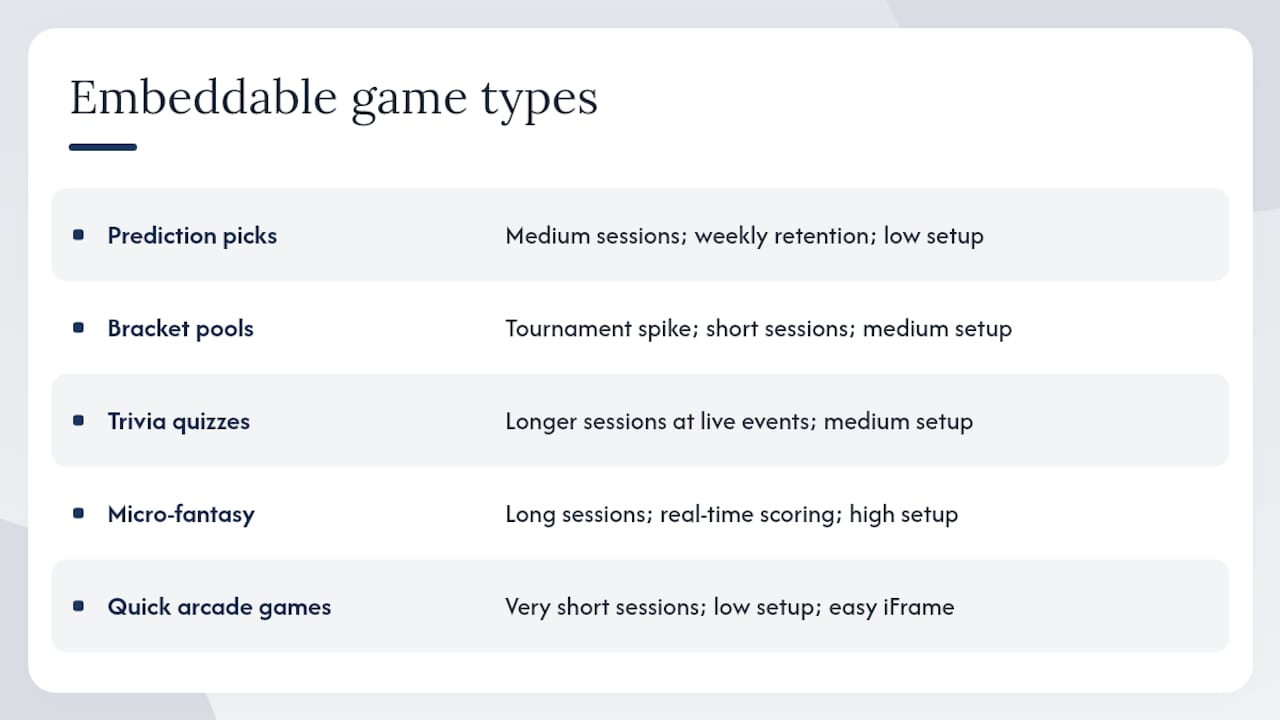
Prediction picks (weekly NFL or NBA picks, for example) are the workhorse format for retention. Players submit before the game, check results after, and return the following week. An iFrame handles this cleanly.
Bracket pools spike engagement around tournament time — March Madness, NFL playoffs — then go quiet. High ceiling for a short window; pair them with a sponsored prize to maximize the moment.
Trivia quizzes shine during live events. Drop a sports trivia widget into a watch-party page and session time climbs because players want to finish the round before the next quarter starts.
Micro-fantasy contests (pick a lineup, score points based on real stats) need more configuration and benefit from API integration when you want scores to update in real time and sync to a persistent leaderboard.
Quick arcade/skill games like Baseball Shootout or Sports Rummy are the easiest iFrame embeds and work well as newsletter CTAs or intranet homepage widgets — low commitment, high click-through.
Pro Tip: For an all-hands contest or company-wide sports challenge, start with a prediction picks format. It requires zero sports knowledge to participate, which broadens the audience beyond hardcore fans.
How do you embed and deploy an office sports game?
iFrame integration can make an embedded game live within hours; API integration is the right move when session and user-level data — leaderboards, rewards, account linking — must connect to your host platform.
iFrame path (same day):
- Get the embed snippet from Megasports-arena's game or contest page
- Paste the snippet into your CMS page, widget zone, or intranet block
- Set width to 100% and a fixed height (typically 500–700px); test on mobile
- Configure branding parameters (colors, logo) if the widget supports them
- Set contest start and end times, then publish
API path (1–4 weeks):
- Authenticate with the platform's API key
- Pass your user ID on each session so scores tie to real accounts
- Receive outcome webhooks to update your own database
- Sync leaderboard data to display natively on your site
A no-code widget workflow can compress the proof-of-concept phase to days, letting non-technical teams iterate on contest formats before engineering gets involved. Full SDK or native embedding — where the game renders entirely within your app's UI — typically takes weeks to months and is rarely necessary for office contest use cases.
Launch checklist: branding confirmed, contest rules published, prize or points settings saved, start/end times set, archived results enabled, mobile view tested.
U.S. legal quick-check for free-to-play sports contests
Free-to-play with no purchase required and skill-based scoring generally keeps a contest outside gambling classification under U.S. law. That said, "generally" is doing real work in that sentence — state rules vary, and prize value can change the picture fast.
Key principle: A contest is typically legal as a sweepstakes or skill contest when no purchase is required to enter, the winner is determined by skill or chance (not a wager), and the rules are clearly published. The moment real money changes hands as an entry fee tied to a prize, you are in regulated territory.
Practical checklist:
- No purchase required to enter (free alternate method of entry if any purchase is involved)
- Rules published and accessible before the contest opens
- Prize value below thresholds that trigger state registration (varies by state; consult counsel above $5,000 in aggregate prizes)
- Age gate where minors are likely (13+ COPPA baseline; 18+ if prizes have real-money equivalents)
- Explicit statement: no real-money wagering, no cash prizes tied to sports outcomes
- Privacy policy updated to reflect any user data collected via leaderboard or sign-up
Pro Tip: If your contest awards points, badges, or non-cash recognition, the legal surface area shrinks dramatically. Reserve cash or gift-card prizes for annual events where you can get a legal review first.
State variance is real. New York, Florida, and Arizona have historically applied stricter sweepstakes rules than most states. When leaderboard sign-ups collect email addresses or user IDs, your privacy policy needs to reflect that data collection and comply with applicable state privacy laws (California's CPRA being the most demanding).
How do you keep scoring fair and contests trustworthy?
Transparent scoring templates and automated anti-cheat, backed by a fast human-review path for disputes, are what separate a contest people trust from one they abandon after the first week.
Scoring principle: Publish the exact point formula before the contest opens. "Correct prediction = 10 points, tiebreaker = submission timestamp" is enough. Ambiguity after the fact destroys credibility faster than a bad pick.
Sample rules template:
- Eligibility: open to registered users 18+ in participating states
- Scoring: correct prediction earns 10 points; partial credit (e.g., correct winner, wrong margin) earns 5 points
- Tiebreaker: earliest valid submission wins
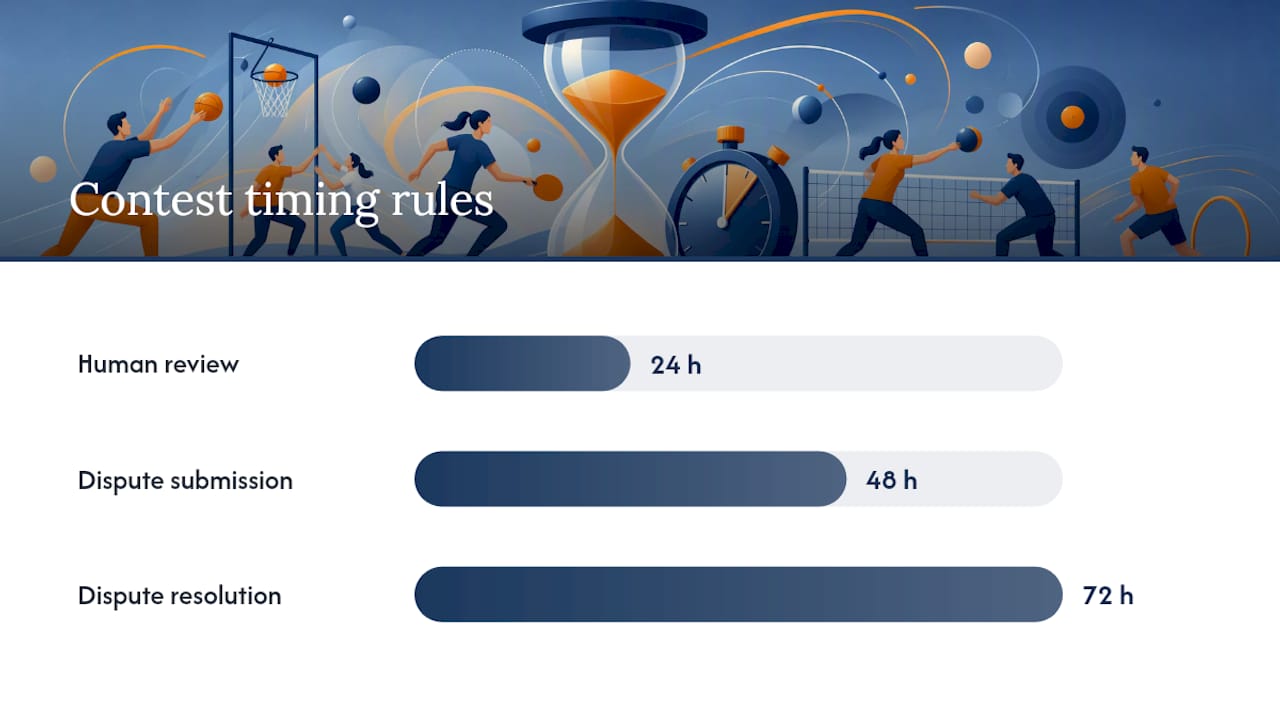
- Disputes: submitted within 48 hours of result publication; resolved within 72 hours
Anti-cheat measures to implement:
- Rate limits on submission endpoints (one entry per user per contest)
- Server-side validation of all scores — never trust the client
- Device fingerprinting or session tokens to catch duplicate accounts
- Threshold alerts when a single account's score jumps anomalously
Moderation workflow: detect anomaly → auto-flag → human review within 24 hours → communicate result to user. Keep a leaderboard that reflects only validated scores, and archive results so past contests are auditable.
Pro Tip: Post a "how scores are calculated" page linked directly from the leaderboard. Players who understand the math trust the outcome even when they lose.
How do embeddable games drive revenue and what should you measure?
Embeds drive revenue three ways: ad inventory inside the widget, sponsored contests, and higher session duration that lifts conversion rates across the rest of your site.
Advertising delivered inside an iFrame can be more resilient to ad blockers than host-page ad formats, which matters on sports sites where ad-blocker rates tend to run high. That resilience makes the widget itself a revenue-generating unit, not just an engagement tool.
Monetization options:
- In-widget ad placements (pre-roll, banner, or interstitial between rounds)
- Sponsored contests (a brand sponsors the prize pool or names the contest)
- Affiliate links tied to sports merchandise or streaming services
- Cross-sell CTAs to premium content or newsletter subscriptions
Metrics that matter:
- Session duration on pages with embeds vs. pages without
- Repeat visit rate week-over-week from contest participants
- Contest sign-up conversion rate from page visitors
- Ad impression volume and CPM inside the widget
- Downstream conversion uplift (purchases, subscriptions) attributed via UTM tags
Tag embed interactions as custom events in Google Analytics 4 or your analytics platform of choice. Use UTM parameters on any CTA inside the widget so you can attribute traffic back to specific contests. Webhooks from the game platform can push outcome data directly into your data warehouse for deeper attribution.
What technical issues should you watch for?
Prioritize responsive sizing, lazy loading, and performance isolation — the iFrame sandbox keeps a slow-loading game from dragging down your host page's Core Web Vitals.
Common issues and fixes:
- CORS errors: use
postMessagefor secure cross-origin communication between the iFrame and host page - Mobile resize jumps: set
width: 100%; height: autowith a minimum height, and test on both iOS Safari and Android Chrome - Ad blocker impact: iFrame-delivered ads are more resilient, but test with uBlock Origin enabled to confirm
- SSL mismatch: the embed source must be HTTPS; an HTTP src in an HTTPS page will be blocked by the browser
Performance tips:
- Lazy-load the iFrame (use
loading="lazy"attribute) so it doesn't block above-the-fold rendering - Set explicit width and height in CSS to prevent layout shift
- Use a skeleton screen or placeholder image while the widget loads
Pro Tip: Check your browser console for Content Security Policy errors first. A misconfigured CSP header on your host page is the most common reason an iFrame embed appears blank.
One iFrame-based platform reports 45 million monthly users across 9,000+ apps and sites — at that scale, the embed model's technical reliability is well proven. Most integration failures trace to host-page configuration, not the widget itself.
Setting up a Megasports-arena game: a concrete example
The fastest path: get the embed code from Megasports-arena, paste it into your CMS, configure the contest schedule, and test on mobile before publishing.
Step-by-step:
- Navigate to your chosen game (e.g., Sports Rummy or Baseball Shootout)
- Copy the iFrame embed snippet from the game's share or embed option
- Paste into your page editor — a WordPress block, Squarespace embed block, or raw HTML zone
- Set container width to full and height within a typical range suitable for your layout
- Configure contest start date, end date, and scoring rules in the platform dashboard
- Enable leaderboard display and set leaderboard retention (e.g., keep results for 90 days)
- Preview on desktop and mobile; confirm branding, start time, and mobile layout
- Publish and share the contest link via email, Slack, or your intranet
Before you go live, confirm:
- Branding colors and logo match your site
- Contest rules are published and linked from the embed page
- Start and end times are set in the correct time zone
- Mobile view renders without horizontal scroll
- Archived results are enabled so past contests stay visible
Engagement typically shows up in the first week: repeat visits from players checking standings, and session duration climbing on the embed page. Direct game integration case studies show publishers achieving 20% repeat-visit rates once embeds become a regular content feature.
What actually matters when you run office sports contests
The conventional wisdom says "make it fun." That's not wrong, but it misses the operational detail that determines whether a contest runs once and dies or becomes a weekly habit.
Three things matter more than game format: fair rules published before the contest opens, a mobile experience that works on the first tap, and a prize or recognition model people actually care about. Get those three right and the format almost doesn't matter. Get one wrong and even a well-designed game loses its audience by week two.
The instinct to start big — full API integration, custom leaderboards, branded prize pools — is almost always the wrong call. Start with an iFrame, measure repeat visits after the first contest, and let the data tell you whether deeper integration is worth the engineering time. Most office communities are satisfied with a clean leaderboard and a weekly email recap. The contest prize ideas that drive the most participation are often the simplest: public recognition, a small gift card, or bragging rights on a visible leaderboard.
Megasports-arena gets you live without the setup overhead
Free embeddable sports games, built-in leaderboards, and contest scheduling — without writing a line of code or negotiating a platform contract. That's the practical difference Megasports-arena offers site owners and office communities who want to run weekly sports contests without a development sprint.

The platform covers MLB, NBA, NFL, NHL, and more, with game formats ranging from prediction picks to Sports Rummy and arcade-style skill games. Every game comes with a shareable leaderboard, archived results, and an iFrame embed ready to drop into any CMS. For partners and advertisers interested in deeper integration, the platform pitch deck outlines co-branded and sponsored contest options. Check the active contests page to see live examples, then grab an embed snippet and schedule your first contest today.
Sources
- Content Player Pro | Embeddable Sports Data & Streaming for Platforms
- Embedded games integration: methods and options<!-- --> | Guul Games
- Embeddable Game Widgets | Embeddable
- Gamezop Business (2026). iFrame Games Online: Free to Embed on Your Website or App.
This article is general information, not a substitute for advice from a qualified lawyer. Consult a qualified legal professional about your own circumstances before acting on anything here.