
A results archive is the saved record of past fantasy contests: match outcomes, leaderboards, draft snapshots, and transaction logs stored so players and partner sites can look back at them. If you run a partner site and just need results on your page today, you have two fast paths. Embed a widget for a plug-and-play leaderboard, or pull from an API or export file when you need full styling control over historical data.
- Widget embed: fastest route, minimal development, works for editorial pages within minutes
- API or CSV/JSON export: full control over layout and data depth, best when you have engineering resources
- Next step: contact Megasports Arena or use the platform's My Picks and embed endpoints to request access
Either path gets a partner site live with real contest history instead of a placeholder or a dead link.
Key Takeaways
Archived fantasy results work best as a dual-track product: a fast widget embed for editorial pages and a full API or export path for engineering teams that need control.
| Point | Details |
|---|---|
| Choose the right access method | Use a widget for speed, an API for branding control, or an export for analytics pipelines. |
| Structure data with full metadata | Include league ID, season, scoring settings, and timestamps so totals aren't misread later. |
| Normalize names across seasons | Fix renamed teams and merged leagues before optimizing caching or infrastructure. |
| Verify before you trust the archive | Spot-check outcomes against scoring rules and log schema changes in a changelog. |
| Start with Megasports Arena | Its embeddable leaderboards and My Picks hubs let partners launch archived results without building a backend. |
Table of Contents
- Why archived fantasy-game results matter to fans and partners
- How do partners embed or access archived results?
- What data structure makes an archive reliable to reuse?
- Technical patterns for building or consuming archive endpoints
- How do you verify and maintain an archive over time?
- What actually matters once you start archiving results
- Megasports Arena: partner-ready archives and embeddable leaderboards
- Sources
Why archived fantasy-game results matter to fans and partners
Fans don't just want live scores. They want to know how their team did last season, who won the league three years running, and whether this week's matchup beats a historical high score. That kind of context is what keeps someone on a page for another five minutes instead of bouncing after checking one score.
Historical data functions as fuel for projections, pre-match storylines, and season recap content, and fantasy platforms lean on it heavily for engagement and analytics. Some platforms go further, using play-by-play archives to build on-demand replay contests that let fans relive a past season's drama instead of just reading about it.
For partner sites, an embedded archive is content that doesn't expire. A leaderboard from a completed season still answers real questions months later, which is a different value proposition than a live score widget that goes stale the moment the game ends.
- Archives extend session time by giving visitors a reason to keep clicking through past weeks and seasons
- They supply raw material for editorial: "best draft ever," "biggest single-week collapse," that kind of story
- Embedded historical widgets create a repeatable UX pattern, so a partner builds it once and reuses it every season
How do partners embed or access archived results?
The right access method depends on how much control you need versus how fast you need to ship. Here's how the three main options stack up.
- Widget or iframe embed. Drop in a snippet, get a styled leaderboard or results table with no backend work. Customization is limited to whatever theming options the widget exposes, but for an editorial team that just needs a "Past Results" box on a page, this is the lowest-friction option.
- API-driven render. You request data through authenticated endpoints and build your own display layer. This means handling API keys, pagination, and occasional schema changes, but it gives you full branding control and lets the archive match your site's existing design language.
- CSV/JSON export. Bulk data pulls suited to analytics pipelines, data warehousing, or building your own long-term archive outside the live platform. This is the option engineering teams reach for when they want to run their own historical analysis rather than just display it.
Before picking a method, run through a short checklist: How much visual customization do you need? How often does the data need to refresh? What's your expected traffic on the embed? And do you have developer hours to spend on integration, or does it need to work out of the box?
Pro Tip: Start with the widget for a quick launch, then migrate to API access later if the embed starts driving meaningful traffic. You'll validate demand before committing engineering time.
What data structure makes an archive reliable to reuse?
An archive is only as useful as its metadata. A leaderboard with no season tag or scoring context is just a list of names and numbers nobody can trust.
At minimum, a usable archive record needs a contest ID, league ID, season and week or date stamp, team and user IDs, a lineup snapshot, and the scoring settings that produced the final totals. Skip the scoring settings and a "142 point week" means nothing. It could be a standard scoring league or a points-per-reception format with completely different math behind it.
- Timestamp every record and tag it with a schema version so downstream systems know how to parse it
- Include the source platform name in the metadata, since scoring conventions and roster rules vary between platforms
- Normalize owner and team names across seasons. Someone renaming their team from "Gridiron Ghosts" to "The Comeback Kids" mid-career shouldn't fracture their history into two disconnected records
Display-wise, most partners settle on three patterns: compact summary cards for a single matchup, embeddable leaderboard blocks for full-season standings, and highlight thumbnails that spotlight a specific record or milestone. A leaderboard gamification approach, where standings update visibly and reward top finishers, tends to hold attention longer than a static table.
Pro Tip: If you're normalizing names across seasons, keep a mapping table separate from the raw archive. Never overwrite historical records to "fix" a display name. You'll lose the audit trail.
Technical patterns for building or consuming archive endpoints
Engineers building against a fantasy archive should expect a fairly standard REST shape: an endpoint for matchups by week, one for season standings, and one for roster or lineup snapshots by team and date. Each payload should carry the scoring settings object alongside the raw stats, not as a separate lookup, because structured payloads with explicit season and league identifiers are what let a consuming app avoid misreading historical totals.
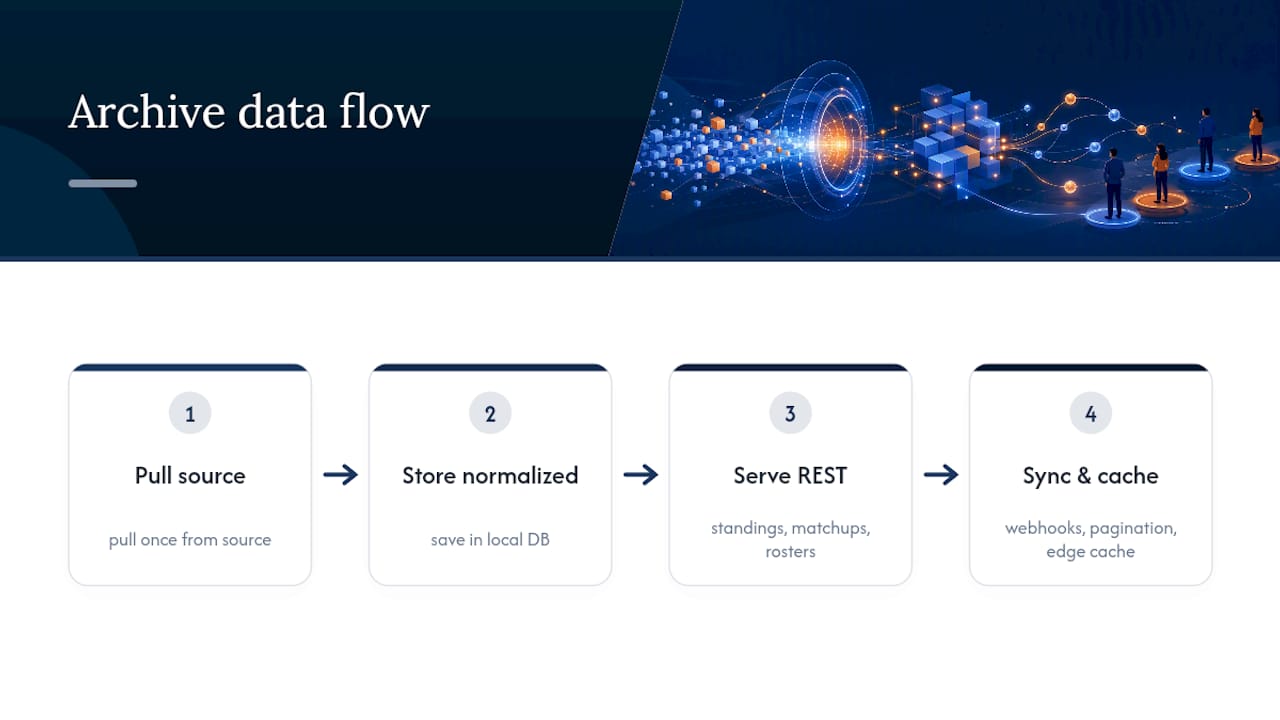
High-traffic embeds need pagination on any endpoint returning multiple seasons of data, plus caching at the edge since historical results rarely change once a season closes. Export workflows and webhook-driven syncs handle incremental updates well, so a partner site isn't polling the full archive every time a single game gets finalized.
One open-source project worth studying directly is a Go-based fantasy archive API that pulls ESPN league data into PostgreSQL and exposes standings, team performance, and draft history through clean REST endpoints.
The pattern is straightforward: pull once from the source platform, store normalized in your own database, and serve from there. That decouples your uptime from the original platform's API limits.
Building this way also protects you from a fragile dependency chain, since reverse-engineered or unofficial endpoints can break without notice.
How do you verify and maintain an archive over time?
Trust in an archive erodes fast once one wrong number surfaces. Verification isn't a one-time task. It's an ongoing habit.
- Spot-check outcomes against scoring settings. Pull a sample of matchups each season and confirm the point totals match the scoring rules on record, not just the final score shown.
- Keep versioned export snapshots. Store a dated copy every time you pull data, and log schema changes in a simple changelog so anyone debugging a discrepancy can see what changed and when.
- Watch for league ID breaks. Platforms sometimes reissue IDs or merge leagues, and an unhandled break can silently orphan years of history.
- Run checks after major events. A season finale, playoff restructuring, or platform update is exactly when data drift tends to appear, so schedule a review right after.
Third-party stat providers can supply player performance numbers, but they generally cannot replicate platform-specific records like exact lineup choices or transaction logs. Those live only inside the platform that hosted the league, which is one more reason to verify against the original source rather than a secondhand stat feed.
What actually matters once you start archiving results
Most advice on this topic treats archiving as a storage problem: keep the data, back it up, move on. That undersells it. The archive itself is a product surface, not a dusty backup folder, and treating it that way changes what you build first.
The conventional approach front-loads infrastructure: build the perfect schema, handle every edge case, then think about display. I'd flip that order. Ship a widget-based embed with rough-but-correct data first, learn which historical views your audience actually clicks on, then invest engineering time in the API layer for the views that prove themselves.
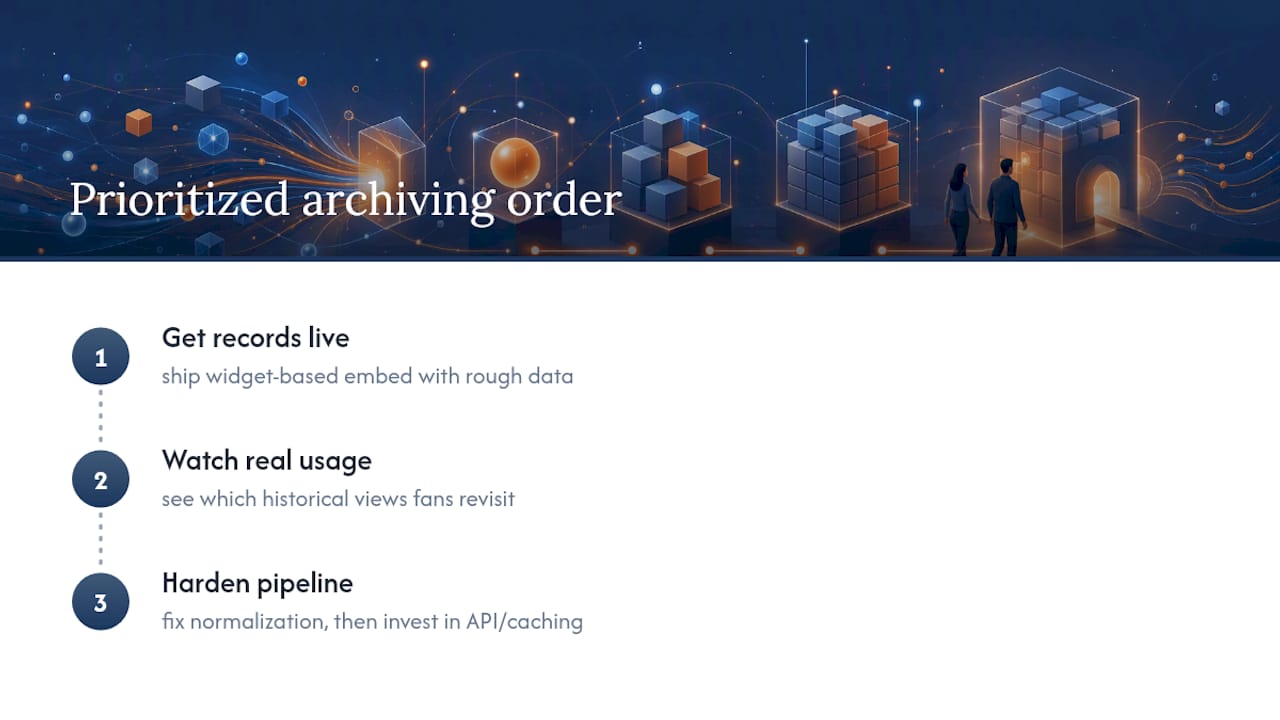
Where most partners underinvest is normalization. Renamed teams, merged leagues, and inconsistent scoring settings across seasons quietly wreck the credibility of an otherwise solid archive. Fix that before you fix your caching strategy.
Prioritize this order: get real records live fast, watch what fans actually revisit, then harden the pipeline behind the features that earn their keep.
— peter
Megasports Arena: partner-ready archives and embeddable leaderboards
Megasports Arena gives partner sites a shortcut past the build-it-yourself problem: archived results, embeddable leaderboards, and personalized "My Picks" hubs are already live and ready to plug into your pages, no schema design or backend work required on your end.

Starting is simple. Embed a widget for an instant leaderboard, request an export if your team wants to run its own analytics, or integrate through the API if you need full branding control. The My Picks hub shows exactly what a player-facing archived interface looks like, and it's the kind of feature partners often preview before deciding how deep to integrate. If your audience skews toward building fantasy squads and wants a companion tool, a team name generator pairs well alongside an embedded leaderboard for extra engagement.
Partners who add these embeds typically see longer session times and more repeat visits, since a results archive gives fans a reason to come back between games instead of just during them. Reach out to explore embed options, or start by browsing the My Picks hub linked above to see what's available today.
Sources
- Discussing the significance of historical sports data — Data Sports Group
- Fantasyhistorydata
- Fantasy Data & Analytics in Modern American Sports — Entity Digital Sports