Here are 12 ready-to-use sports crossword ideas you can start building with today. Each theme is paired with sample entries so you can drop them straight into a constructor.
- League Packs (NBA/NFL/NHL/MLB): DUNK (Slam in basketball), BLITZ (Defensive rush), PUCK (Hockey disc)
- Olympics Bridge Pack: RELAY (Track handoff event), LUGE (Winter sliding sport), VAULT (Gymnastics apparatus)
- Player Short-Fill Pack: ALI (Boxing legend, 3 letters), MAYS (Giants outfield great), BOLT (Fastest man on Earth)
- Equipment & Jargon: CLEAT (Shoe spike for traction), BATON (Relay handoff stick), CREASE (Goalie's protected zone)
- Venues & Mascots: FENWAY (Boston's storied ballpark), PATRIOT (New England's team symbol), DOME (Covered stadium type)
- Stats & Records: ERA (Pitcher's key metric, abbr.), RBI (Run batted in, abbr.), STREAK (Consecutive wins run)
- Chants & Traditions: WAVE (Stadium crowd motion), RALLY (Fan energy surge), ANTHEM (Pre-game song)
- Hybrid Summer + Winter Olympics: TORCH (Opening ceremony symbol), MEDAL (Podium prize), ALPINE (Ski racing category)
- Event-Tied Packs (Super Bowl/March Madness): BRACKET (Tournament grid), HALFTIME (Show intermission), SEED (Tournament ranking)
- Coaching Terms: TIMEOUT (Play stoppage call), FORMATION (Team alignment), AUDIBLE (Last-second play change)
- Youth Sports Basics: REFEREE (Rule enforcer), JERSEY (Team shirt), PENALTY (Rule-breaking consequence)
- Multisport Scavenger Hunt: COURT (Tennis or basketball surface), LANE (Swimming or bowling path), NET (Shared by tennis and volleyball)
Megasports-arena hosts embeddable sports puzzle games across MLB, NBA, NFL, and NHL that pair naturally with these themes. The Olympics and NBA alone give you enough vocabulary to build a dozen grids without repeating an entry.
Table of Contents
- How to pick the right difficulty level for your audience
- How to write sports clues that are fair, solvable, and fun
- Grid construction: mini vs. 15x15 and how to fill them well
- Two sample puzzles and starter wordlists you can copy
- Where to publish sports crosswords for maximum engagement
- Key Takeaways
- Why sports crosswords belong in every fan engagement strategy
- Ready-made sports puzzles you can embed today with Megasports-arena
- Sources and further reading
How to pick the right difficulty level for your audience
The one-sentence rule: choose beginner for classrooms (grades 3–5), intermediate for casual fans and newsletters, and expert for trivia nights and die-hard enthusiasts.
Cluegrid's printable sports crossword confirms that difficulty ranges from primary-school vocabulary (major sport names, basic equipment) all the way up to league history and tactical terminology. That spectrum gives you a clear ladder to climb.
Beginner clues stick to words most kids already know: sport names, basic positions, and common equipment. "Sport played on ice with a puck" (HOCKEY) works perfectly here. Answers should be 3–6 letters, and every clue should have exactly one obvious answer.
Intermediate puzzles introduce player names, common stats, and rule-based clues. "Pitcher's earned run average, abbr." (ERA) or "LeBron's team city, 2016 champion" (CLEVELAND) fits this tier. Casual fans recognize these without needing deep knowledge.
Expert grids go deep: league-specific history, tactical terms, and obscure events. "Defensive scheme with four linemen and three linebackers" (FOUR-THREE) or "Wilt's single-game scoring record" (ONE HUNDRED) belongs here. These clues reward the true enthusiasts and work well at pub quizzes or fan-event contests.
Audience match at a glance: Classroom lesson plans → beginner. Fan newsletter → intermediate. Trivia night or fantasy league event → expert.
How to write sports clues that are fair, solvable, and fun
Description-based clues beat bare team names every time. "Sport with touchdowns" pointing to FOOTBALL teaches the mechanic and checks knowledge simultaneously, which is exactly what a well-constructed sports crossword should do.
Abbreviation rule: if your clue uses an abbreviation, the answer must be one too. "QB's stat for passes caught, abbr." → REC works. "Passes caught by a receiver" → RECEPTIONS works. Mixing them creates unfair ambiguity.
Short legendary surnames are your best friends as grid anchors. ALI, PELE, MAYS, and BOLT each fit in tight three-to-four-letter spaces and carry instant recognition across age groups. Use them to create crossing opportunities rather than forcing obscure fill.
Numeric anchors are the most solver-friendly clues in any sports grid. "Year the Bulls won their sixth title" (NINETEEN NINETY-EIGHT) or "DiMaggio's consecutive-game hit streak" (FIFTY-SIX) have exactly one correct answer, which makes them ideal starting points for solvers working through a tough grid.
Pro Tip: Write every clue and then ask: could this answer be anything else? If yes, tighten the clue with a stat, a year, or an official term until only one answer fits.
Six example clues across levels: "Sport played with a shuttlecock" (BADMINTON, beginner) | "NBA's all-time scoring leader as of 2023" (JAMES, intermediate) | "Defensive penalty in soccer for deliberate handball in the box" (FOUL, intermediate) | "Pitcher's ERA formula component, abbr." (IP, expert) | "Tour de France mountain stage prize jersey color" (POLKA DOT, expert) | "Tennis term for zero points" (LOVE, beginner).
Grid construction: mini vs. 15x15 and how to fill them well
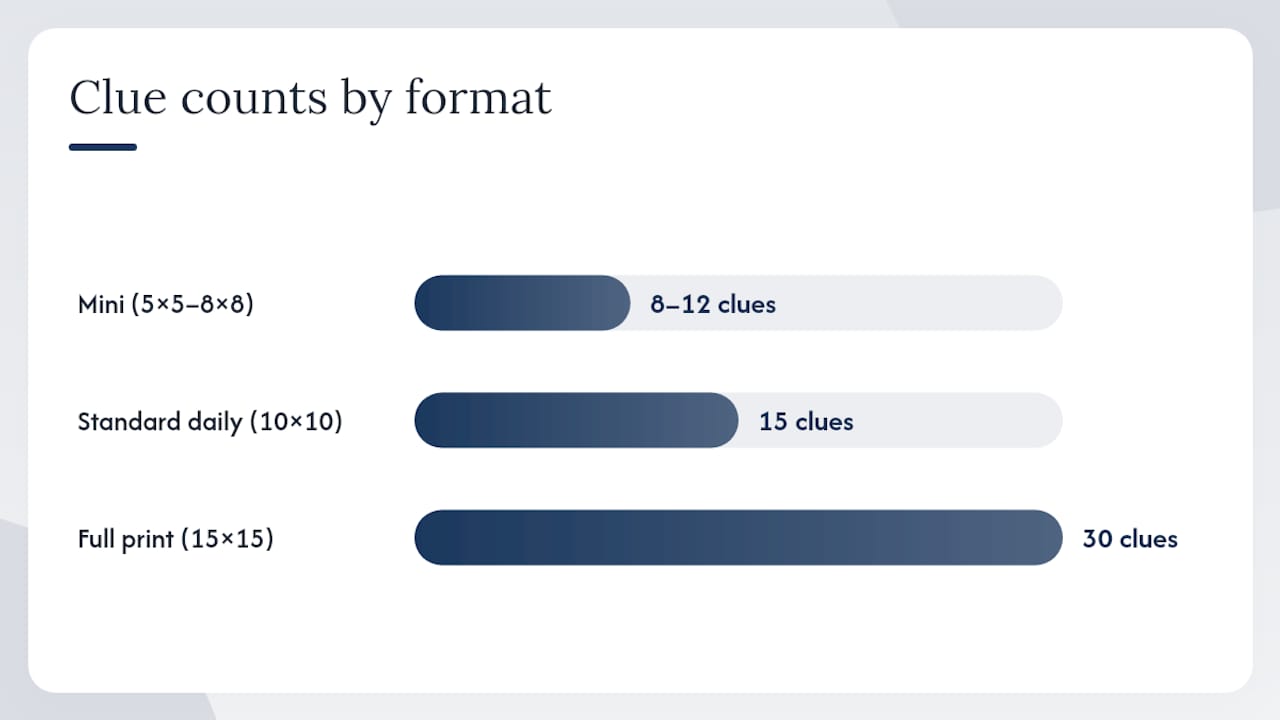
Choose mini puzzles (8–10 clues) for social posts and newsletters; go 15x15 for print handouts and event programs. Crosswordle Sports uses a 10×10 board for its daily quick-play format, which shows how smaller grids drive repeat engagement without overwhelming solvers.
| Format | Grid Size | Clue Count | Best Use |
|---|---|---|---|
| Mini | 5×5 to 8×8 | 8–12 | Social posts, email headers |
| Standard daily | 10×10 | 15 | Newsletters, app embeds |
| Full print | 15×15 | 30 | Event handouts, classrooms |
Theme-entry placement: put your longest theme answers in the center rows as across entries, then build the grid outward. Staggering two long entries (say, MARCHMADNESS and SUPERBOWL) symmetrically keeps the grid balanced and solvable.
Fill checklist for constructors:
- Keep at least 60% of your word pool at 4–7 letters to avoid awkward short fill.
- Every answer must cross at least two others so no entry is isolated.
- Limit entries longer than 10 letters to theme answers only.
- Use Olympic event names and league abbreviations (NBA, NFL, ERA, DRS) to expand the pool without adding obscure words.
- Short surnames (ALI, BOLT, MAYS) solve crossing problems in tight corners fast.
Printable Word and PDF templates from sites like WordMint let you export finished grids for classroom distribution or event handouts without any extra formatting work.
Two sample puzzles and starter wordlists you can copy
Start with a theme, not a blank grid. Here are two ready-to-use puzzle sets.
| Puzzle | Grid Size | Audience | Across Entries | Down Entries |
|---|---|---|---|---|
| Mini Beginner | 8×8 | Grades 3–5, casual fans | 6 | 6 |
| Standard Advanced | 15×15 | Trivia nights, fan events | — | — |
Mini beginner clue list (copy-paste ready):
- ACROSS: "Sport with a hoop" → BASKETBALL
- ACROSS: "Ice sport with a puck" → HOCKEY
- ACROSS: "Foot-to-ball sport" → SOCCER
- ACROSS: "Baseball hit that scores all bases" → HOMERUN
- DOWN: "Player who guards the net" → GOALIE
- DOWN: "Race in a pool" → SWIM
Standard advanced theme entries (NBA history):
- LEBRON (6) — "King James, to fans"
- DYNASTY (7) — "Chicago Bulls' 1990s run"
- DRAFTPICK (9) — "Annual rookie selection event"
- OVERTIME (8) — "Extra period after a tie"
- THREEPEAT (9) — "Winning three titles in a row"
Starter wordlists by category:
- Basketball short names: WADE, BIRD, MAGIC, SHAQ, KOBE
- Olympic events: LUGE, VAULT, RELAY, EPEE, SCULLS
- Stadia: FENWAY, WRIGLEY, ROSE (Bowl), CAMP (NOU)
- Equipment: CLEAT, BATON, FOIL, POMMEL, CREASE
- Stats abbreviations: ERA, RBI, PPG, FGA, DRS
For classroom distribution, WordMint's printable crossword templates let you export Word or PDF versions in minutes.
Where to publish sports crosswords for maximum engagement
The highest-impact placements are email newsletters, game-day programs, fantasy league hubs, and classroom activity sheets. Each works for a different reason: newsletters reward subscribers with exclusive content, game-day programs give fans something to do before kickoff, fantasy hubs keep users on the page between scoring updates, and classrooms turn vocabulary into play.
Embedding puzzles on sports or fantasy platforms converts casual readers into recurring visitors by offering mentally engaging, sport-adjacent content alongside the scores and stats they already came for.
Contest mechanics that drive repeat visits:
- Timed solves with a weekly leaderboard posted every Monday.
- Bonus points for completing theme answers (the longest entries) first.
- Social sharing prompts: "Share your time and challenge a friend."
- Scavenger-hunt crosswords at fan events where each solved clue reveals a location or prize code.
Pair puzzles with daily sports trivia for a two-activity engagement block that keeps fans on your page longer than either format alone. For ideas on making puzzles shareable, viral quiz mechanics offer a useful framework for structuring puzzles that spread on social media.
Key Takeaways
Start with an NBA short-fill or Olympics bridge pack, match difficulty to your audience, and publish where your fans already spend time.
| Point | Details |
|---|---|
| Match difficulty to audience | Beginner suits grades 3–5; intermediate fits casual fans; expert works for trivia nights. |
| Use description-based clues | "Sport with touchdowns" beats bare team names and doubles as a vocabulary check. |
| Right grid for the channel | Mini (8×8 to 10×10) for newsletters and social; 15×15 for print handouts and events. |
| Short surnames anchor grids | ALI, BOLT, MAYS, and PELE solve tight corner fill without forcing obscure entries. |
| Megasports-arena for embeds | Megasports-arena provides embeddable sports games and leaderboards that pair directly with crossword contests. |
Why sports crosswords belong in every fan engagement strategy
The conventional wisdom treats crosswords as a print-only, newspaper-reader format. That framing misses what actually happens when you drop a well-built sports puzzle into a fantasy league hub or a pre-game newsletter: fans who came for the scores stay for the puzzle, and they come back the next week to beat their time.
What most creators underestimate is the clue-writing step. Builders spend hours on grid symmetry and almost no time on clue quality. A single ambiguous clue breaks the solver's trust in the whole puzzle. The fix is simple: numeric anchors and official terminology first, descriptive mechanics second, and proper nouns only when they are unambiguous. That discipline separates a puzzle fans share from one they abandon halfway through.
The Olympics angle is genuinely underused. Because the Games bridge summer and winter vocabularies, a single Olympics-themed grid can serve a mixed audience of track fans, skiing fans, and gymnastics fans simultaneously. That breadth is hard to get from any single league pack.
Sports crosswords also work as a low-cost retention tool for sites that already publish fantasy content. The sports puzzle games format pairs naturally with prediction contests and leaderboards, turning a one-visit reader into a weekly regular without requiring any new content vertical.
Ready-made sports puzzles you can embed today with Megasports-arena
Building a sports crossword from scratch takes time. Megasports-arena cuts that work by giving you free, ready-to-embed sports games and puzzle content across MLB, NBA, NFL, NHL, and more, all in one place.

The platform includes interactive games with built-in leaderboards, contest scheduling, and archived results, so you can run a weekly puzzle contest without managing the backend yourself. Pair a crossword with the Sports Rummy leaderboard to give your audience a competitive layer that keeps them coming back. Want to see how the embed experience works before committing? Play a game now and check the active contests page for live examples of how contest mechanics run on the platform.
Sources and further reading
These resources cover construction rules, sample clues, and starter wordlists for builders who want to go deeper.
- Printable Sports Crossword
- The 10 Best Sports Crossword Topics for Sports Fans | Grid Genius
- Football Crossword Challenge - Apps on Google Play
- Crosswordle Sports – Daily Sports Word Puzzle
- Sports Crossword - WordMint