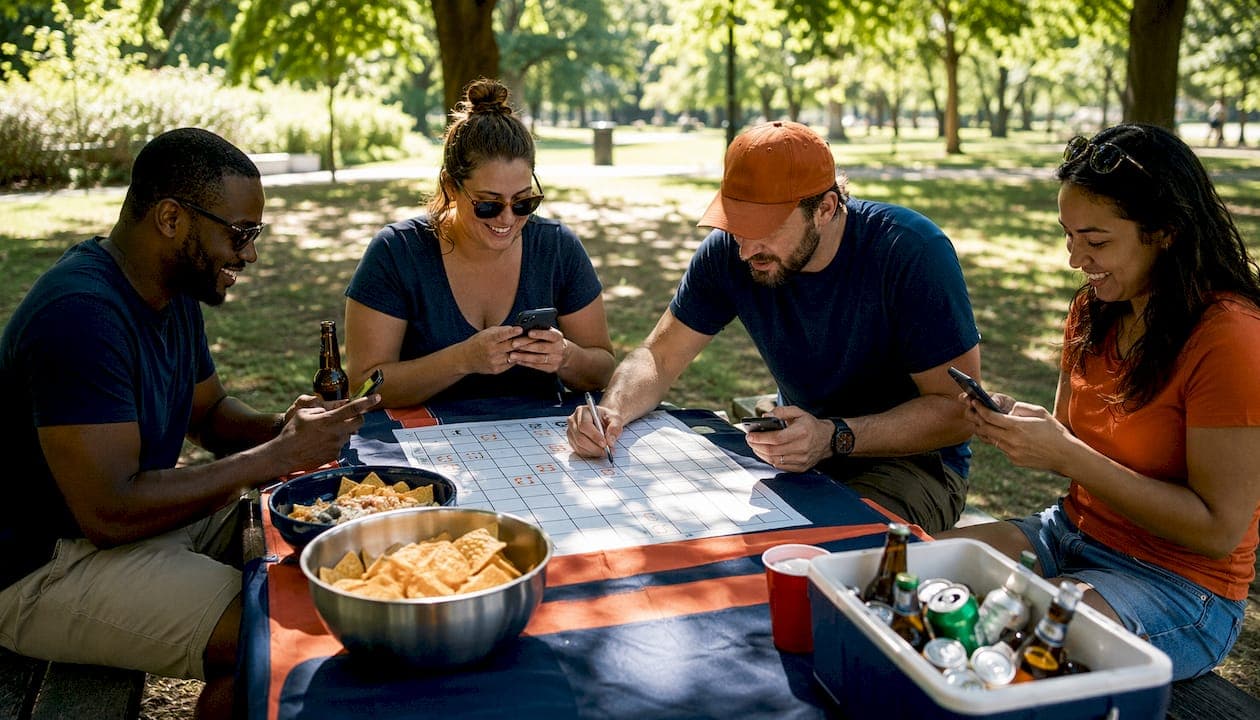
Super Bowl squares rules come down to four things: a 10×10 grid, blank squares sold before any numbers appear, a random draw of 0–9 on each axis only after every square is claimed, and winners determined by the last digit of each team's score at the end of each quarter.
Quick checklist before you sell a single square:
- Set the buy-in price and payout split before selling squares
- Decide your overtime and unsold-squares policy
- Lock the board and document the number draw
Worked example: The score at the end of Q1 is 10–3. Last digit for Team A is 0, last digit for Team B is 3. Find column 0 and row 3 on the grid — whoever's name sits in that square wins the Q1 payout.
Pro Tip: Write your house rules in a group chat or email before you collect a dollar. Disputes almost always trace back to rules that were never written down.
Table of Contents
- How do you set up a Super Bowl squares grid?
- How are winners determined, and what do payouts look like?
- What house rules should you publish before selling squares?
- Which numbers win most often, and does strategy matter?
- What variations work for small groups or fundraisers?
- How do you run squares smoothly at a watch party?
- Key Takeaways
- What experienced organizers wish they had known
- Megasports-arena makes online squares easy
- Useful sources
How do you set up a Super Bowl squares grid?
Start with a 10×10 grid — 100 squares total. Leave a blank row across the top and a blank column down the left side; those spaces hold the numbers 0–9, which stay empty until every square is sold. Label one team across the top and the other down the side.
Selling squares: Players write their initials in any open square. Collect payment at the time of purchase, not after. For large groups, cap how many squares one person can buy so the board doesn't get monopolized. Common buy-ins run a moderate amount per square suitable for party pools.
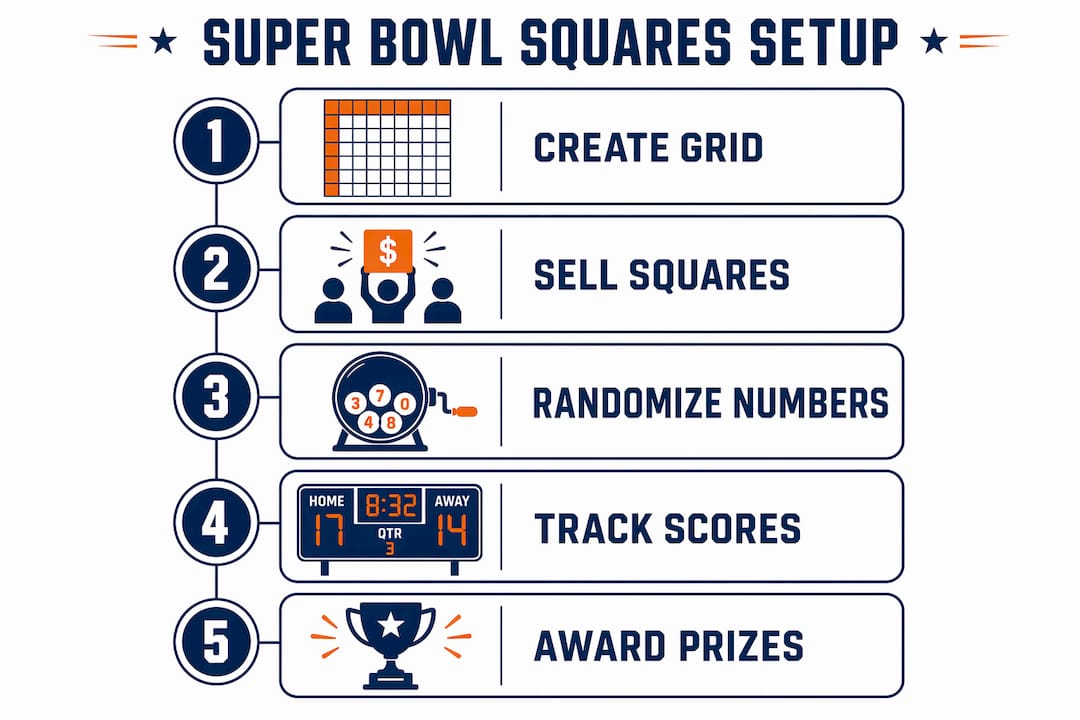
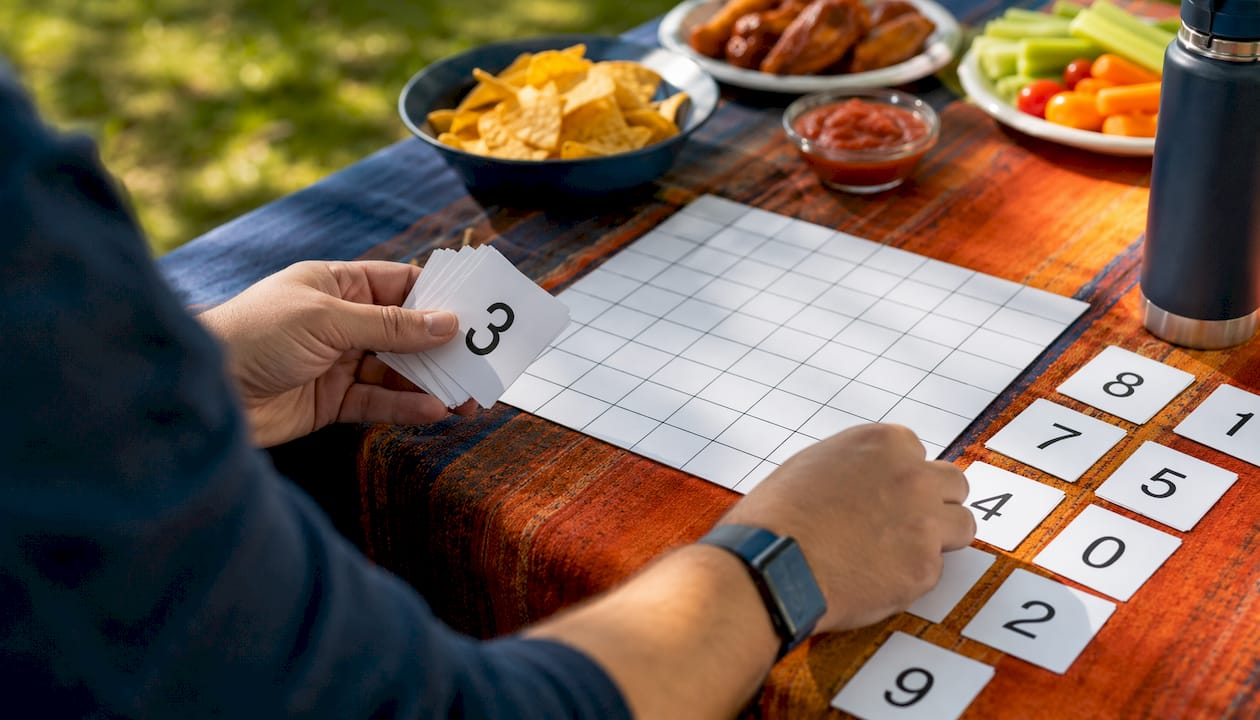
When to assign numbers — this is the step most organizers get wrong. Numbers must be randomized only after all 100 squares are filled. Write digits 0–9 on slips of paper, draw them one at a time from a hat, and assign them left to right across the top row, then repeat for the left column. Record the draw on video or with a photo.
| Pre-kickoff task | Details |
|---|---|
| Set price per square | a typical range for a party pool |
| Choose payout split | Equal, weighted, or halftime-final (see next section) |
| Unsold squares policy | House squares, re-draw, or refund — publish before selling |
| Overtime policy | OT replaces final, separate OT prize, or regulation stands |
| Number draw witness | At least one neutral person present; photo or video required |
Pro Tip: Use Venmo, Zelle, or Cash App to collect money. Digital receipts eliminate "I already paid you" arguments.
How are winners determined, and what do payouts look like?
At the end of each quarter, check the scoreboard. Take the last digit of Team A's score and find that column. Take the last digit of Team B's score and find that row. The square where they intersect wins that quarter's payout. That's the whole mechanic.
Common payout splits give organizers three practical options:
- Equal (25/25/25/25): Every quarter pays the same. Simple and popular for casual groups.
- Weighted (10/20/30/40): Later quarters pay more, which keeps players engaged deep into the fourth.
- Halftime-final (50/50): Only two payouts, bigger prizes, fewer winners.
Sample payout table — a pot example:
| Quarter | Equal split | Weighted split | Halftime-final |
|---|---|---|---|
| Q1 | similar share | lesser share | — |
| Q2 (Halftime) | similar share | moderate share | larger share |
| Q3 | similar share | moderate share | — |
| Final | similar share | larger share | larger share |
Overtime: Pre-agree on one of three approaches and publish it before selling squares: (A) the OT final score replaces the Q4 payout, (B) a separate OT prize is funded from a reserved slice of the pot, or (C) the winner is locked at the end of regulation regardless of OT. Silence on this point is the fastest way to end a friendship.
What house rules should you publish before selling squares?
Unclear house rules are the top cause of conflict in squares pools. Unsold squares, overtime, and duplicate winners are the three issues that blow up most often. Publish a short ruleset before anyone hands over money.
Mandatory clauses to cover:
- Unsold squares: Will they become house squares, get re-drawn, or trigger a refund? Pick one option and state it upfront — ambiguity here is the single biggest dispute trigger.
- Overtime: State which of the three OT options you are using (see above).
- Duplicate winners: If the same person holds the winning square for two quarters, do they collect both payouts? Almost always yes, but say so.
- Refund policy: No refunds after numbers are drawn is the cleanest rule.
- Draw witness: Name who will witness and record the number draw.
Sample rules text you can paste into a group chat:
Pro Tip: Take a timestamped photo of the completed board immediately after the number draw and post it to the group. That single image resolves 90% of potential disputes before they start.
Which numbers win most often, and does strategy matter?
Digits 0, 7, and 3 are statistically dominant in NFL scoring because touchdowns (7 points), field goals (3 points), and scores like 10, 20, and 30 all end in those digits. Digits 2, 5, and 9 are the weakest — a 2-2 square requires both teams to have a score ending in 2, which almost never happens in a real NFL game.
Stat callout: Zero (0) is the most common last digit in NFL quarter-end scores, followed by 7 and 3. Digits 2, 5, and 9 appear far less frequently, with the 2-2 combination sitting at the very bottom of historical frequency tables.
Here's the catch: because numbers are randomly assigned after all squares are sold, no player can influence which numbers they get. You buy a blank square, not a number. The randomization is what keeps the game fair and makes it ideal for casual pools and fundraisers alike.
The NFL's move of the extra point to the 15-yard line has slightly increased missed PAT frequency, nudging scores ending in 6 and 9 a bit more often than before. The core hierarchy — 0, 7, 3 on top; 2, 5, 9 at the bottom — holds.
Pro Tip: If someone insists on picking their own numbers before the draw, that's a red flag for the whole group. Randomization after the sale isn't optional — it's what makes the game honest. See how scoring trends affect odds in other pool formats too.
What variations work for small groups or fundraisers?
A 25-square (5×5) board is the go-to for gatherings with fewer than 20 players. Each square covers two numbers per team instead of one, so every player wins more often. The tradeoff is smaller individual payouts.
Other popular variants:
- Every-score-pays: A small prize goes out every time the score changes, not just at quarter ends. This inflates the value of 0 and 7 even further and keeps casual fans glued to the screen.
- Reverse payouts: The holder of the "reverse" square (e.g., if the score is 7-3, the 3-7 holder also gets paid) gets a smaller consolation prize. Reduces variance and keeps more people in the game.
- Auction boards: Instead of a fixed price per square, players bid on specific squares. This is the most market-driven format and rewards anyone who knows the digit frequency data.
Fundraiser math: If you reserve 20% of the pot for a cause on a $1,000 board, $800 goes to winners and $200 goes to the charity or organization. Publish that split before selling — transparency is what keeps donors happy. Digital games for groups consistently show that clear, upfront rules increase participation and trust.
Running squares online brings real advantages: auto-randomization, payment records, and livestreamed draws reduce disputes and cut the administrative load significantly compared to a paper board.
Pro Tip: For online runs, share the randomization screen live via Zoom or a group video call. Players who watch the draw happen in real time almost never dispute the results.
How do you run squares smoothly at a watch party?
Timeline:
- Two weeks out: Recruit players, share the written rules, set the buy-in and payout split.
- One week out: Open the board for square selection; collect payment immediately.
- Day before kickoff: Close sales, perform the number draw with a witness, photograph the completed board, and share it with all participants.
- At kickoff: Lock the board. No changes after this point.
Money and documentation:
- Collect digitally (Venmo, Zelle, PayPal) so you have a receipt for every payment.
- Keep a running list of who paid and which squares they hold.
- Pay out each quarter winner promptly — cash on site or a digital transfer within minutes of the quarter ending.
Duplicate and multiple wins: If one person wins two quarters, they collect both payouts. No rule prevents it. If a blank square wins because a square went unsold, apply whichever unsold-squares policy you published before the game.
Pro Tip: Post the updated score and winning square to the group chat after each quarter. Players who aren't at the party stay engaged, and everyone can verify the winner without asking you directly.
Key Takeaways
Assign numbers only after every square is sold, publish house rules before collecting money, and decide your payout split and overtime policy upfront — those three decisions prevent nearly every dispute.
| Point | Details |
|---|---|
| Numbers after sales only | Randomize digits 0–9 on each axis only after all 100 squares are claimed to preserve fairness. |
| Publish rules before selling | Cover unsold squares, overtime, refunds, and the draw witness in writing before taking any money. |
| Payout split options | Equal (25/25/25/25), weighted (10/20/30/40), or halftime-final (50/50) — set it before selling. |
| Top digits: 0, 7, 3 | These three digits dominate NFL scoring history; 2, 5, and 9 are the weakest combinations. |
| Megasports-arena for online pools | Megasports-arena offers free interactive pool formats with leaderboards and automated draws for online groups. |
What experienced organizers wish they had known
The mistake that kills the vibe fastest isn't a bad rule — it's no rule at all. Organizers who assign numbers before the board is full, skip the overtime clause, or collect money on an honor system almost always face a dispute by halftime. The fix is boring but effective: write it down, share it before anyone pays, and document the draw.
Engagement drops sharply after Q2 for players who are mathematically eliminated. A few simple moves keep the room alive: post the winning square name to the group chat immediately after each quarter, put the current board on a TV screen if you can, and consider a small consolation prize (a six-pack, a gift card) for the player whose square comes closest without winning. Limiting purchases to five squares per person also prevents one person from owning a third of the board, which kills the social energy fast.
The free-to-play format is genuinely the best version of this game for casual fans. No sports knowledge required, no skill gap, no reason for anyone to feel left out. That's the whole point.
Megasports-arena makes online squares easy
Running a squares pool for a remote group or a large online community used to mean spreadsheets, Venmo screenshots, and someone manually rolling dice on camera. Megasports-arena is built for exactly this situation: free interactive pool formats, automated draws, live leaderboard updates, and embeddable widgets that let any website host a live pool without technical setup.

The platform handles the record-keeping that trips up manual organizers — payment tracking, archived results, and automatic winner notifications. For football fans who want the squares experience without the administrative headache, the Megasports-arena game room is the fastest path from "let's do squares" to a live, running pool. Head there now and set up your group before kickoff.
Useful sources
- Football Squares Rules: The Definitive Analytics & Strategy Guide — EdgeSlip: primary source for digit frequency data and the fairness rationale behind post-sale number assignment.
- How do Super Bowl squares work? — Sporting News: house-rules best practices, the case for assigning numbers after sales, and the 25-square variant.
- Super Bowl Squares Template — Covers: payout structure examples, overtime handling options, and unsold-squares policy guidance.
- Super Bowl LX Squares — NBC Sports: online hosting advantages including auto-randomization and livestreamed draws.