
The best survivor pool strategy is simple to state and hard to execute: pick the team with the highest Expected Value (EV) this week, while keeping enough premium teams available for the brutal choke points in November and December. Every week you survive, your odds of winning improve. Every premium team you burn in September is one you cannot use in Week 15.
Before you lock any pick, run this quick check:
- W% — What is the team's win probability? Use moneyline odds or a trusted model.
- P% — What percentage of your pool is picking them? High ownership kills your edge.
- Situational flags — Any late injury news, line movement, or weather alert that changes the picture?
Home favorites win outright roughly 66% of the time in historical samples, and heavy favorites push near 80%. That baseline is your starting point, not the end of the analysis.
Table of Contents
- How survivor pools work — and why the rules change everything
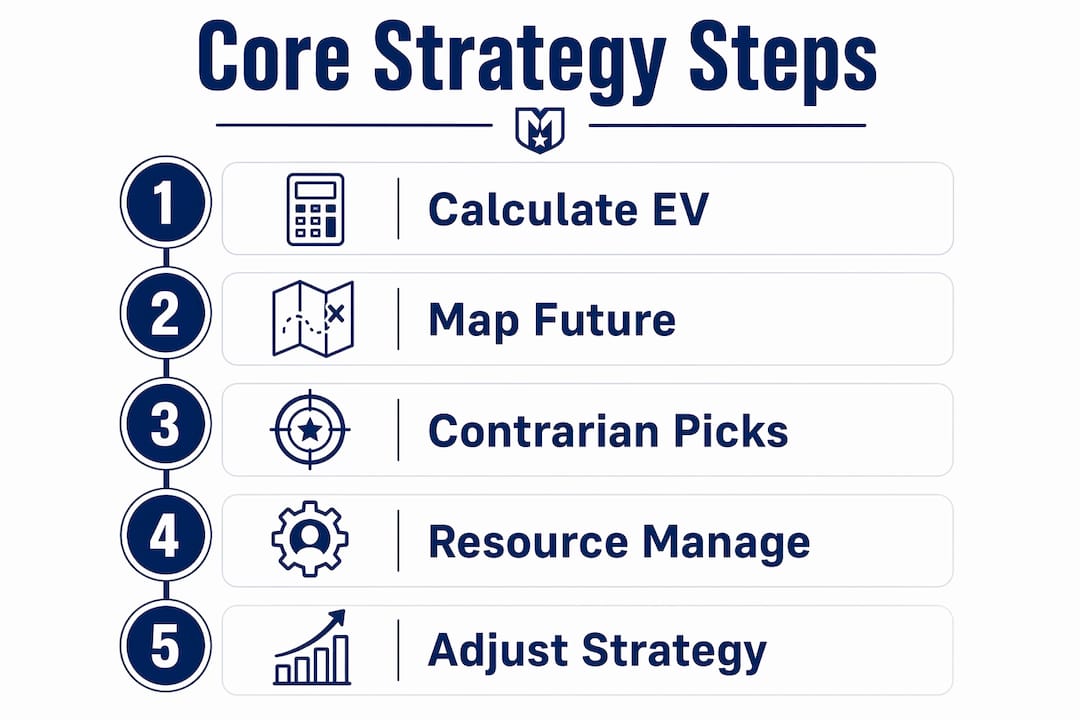
- The four core principles of a winning survivor pool strategy
- Your week-by-week playbook
- How to calculate EV and estimate pick popularity
- Common mistakes that end smart players early
- Adapting your plan for rule variants and other sports
- Three scenarios with recommended approaches
- How to spot and exploit predictable patterns in your pool
- What to do after you get eliminated
- Statistical tools and software for sharper win probability estimates
- Key Takeaways
- Why data tools make the difference in survivor pools
- Megasports-arena puts your survivor strategy into practice
- Useful sources and tools
How survivor pools work — and why the rules change everything
The standard format is one pick per week, no team used twice. That single constraint turns a weekly prediction game into a season-long resource management problem. You can review the standard rules and format before your first pick.
Common rule variants and what they mean for your plan:
- Double-pick weeks — You need two winners in one week. Reserve an extra premium team for those weeks or your EV math falls apart.
- Strike systems — One loss does not eliminate you immediately. Lower risk tolerance early; save premium teams slightly longer.
- Buy-backs — Eliminated players can re-enter. More entries stay alive longer, which keeps pick popularity higher and reduces contrarian edge.
- Multiple entries — You can run parallel picks. Split them across top options rather than duplicating the same pick.
Pool size matters just as much as rules. Small pools favor conservative play; large pools with hundreds or thousands of entries almost always run the full season, so you genuinely need 18 solid picks. Always audit your specific contest settings before Week 1.
The four core principles of a winning survivor pool strategy
1. Expected Value is the primary decision metric
EV combines win probability (W%) and pick popularity (P%) to identify the pick that maximizes your expected winnings. A simplified version: EV = W% ÷ P%. A team with a 75% win probability that only 5% of your pool is picking scores an EV of 15.0. An 80% team that 35% of the pool is on scores just 2.3. The math consistently favors the less popular option when win probabilities are close.
Home favorites of 7+ points generally win a large share of the time — a reliable baseline when hunting for high-W%, lower-ownership picks.
2. Future value: map 6–9 weeks ahead
Planning 6–9 weeks forward prevents the most common late-season disaster: arriving at Week 14 with no viable options because you burned every premium team in October. Identify choke point weeks now — weeks where only one or two teams project as heavy favorites — and reserve a premium team for each one.
3. Pick popularity and the contrarian edge
W%, future value, and P% form the core decision framework that separates sharp players from casual ones. Most players only think about win probability. The contrarian edge only works when the underlying win probability is still strong, generally above 65%. Below that, the risk of elimination outweighs the benefit of being different from the crowd.

4. Resource management
Identify 5–6 premium teams before the season (Chiefs, Bills, Eagles, 49ers, Ravens, and whoever else projects as a consistent favorite). Treat them as scarce assets.
Pro Tip: Map 3–4 "forced-use" weeks before the season starts — weeks where the schedule is so thin that you will have no choice but to use a premium team. Knowing those weeks in advance stops you from burning a premium team unnecessarily in a week with plenty of alternatives.
Your week-by-week playbook
Early season (Weeks 1–6): Target high-W% home favorites that are NOT your premium teams. Identify your 5–6 premium teams and avoid burning more than one or two of them. The field thins naturally from bad beats; your job is to stay alive without wasting assets.
Midseason (Weeks 7–12): Start deploying one or two premium teams if future weeks look crowded. Monitor pick popularity weekly and adjust. Real-world pool winners consistently combined home favorites, line monitoring, and resource preservation to survive deep into the season.
Late season (Weeks 13+): Deploy preserved premium teams at choke points. Take contrarian risks selectively if your pool is large and the EV math supports it.
Weekly checklist:
- Pull win probabilities from moneyline odds or a model.
- Estimate pick popularity using leaderboard data and forum chatter.
- Calculate EV for your top two or three candidates.
- Check injury reports, weather, and line movement.
- Lock your pick — but not before the last responsible moment.
Pro Tip: Before choosing a contrarian pick, check the Leaderboard Hub on Megasports-arena to see how the active field is distributed. A contrarian play only pays off if a meaningful chunk of your competition is actually on the chalk.
How to calculate EV and estimate pick popularity
Combining W%, P%, and projected future weeks' win probability gives you a multi-week EV plan rather than a single-week snapshot.
Worked example:
| Team | W% | P% (est.) | EV (W% ÷ P%) |
|---|---|---|---|
| Team A (chalk) | 80% | 35% | 2.3 |
| Team B (contrarian) | 75% | 5% | 15.0 |
Team B wins the EV comparison despite a lower win probability. That gap is where your edge lives.
How to estimate P% quickly:
- Check nationwide pick trends on major survivor hosting platforms.
- Review the My Picks Hub on Megasports-arena for ownership indicators in your contest.
- Scan sports forums and social media for which teams are getting heavy media attention — media hype drives public ownership.
- When in doubt, assume popular teams are being picked by 30–40% of large public pools and adjust conservatively.
Quick P% estimates carry real uncertainty. When the data is thin, use conservative assumptions and weight future value more heavily in your decision.
Common mistakes that end smart players early
- Burning premium teams in Weeks 1–4. The most common error. Panic picks in September cost you November options.
- Blindly following the most popular pick. High ownership means you gain nothing when the pick wins and lose everything when it loses.
- Ignoring bye-week crowding. Never use more than one team from the same bye week early in the season.
- Overreacting to media hype. Media narratives drive public ownership, not win probability. Use objective moneyline data instead.
- Defaulting to Thursday night games. Short weeks increase variance and injury risk. Avoid them unless the EV is clearly superior.
Situational red flags — pivot immediately if you see these:
- Starting QB ruled out after your pick deadline closes — check if your platform allows late changes.
- Severe weather forecast for an outdoor game (wind above 20 mph, heavy rain) — favors the underdog and kills high-scoring favorites.
- Line movement of 3+ points against your pick after you locked it — sharp money disagrees with you.
- Divisional matchup with a motivated underdog — upsets happen at a higher rate than the spread implies.
Adapting your plan for rule variants and other sports
Double-pick weeks require two winners, which doubles your elimination risk. Reserve an extra premium team specifically for those weeks and recalculate EV for both picks together, not independently.
Strike systems reduce urgency early. You can afford slightly lower W% picks in the first few weeks because one loss does not end your run. Save premium teams even longer.
Buy-backs keep more entries alive, which inflates pick popularity and compresses contrarian edge. Play slightly more conservatively until the field thins post-buy-back deadline.
Other sports (MLB, NBA):
- Smaller sample sizes and higher variance mean a 70% favorite can lose far more often than the number implies.
- Favor higher W% picks (above 70%) when variance is elevated.
- Multiple-entry strategies work well in high-variance formats — split picks across entries to raise the probability that at least one survives.
Always review your specific contest rules before finalizing any weekly plan. Rule variants materially change when to use premium teams.
Three scenarios with recommended approaches
| Pool type | Risk tolerance | Premium-team rule | Example week action |
|---|---|---|---|
| Friends pool (<100 entries) | Low | Save 1–2 for Weeks 13+ | Pick the obvious home favorite; no need to differentiate |
| Large public pool (hundreds–thousands) | Medium-high | Save 3–4 for late-season weeks | Fade the chalk when EV favors a 70%+ contrarian pick |
| Expert competition (skilled field) | High | Split across multiple entries | Run portfolio picks; use precise EV modeling each week |
In a friends pool, the field thins quickly from bad luck and careless picks. Conservative play and obvious favorites get you deep without burning assets. Large public pools almost always run the full season, so you need 18 solid picks and aggressive differentiation. Expert fields demand portfolio diversification across multiple entries — splitting picks across top options raises the probability that at least one entry survives each week.
How to spot and exploit predictable patterns in your pool
Most pool participants follow a predictable playbook: pick the biggest spread favorite, follow the media narrative, and never think past the current week. That predictability is your edge.
Watch for these recurring biases:
- Recency bias — A team that won big last week gets disproportionate ownership this week, regardless of matchup quality.
- Name-brand loyalty — Casual players default to marquee franchises (Chiefs, Cowboys, Patriots) even when the matchup is mediocre.
- Primetime inflation — Monday and Sunday night games get outsized attention, inflating ownership on the featured team.
- Bye-week blindness — Players forget to check which teams are on bye and accidentally pick unavailable teams, or panic-pick a bad option last minute.
Once you identify these patterns in your specific pool, you can engineer leverage situations. If you know 40% of your pool will default to the primetime favorite, a 72% win-probability team with 8% ownership can be the highest-EV play of the week.
What to do after you get eliminated
Getting knocked out early stings, but it is not the end of your season if your pool has buy-back options or if you run multiple entries.
If buy-backs are available: Re-enter only if you have a clear strategic plan for the remaining weeks. Audit which premium teams you have left, map the remaining schedule for choke points, and re-enter with a differentiated pick from the surviving field.
If you ran multiple entries: Treat the surviving entries as your priority. Adjust the eliminated entry's "ghost plan" to inform future picks on live entries — what would you have done differently? That analysis sharpens your decision-making going forward.
If you are fully eliminated with no re-entry: Use the rest of the season as a learning exercise. Track your picks against the optimal EV choice each week. By Week 18, you will have a clear picture of where gut instinct diverged from the math — and that gap is exactly what to close before next season.
Statistical tools and software for sharper win probability estimates
Gut feel and point spreads are a starting point, not a finish line. Sharper players layer in objective probability models.
Where to get reliable win probability data:
- Moneyline odds from major sportsbooks are the most market-efficient signal available. Convert them to implied probability using a standard formula (e.g., for -200 odds: 200 ÷ (200 + 100) = 66.7%).
- Computer rankings and power ratings (such as those published by sites like 4for4 or SurvivorPoolGuide) adjust for strength of schedule and recent performance in ways that raw spreads do not.
- Injury-adjusted models — Any model that does not update for late-breaking injury news is already stale by Sunday morning.
How to use these tools practically:
- Pull moneyline-implied win probabilities for every game on your candidate list.
- Cross-reference with a power-rating model to check for discrepancies.
- Adjust manually for significant injury news or weather.
- Feed the adjusted W% into your EV calculation alongside your P% estimate.
The My Picks Hub on Megasports-arena surfaces ownership data within your contest, which is the P% input most players skip entirely. Combining that with external win probability models gives you both sides of the EV equation in one workflow.
Key Takeaways
The single most important rule in survivor pools: always pick the highest EV option, not the highest win probability, because ownership percentage determines how much your survival actually matters.
| Point | Details |
|---|---|
| EV beats raw win probability | Divide W% by P% — a 75% team at 5% ownership outscores an 80% team at 35% ownership. |
| Plan 6–9 weeks ahead | Map choke points now and reserve a premium team for each one to avoid late-season dead ends. |
| Home favorites as baseline | Home favorites win roughly 66% of the time; heavy favorites push near 80% — use them as your W% floor. |
| Adapt to your pool's rules | Double-pick weeks, strikes, and buy-backs each change when to deploy premium teams; audit rules before Week 1. |
| Megasports-arena tools support the strategy | Use the My Picks Hub and Leaderboard Hub to estimate P% and track contest dynamics before locking picks. |
Why data tools make the difference in survivor pools
The conventional wisdom says "just pick the safest team." That advice is wrong, and the EV math proves it every season. A 75% team with 5% ownership is a better pick than an 80% team with 35% ownership — not sometimes, but consistently, over a full season. The players who internalize that truth and build a 6–9 week plan around it are the ones still alive in December.
Megasports-arena's Last Player Standing format is built around exactly this kind of strategic depth. The My Picks Hub shows you where the field is concentrating each week, the Leaderboard Hub tracks contest dynamics in real time, and the How To Play resources walk through the rules so you never get caught by a variant you missed. Data-driven EV plus forward planning beats gut-only picks. The tools are there — use them.
Megasports-arena puts your survivor strategy into practice
Free-to-play survivor pools with real leaderboard tracking, pick management, and multi-sport options — that is what Megasports-arena delivers without a subscription or entry fee.

Three platform features map directly to this guide:
- My Picks Hub — Track your weekly picks, review past selections, and monitor ownership concentration in your contest.
- Leaderboard Hub — See live contest standings and identify how the field is distributed before you lock a pick.
- How To Play resources — Clarify rule variants (double picks, strikes, buy-backs) so your strategy matches your actual pool format.
Head to the Football 301 My Picks Hub to start tracking your picks this week, or explore the full sports match game for cross-sport survivor formats across MLB, NBA, and more.
Useful sources and tools
Strategy guides and research:
- PoolGenius / TeamRankings — Survivor Strategy Guide
- Action Network — NFL Survivor Pool Strategy
- SurvivorGrid — Strategy 101
- SurvivorPoolGuide — Top 7 Strategies
- 4for4 — 10 Tips for Winning Your NFL Survivor Pool
- FantasyAlarm — NFL Survivor Pool Strategy
Megasports-arena platform tools:
- Last Player Standing — How To Play
- My Picks Hub
- Leaderboard Hub
- Active Contests