
Take a 10 to 15 minute mixed-sport starter quiz right now. That single move tells you more about your actual gaps than any amount of general reading, because it forces retrieval instead of recognition, and retrieval is the skill you're trying to build.
Here's the plan for the next month: quiz first, score honestly, then let the results choose your focus. Someone who misses every NHL question but nails NFL history doesn't need a broad study plan. They need hockey. Someone who confuses 1990s and 2000s champions across every sport needs chronological anchors, not more facts crammed in randomly.
Do these three things today:
- Take a mixed-sport starter quiz and score yourself by category, not just overall.
- Pick one weak sport or one decade you keep mixing up.
- Book a 10 to 15 minute recurring slot this week to drill that one area with active recall, not passive reading.
Pro Tip: Time yourself on the starter quiz. Trivia nights and app leaderboards reward speed as much as accuracy, and you won't know your pace problem exists until you clock it.
Table of Contents
- How to Improve Sports Trivia With a Starter Quiz
- Question Banks by Sport and Difficulty
- Why You Forget Trivia and How to Actually Fix It
- Building a Daily Sports Trivia Habit
- How to Create Your Own Trivia Quiz and Host a Quiz Night
- Measuring Progress and Moving From General Knowledge to Niche Mastery
- Why Use Megasports Arena to Practice Sports Trivia
- Quick Recap: What to Do Next
- Sources
How to Improve Sports Trivia With a Starter Quiz
Grab a timer. Fifteen questions, mixed sports, ascending difficulty, roughly one minute each. This mirrors the format outlets like The Washington Post use in their weekly trivia quizzes, which warm readers up with easier questions before escalating, a structure that works because it activates recall before it tests depth.
| # | Question | Difficulty |
|---|---|---|
| 1 | Which sport uses a puck? | Easy |
| 2 | How many players are on a basketball court per team at once? | Easy |
| 3 | What country hosts the next Summer Olympics after 2028? | Easy |
| 4 | Which MLB team has won the most World Series titles? | Medium |
| 5 | Who holds the NFL record for most career passing touchdowns? | Medium |
| 6 | Which nation has won the most FIFA World Cup titles? | Medium |
| 7 | What Grand Slam tournament is played on clay courts? | Medium |
| 8 | Which NBA team drafted Michael Jordan? | Medium |
| 9 | Name the last team to win back-to-back Stanley Cups before 2020. | Hard |
| 10 | Who was the youngest golfer to win the Masters? | Hard |
| 11 | Which college football program has the most national championships claimed? | Hard |
| 12 | What year did the NFL and AFL merge? | Hard |
| 13 | Name the boxer known as "The Greatest" who lit the Olympic torch in 1996. | Medium |
| 14 | Which Olympic sport added mixed-gender relay events recently? | Hard |
| 15 | Who won the first-ever Super Bowl? | Hard |
Score yourself: 13 to 15 correct means you're ready for niche, era-specific decks. Nine to 12 means you have solid general knowledge with a couple of soft spots worth chasing down. Five to eight means you should spend two weeks on broad category drills before specializing. Under five isn't a bad sign, it's just data. It tells you to start with anchor facts (all-time champions, record holders) before chasing obscure trivia.
Notice which questions tripped you up. If it was the chronology ones (question 9, 12, 15), that's a signal your issue isn't facts, it's sequencing. That distinction changes what you study next.
Question Banks by Sport and Difficulty
Jump to what you need: NBA, NFL, MLB, NHL, soccer, Olympics, tennis, college sports. Long, categorized banks like this work well because they mirror how outlets such as Parade and Today structure their trivia collections, grouping by sport first and difficulty second so readers can drill exactly where they're weak.
NBA
- Easy: Which team has won the most NBA championships all time?
- Easy: How many points is a shot from behind the three-point arc worth?
- Intermediate: Who holds the NBA record for most career assists?
- Intermediate: Which player has won the most regular-season MVP awards?
- Hard: Who was the first player selected in the 1984 NBA Draft?
- Hard: Which team traded away a young Kobe Bryant on draft night?
- Anchor fact: memorize the last ten NBA champions in order. This single list solves more trivia questions than any other piece of memorization.
NFL
- Easy: How many points is a touchdown worth before the extra point?
- Easy: Which position throws the ball on most offensive plays?
- Intermediate: Who has thrown the most career touchdown passes?
- Intermediate: Which team has appeared in the most Super Bowls?
- Hard: Name the quarterback who won Super Bowl MVP as a rookie starter.
- Hard: Which team lost three consecutive Super Bowls in the 1990s?
- Anchor fact: learn every Super Bowl winner since 2000. It's a shorter list than people assume, and it anchors two decades of NFL history.
MLB
- Easy: How many outs are in a full inning?
- Easy: Which league did the Yankees originally belong to?
- Intermediate: Who holds the record for career home runs?
- Intermediate: Which team broke a 108-year championship drought in 2016?
- Hard: Name the pitcher who threw a perfect game in the 2010 postseason race.
- Hard: Which player's single-season home run record still stands unbroken by a non-suspected user?
- Anchor fact: the World Series winners by decade. For a deeper dive, our MLB trivia collection has more than 50 baseball-specific questions organized this same way.
NHL
- Easy: What trophy is awarded to the playoff MVP?
- Easy: How many periods are in a regulation hockey game?
- Intermediate: Which team has won the most Stanley Cups?
- Intermediate: Who holds the record for most career goals?
- Hard: Name the last Original Six team to win a Cup after a multi-decade drought.
- Hard: Which goalie holds the record for most career shutouts?
- Anchor fact: Original Six team names and founding order.
Soccer, Olympics, Tennis, College Sports
- Soccer easy: How many players are on the field per team?
- Soccer hard: Which country has won the most Women's World Cup titles?
- Olympics easy: How often are the Winter Games held?
- Olympics hard: Which country has won the most Summer Olympic gold medals all time?
- Tennis intermediate: Which Grand Slam is played on grass?
- Tennis hard: Who holds the record for most Grand Slam singles titles?
- College sports hard: Which college football program has claimed the most national titles?
Cross-Sport Hard Set
This is where trivia nights get won or lost. Try these 12 questions built to test chronology and multi-select recall:
- Put these championship years in order: 1994 NBA Finals, 1996 Summer Olympics, 1998 World Cup.
- Which of these athletes competed in both the Summer Olympics and a major professional league (select all that apply)?
- Name the three most recent expansion teams added across the four major North American leagues.
- Which decade saw both a female jockey win a Triple Crown race and the first Wild Card MLB team reach the World Series?
- Order these Super Bowl-winning quarterbacks by their draft year.
- Which country has hosted both a Summer and Winter Olympics?
- Name two athletes who have their jersey numbers retired across multiple franchises.
- Which sport introduced instant replay review first among the major four US leagues?
- Put these boxing weight class champions in the order they were crowned.
- Which NBA and NFL franchises share the same home arena or stadium complex?
- Name the last three colleges to win a men's basketball national title as a lower seed.
- Which tennis player won a calendar Grand Slam, and in what year?
Why You Forget Trivia and How to Actually Fix It
The most effective way to lock in sports trivia is a combination of three techniques: spaced repetition, active recall, and chronological anchoring. None of them are exotic. All three are backed by decades of memory research, and all three apply cleanly to sports facts.
Active recall means testing yourself instead of rereading. Flipping through a list of Super Bowl winners feels productive, but it barely helps because you're recognizing answers, not retrieving them. Turn every fact into a question you have to answer cold. "Who won Super Bowl XXXV?" beats "The Ravens won Super Bowl XXXV" every time you review it.
Spaced repetition solves the second problem: facts you learn once fade fast. Deep knowledge from trivia practitioners suggests reviewing new facts at increasing intervals, roughly one day, three days, one week, then one month, rather than cramming the same list repeatedly in one sitting. Build this into flashcards: a stack of physical index cards or a digital deck works, as long as you're reviewing on a schedule instead of whenever you remember to.
Chronological anchoring is the technique most people skip, and it's the one that fixes the most common trivia failure: mixing up eras. Learning champions in order, rather than as isolated facts, gives your brain a timeline to hang new information on. When you already know the 1990s Bulls dynasty came before the 2000s Lakers three-peat, a new fact about either era slots into a mental sequence instead of floating alone, waiting to be confused with something else.
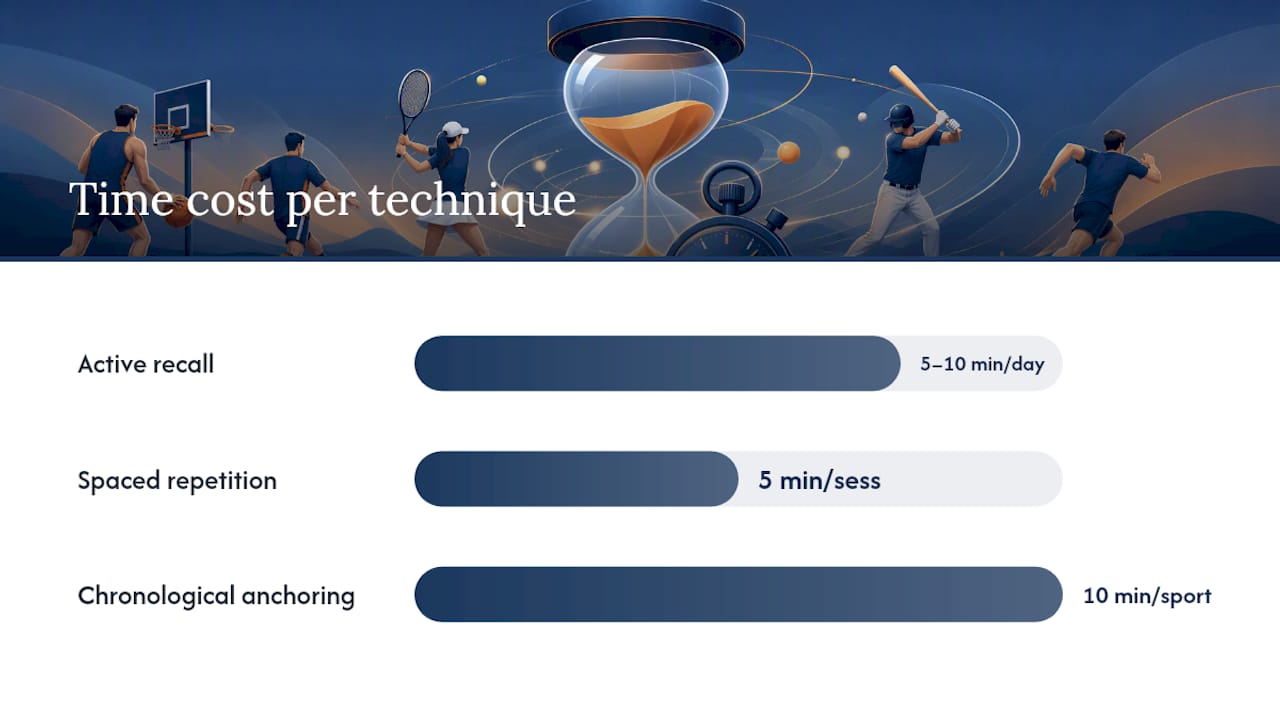
| Technique | How to apply it to trivia | Time cost |
|---|---|---|
| Active recall | Convert every fact into a question, quiz yourself before checking the answer | 5 to 10 minutes daily |
| Spaced repetition | Review new facts at 1 day, 3 days, 1 week, 1 month intervals | 5 minutes per session |
| Chronological anchoring | Memorize champion lists in order before adding side facts | 10 minutes per sport |
| Distractor elimination | Practice ruling out two wrong answers first on multi-choice questions | Built into quiz time |
For multi-select and multiple-choice questions specifically, build a rapid elimination habit. Rule out the two most implausible answers first, then verify the remaining options against something you actually know, rather than guessing among four. This shrinks your error rate on hard questions without requiring you to know the full answer outright.
Pro Tip: Pair trivia facts with a strong visual or a rivalry story instead of a bare stat. "Bird versus Magic" sticks longer in memory than "Larry Bird, three championships," because your brain encodes narrative better than isolated numbers.
Building a Daily Sports Trivia Habit
Consistency beats intensity here. A 10-minute daily habit for a month will outperform a single three-hour cram session, because spaced review is what actually moves facts into long-term memory.
Pick a routine that matches your goal:
- 5-minute casual routine: one flashcard review during a commute or coffee break, five questions, no pressure.
- 15-minute regular routine: a timed quiz plus a two-minute review of anything you missed, done four to five days a week.
- 30-minute weekly deep session: pick one sport or decade, work through a full category set, and log your accuracy by topic.
Track three things: questions attempted, accuracy broken out by sport or era, and time spent per session. A simple spreadsheet with four columns, date, sport, score, and notes on what you missed, is enough. The point isn't fancy tracking. It's noticing patterns, like discovering you consistently miss 1980s baseball questions but ace anything from the last ten years.
Video and highlight reels reinforce facts better than text alone, especially for record-breaking moments and iconic plays. Watching the actual highlight of a record-setting game gives your memory two anchors instead of one: the fact and the image. Our sports puzzle games collection offers a good complementary format for this kind of pattern-based reinforcement, and daily short quizzes like our daily sports trivia page work well as the five-minute version of this habit.

Watch parties and warm-ups are underused practice windows. Fire off two or three questions before kickoff with friends, or use a commute to run through a quick quiz on your phone. Weekly published quiz formats work partly because they keep practice tied to a predictable rhythm, and current events, not just historical facts, so your knowledge stays current instead of frozen in whatever decade you originally studied.
How to Create Your Own Trivia Quiz and Host a Quiz Night
Building a good quiz is a checklist problem, not a creativity problem. Follow these steps in order:
- Pick a theme. Broad ("sports history") works for mixed crowds; narrow ("2010s NBA") works for enthusiast groups.
- Balance difficulty. Aim for roughly 40% easy, 40% intermediate, 20% hard questions so nobody gets shut out early or bored by the end.
- Set time limits. 30 to 45 seconds per question keeps energy up without rushing thoughtful players.
- Write plausible distractors. Wrong answers should be believable, not silly. "Which team won the 1985 World Series?" needs three other real contenders from that era, not obviously wrong teams from a different decade.
- Verify every fact before use. Cross-check against a reliable reference like Wikipedia's event history pages for dates and champions, especially anything you're recalling from memory.
- Choose your format. Multiple choice for casual groups, speed rounds for competitive crowds, select-all questions for advanced players, and a bonus chronology round to test sequencing.
- Add stakes. Leaderboards, team rounds, or small prizes noticeably raise engagement. Check our contest prize ideas if you want inspiration beyond bragging rights.
A round of 10 to 15 questions per category keeps sessions tight without exhausting players, a pacing echoed in collections like Quizado's 100+ question sports trivia set, which is built with watch parties and group settings specifically in mind. If you want to scale beyond a one-off night into an ongoing contest with standings, our guide on building your own sports contest walks through running it as a recurring event.
Measuring Progress and Moving From General Knowledge to Niche Mastery
Track three numbers over time: accuracy by sport, average response time per question, and retention rate after a week and again after a month. These three metrics tell you almost everything. High accuracy but slow response time means you know the facts but haven't drilled recall speed. High accuracy that collapses after a week means you're not spacing your reviews.
Score benchmarking frameworks, like the tiered scoring used in FormHug's multi-sport trivia challenges, classify performance into rough bands, casual, knowledgeable, and expert, based on percentage correct across mixed categories.
AI tools can speed up building niche quizzes, but they need specific prompting to stay accurate. Try prompts like:
- "Generate 10 intermediate-difficulty NHL trivia questions from the 2000 to 2010 era."
- "Create 5 hard multi-select questions about Summer Olympic track and field record holders."
SimpleQuizMaker's AI sports quiz generator can build era- or league-specific rounds quickly this way, though it flags that very recent results, anything from the last six months, often need manual double-checking since AI training data lags behind live sports outcomes.
Pro Tip: When you plateau on general knowledge, pick one decade and go deep for a full week instead of spreading effort thin across every era. Staged, single-focus review consistently beats trying to improve everything at once.
Why Use Megasports Arena to Practice Sports Trivia
Megasports Arena gives you what a stack of scattered quiz sites and print lists can't: one place to run drills, track results, and compete without hunting across a dozen bookmarked pages.

The platform brings together ready-made question banks, customizable quizzes you can build around a specific sport or era, and leaderboards that turn solo practice into something more competitive. If chronological anchoring and active recall are the techniques that make facts stick, a leaderboard is what makes you show up daily to practice them. Instead of guessing whether your MLB knowledge is actually improving, you can see your score change week over week against real competition.
Here's what it offers a reader working through this guide:
- Ready-to-use question banks across major sports, so you skip the setup work of building quizzes yourself.
- Customizable quiz formats for the sport-specific or era-specific practice this article recommends.
- Leaderboards that add the accountability a spreadsheet tracker can't.
- Daily practice options that fit the 5 to 15 minute habit windows already covered.
Start with the sports rummy game to see how the scoring and leaderboard system works, then build your own practice rhythm from there.
One habit separates frequent trivia winners from everyone else
Frequent quiz winners rarely rely on raw knowledge volume. What sets them apart is a consistent review cycle: they revisit missed questions within a day or two, instead of moving on and hoping the correct answer sticks on the first pass. That single habit, close the loop on mistakes fast, does more for long-term recall than any amount of new question exposure.
Copy this checklist if you want the same result:
- Review every missed question within 48 hours of getting it wrong.
- Keep a running list of your three weakest categories and rotate through them weekly.
- Re-quiz yourself on last month's missed questions once before moving to new material.
Quick Recap: What to Do Next
The fastest path to real sports trivia improvement combines a diagnostic starter quiz, spaced daily practice, and chronological anchoring rather than isolated fact memorization.
- Take the mixed-sport starter quiz and score yourself by category, not just overall total.
- Pick one weak sport or era and commit to it for at least a week before switching focus.
- Schedule a short daily practice session, five to 15 minutes, and stick to the interval schedule for review.
- Use active recall and chronological anchors instead of passive rereading for every new fact.
- Use Megasports Arena's quizzes and leaderboards to track your progress and stay accountable over time.
Measuring progress weekly, and adjusting your study focus based on what the numbers actually show, matters more than any single study technique on this list.
| Point | Details |
|---|---|
| Start with diagnosis | Take a mixed-sport starter quiz first to find real gaps instead of guessing where to study. |
| Study in short daily bursts | Ten to 15 minutes of active recall daily beats long, infrequent cram sessions. |
| Anchor facts chronologically | Learn champions in order first, then layer in side facts around that timeline. |
| Track three metrics | Watch accuracy by sport, response time, and retention after a week and a month. |
| Practice on Megasports Arena | Use its question banks and leaderboards to drill daily and measure real progress over time. |
Sources
For fact-checking dates and champions before you build a quiz, Wikipedia's Super Bowl history page is a fast, reliable starting point. For large question banks organized by difficulty, the collections from Parade and Today.com are worth bookmarking, and The Washington Post's weekly trivia quiz is a solid recurring practice source tied to current events.
When you use AI tools to generate new questions, specify the era or competition directly in your prompt. Vague prompts pull from a blended timeline and can misattribute records to the wrong decade or player.
If you want a deeper bank to work through on your own, our 200+ sports trivia questions collection covers all skill levels, and the sports rummy landing page is a good hub for exploring the platform's full range of practice games.
- Sports trivia quiz: Test your knowledge - Washington Post
- 125 Sports Trivia Questions (Parade)
- Today