
A multi-sport fantasy league is a single competition that scores your roster across two or more sports instead of locking you into one. The fastest way to start one is a year-round, one-roster format on a platform that supports embeddable, cross-sport play. Grab a copy-ready 12-team template, pick your scoring weights, and launch before your group loses momentum.
TL;DR:
- Year-round, one-roster leagues promote higher engagement by maintaining a continuous leaderboard that updates across all sports and seasons.
- Setting fixed scoring multipliers before the draft prevents disputes and ensures fair comparison across different sports' statistical categories.
- Using a single master draft simplifies management but may lead to outdated picks for later seasons, while staggered drafts keep rosters fresh at the cost of extra admin work.
- Cross-sport trades require strict guardrails and a multi-day trade freeze to prevent exploitation and maintain competitive integrity.
- Platforms that support customizable scoring, flexible roster construction, and embedded leaderboards are essential for smooth cross-sport management.
Table of Contents
- How Do Multi-Sport Fantasy Leagues Actually Work?
- League Settings You Must Decide (Copy-Ready Templates)
- Draft Formats and Calendar: One Draft or Several?
- Managing a Multi-Sport Season: Trades, Waivers, and Scoring
- Three Example Setups You Can Copy
- How to Recruit and Keep Players Coming Back
- Strategy: Balancing Player Value Across Different Sports
- Technical Platforms and Tools That Support Multi-Sport Play
- Common Challenges (and Fixes) Unique to Multi-Sport Leagues
- Why Megasports Arena Bets on Year-Round, One-Roster Play
- Launching Your Templates on Megasports Arena
- Sources
How Do Multi-Sport Fantasy Leagues Actually Work?
Every multi-sport fantasy league starts with one decision: does each owner carry a single roster all year, or a fresh roster per sport? Single-roster leagues keep the same teams competing from football through basketball into baseball, with player values shifting as each sport's season opens and closes. Per-sport rosters reset the draft every few months, which feels cleaner but resets your community's investment right when it's peaking.
Scoring aggregation is where things get interesting. Most commissioners convert each sport's stats into a shared points scale rather than trying to compare a home run to a touchdown directly. That means building conversion tables ahead of time, not mid-season when someone's already complaining about a lopsided week.
Win conditions matter more here than in single-sport leagues, because you're deciding what "best team" even means across different games:
- Cumulative points: total score across the whole calendar year, rewarding consistency.
- Rotating championships: a mini-title for each sport's season, plus a grand champion at year's end.
- Head-to-head brackets: weekly matchups that adapt scoring weight depending on which sports are active.
The insights from ESPN's fantasy platform suggest that year-round, one-roster formats hold engagement better than segmented leagues, largely because owners stay invested in a leaderboard that never fully resets.
League Settings You Must Decide (Copy-Ready Templates)
Skip the blank-page problem. Here's a 12-team template you can paste directly into your commissioner panel:
- Roster size: 20 total slots, split as 12 active starters and 8 bench, with flexible slots that accept players from any covered sport.
- Starting slots: 3 flex slots per sport during that sport's active window, collapsing to 1 flex slot during its offseason.
- Scoring weight: normalize each sport to a 100-point weekly scale, then apply sport-specific multipliers (football touchdowns count differently than basketball triple-doubles) so no single sport dominates the standings.
- Tiebreakers: use sport-weighted head-to-head differential first, then fall back to season-long total points. That structure keeps a single hot week in one sport from deciding a cross-sport title unfairly, a technique borrowed from advanced commissioner setups on platforms like MyFantasyLeague.
- Playoffs: top 6 of 12 teams qualify, with a 3-week bracket that spans whichever two sports are active during your league's final month.
Pro Tip: Set your scoring multipliers before the first draft, not after week one. Retroactive scoring changes are the fastest way to lose a league's trust.
For entry fees, a modest amount per team covers a reasonable prize pool without pricing out casual players, and a simple split across first, second, and third place keeps things easy to explain. Governance basics: one commissioner, one co-commissioner as backup, and a written rules doc everyone can access before the draft.
Draft Formats and Calendar: One Draft or Several?
A single master draft, held once before your first sport's season opens, is the simplest way to launch a year-round league. Owners draft a full roster covering every sport in one sitting, and management shifts to trades and waivers as each season rolls in.
Staggered drafts, one per sport, spread the commitment out but add real administrative weight. You're now running three or four separate draft events, each with its own scheduling headaches and its own round of "wait, who's still active from the last draft?"
- Single master draft: faster to launch, easier for casual groups, but early picks can age poorly by the time a later sport's season starts.
- Staggered drafts: fresher rosters each season, better for competitive groups, but demands more commissioner time and clearer carryover rules.
- Hybrid approach: draft your two highest-priority sports together, then hold shorter supplemental drafts for the rest.
Timing matters most when seasons overlap. Basketball and football both run active weeks in November and December, so if your league covers both, decide in advance whether trades freeze during that overlap or stay open. Major platforms lean into staggered options because Yahoo Sports' commissioner tools show that separate drafts per sport reduce the mental load on casual players, even though it costs commissioners extra setup time.
Managing a Multi-Sport Season: Trades, Waivers, and Scoring
Cross-sport trades need guardrails that single-sport leagues rarely think about. A star quarterback and a starting point guard don't have an obvious exchange rate, which is exactly why disputes happen.
- Require both trading owners plus a commissioner vote for any deal involving players from different sports.
- Freeze traded players for 2 to 3 days post-trade to prevent same-week lineup exploitation.
- Restrict trading of top-tier assets during any sport's active playoff window, a safeguard CBS Sports' commissioner guidance recommends to preserve competitive integrity.
Waiver windows should shift with the calendar. When basketball opens while baseball is still wrapping up its playoffs, run a 24-hour waiver period for the sport that's active and a slower 48-hour window for whichever sport is winding down. Injury handling gets trickier too. A torn ACL in football and a hand fracture in basketball both need the same clear replacement rule, whatever sport they hit.
Live scoring feeds and weekly recalculations keep everyone honest. Platforms that pull real-time projections from prediction markets give owners a live sense of where standings sit mid-week, not just after Sunday's games finish, which keeps the league's group chat alive between game days.
Three Example Setups You Can Copy
Pick the template that matches your group's actual appetite for competition, not the one that sounds most impressive.
- Casual template: 8 teams, single roster, cumulative points scoring, no entry fee, quarterly "champion" recognition. Works well for friend groups who want a running joke and light bragging rights, not a spreadsheet war.
- Competitive template: 12 teams, deep bench (8+ slots), sport-weighted tiebreakers, $30 to $50 entry, 3-week playoff bracket. Built for groups that want draft depth to actually matter.
- Year-round one-roster template: 10 to 14 teams, one draft in the first active sport, rolling waiver additions as new sports open, continuous leaderboard with no full resets between seasons.
| Template | Best for | Draft style | Reset frequency |
|---|---|---|---|
| Casual | Friend groups, low stakes | Single draft | Never resets |
| Competitive | Serious players, prize pools | Single or staggered | Resets each playoff cycle |
| Year-round one-roster | Long-term community building | Single master draft | Continuous, no reset |
How to Recruit and Keep Players Coming Back
Recruiting for a multi-sport league is easier than a single-sport pitch, because you're selling year-round relevance instead of a four-month commitment. "This league never really ends" is a stronger hook than most people expect.
Start with your existing group chat or office pool list, since people already playing one fantasy game are your warmest leads. Frame the invite around the format, not the sport: mention that rosters carry over, that there's always something active, and that late joiners aren't stuck waiting for the next draft.
Retention comes down to visibility. A leaderboard that updates constantly gives owners a reason to check in even during a slow week for their strongest sport. Community discussion threads back this up. Long-running fantasy groups on forums like Reddit describe house rules, side bets, and informal traditions as the actual glue that keeps a league alive for years, far more than the scoring system itself.
Send a short recap after every scoring window, even a casual one. Highlight the week's top scorer, the biggest trade, and where the standings shifted. Leagues that go quiet between drafts lose members. Leagues that keep a steady drumbeat of small updates rarely do. Gamified leaderboards that show rank movement, not just raw totals, tend to pull lurking members back into active management.
Strategy: Balancing Player Value Across Different Sports
The hardest skill in multi-sport fantasy isn't drafting well within one sport. It's knowing when a basketball breakout player is worth more right now than a football veteran who's about to enter his bye week.
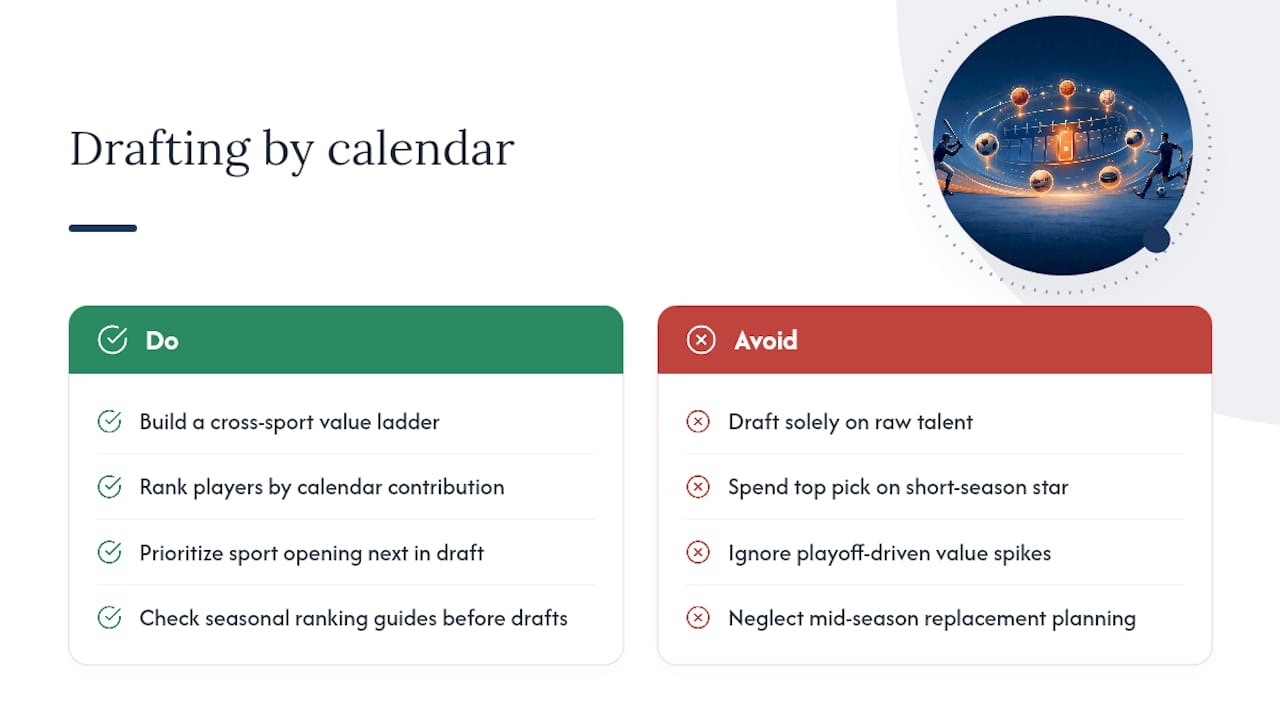
Build a rough value ladder before your draft, ranking players not just within their sport but by how much of the calendar year they'll actually contribute. A hockey star who plays October through June delivers value across three-quarters of your season. A player from a sport with a short, intense window delivers a concentrated burst that can win you a specific stretch but does nothing the rest of the year.
Draft capital should follow playing calendar, not just raw talent. Spending an early pick on a generational talent whose season ends in month three can leave you scrambling for replacement value the rest of the year. Many strong drafters instead prioritize players from whichever sport is about to open, then circle back for future-season value once that sport's season is underway.
Watch for value spikes tied to playoff runs. A player entering the postseason in one sport often outproduces a mid-tier player from a sport that's between seasons, even if the season-long stat line says otherwise. Seasonal ranking guides from sites like ESPN's fantasy hub and CBS Sports' fantasy games section are worth checking before each sport's opening week, since they update draft rankings specifically for that sport's new season, which is exactly the moment your league's value ladder needs to shift.
Technical Platforms and Tools That Support Multi-Sport Play
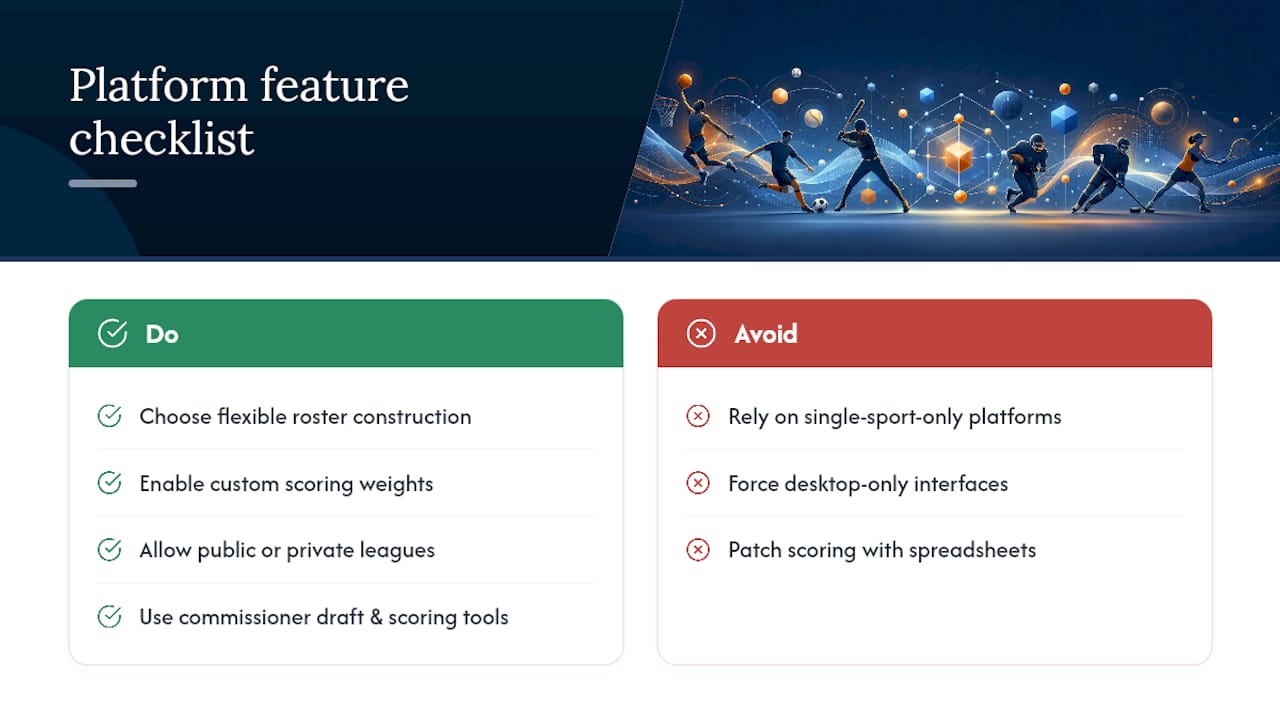
Most single-sport platforms weren't built with cross-sport rosters in mind, which is why commissioners often end up patching together spreadsheets to track scoring across formats the platform doesn't natively combine.
Look for platforms that support flexible roster construction, custom scoring weights, and public or private league creation without forcing you into a single sport's template. Commissioner tools that allow custom scoring options and multiple draft types, similar to what Yahoo Sports offers for football leagues, are worth studying even if you're building a cross-sport setup, since the underlying flexibility (custom categories, playoff brackets, waiver automation) transfers well.
Mobile access matters more than most commissioners plan for. If half your league can only check standings from a phone during a lunch break, a clunky desktop-only interface will kill engagement fast. Embeddable game widgets, the kind that let a league's leaderboard live directly on a group's own website or fan page, solve a real problem for communities that already have a home base and don't want to send members somewhere unfamiliar. That embeddability is also what separates a platform built for casual, ongoing play from one built purely for single-season competitive leagues.
Points-system templates from league-management resources, including the player-of-the-year scoring formula published by Shuffle Up and Deal, offer a solid starting framework for weighting different statistical categories fairly, whether you're building a single-sport points system or adapting one for cross-sport use.
Common Challenges (and Fixes) Unique to Multi-Sport Leagues
Overlapping seasons cause the most friction. When two sports are both active, owners have to manage two sets of lineup decisions in the same week, and it's easy for one sport to get neglected. The fix is a shared weekly deadline calendar posted at the start of each month, so nobody's guessing which sport locks first.
Injury impact is harder to standardize across sports because recovery timelines vary wildly. A basketball ankle sprain might sideline a player for a week; a football knee injury can end a season. Build a simple universal rule: any player ruled out for more than 4 weeks becomes immediately droppable, regardless of sport, so rosters don't get clogged with dead weight.
Scoring imbalance shows up when one sport's stat categories naturally produce bigger point swings than another's. Revisit your conversion table after the first full month of a new sport's data and adjust multipliers if one category is clearly running hot.
Commissioner burnout is real in leagues that never take a full offseason. Building in a genuine quiet period, even just a two-week stretch between two sports' seasons, gives commissioners room to handle rule changes and payouts without added pressure.
Why Megasports Arena Bets on Year-Round, One-Roster Play
Consolidated leaderboards keep owners checking in during a sport's off-window, not just its peak weeks, which is the retention pattern ESPN's fantasy data points to across large-scale platforms. Embeddable games extend that further: a league living on a group's own page recruits new members without ever sending them to an unfamiliar site. That's the practical case for one roster, one leaderboard, all year.
— peter
Launching Your Templates on Megasports Arena
A platform can give you a free path to running the exact templates above without stitching together separate tools for scheduling, scoring, and leaderboards. The casual, competitive, and year-round formats all map to the same setup flow: pick your game, set your schedule, and share the link with your group.

Start by checking the sports rummy how-to-play guide to see how contest scheduling and scoring work in practice, then head to the sports rummy play page to create your league. Once it's live, point your group toward the leaderboard page so everyone can track standings without asking you for updates. For groups running a full year-round rotation, the sports match leaderboard hub keeps momentum visible between sports. If you run a fan page or community site, some games are built to embed directly, so your leaderboard lives where your people already hang out instead of sending them somewhere new. Create your first contest today and get a link in front of your group before the next draft window closes.