
Well-written contest rules for fantasy sports do one thing above all else: they declare prizes and eligibility up front, then describe scoring and winner determination in unambiguous, skill-focused terms. Every compliant set of rules needs six elements: eligibility, entry method and fees, scoring and tie-breakers, prizes and payout schedule, refunds and cancellations, and dispute resolution. Under Nelson Mullins' analysis of U.S. fantasy sports regulation, prizes must be established and disclosed before the contest opens, and outcomes must be determined predominantly by accumulated statistical results of real athletes' performances. The Unlawful Internet Gambling Enforcement Act (UIGEA) carve-out that protects fantasy sports hinges on exactly those two conditions. State regulators like the Iowa Racing and Gaming Commission and the New York State Gaming Commission may also require prior submission of rules before a contest launches.
A minimal prize-disclosure snippet looks like this:
"The prize pool for this contest is $[AMOUNT], fixed regardless of the number of entrants. Winners are determined solely by accumulated fantasy points scored across all contest events, as defined in Section 4."
| Must-Have Element | What It Must State |
|---|---|
| Eligibility | Minimum age, U.S. state restrictions, account verification method |
| Entry and fees | How to enter, cost per entry, no-purchase-necessary alternative if applicable |
| Scoring and tie-breakers | Point formula, stat sources, tie-breaker procedure |
| Prizes and payout | Pre-declared prize amounts, payout schedule, guaranteed vs. conditional pool |
| Refunds and cancellations | Conditions for refund, what triggers cancellation, minimum-player threshold |
| Dispute resolution | Appeals window, decision authority, finality language |
Key Takeaways
Compliant U.S. fantasy contest rules require pre-declared prizes, accumulated-statistics scoring, and a documented audit trail to satisfy both UIGEA criteria and state commission requirements.
| Point | Details |
|---|---|
| Pre-declare all prizes | State every prize amount before the contest opens; prizes cannot depend on entry count. |
| Use accumulated-stats scoring | Tie outcomes to multiple events and multiple athletes to demonstrate predominant skill. |
| Check state requirements | Iowa, New York, and others may require prior submission; age minimums vary by state. |
| Build an audit trail | Retain registration forms, scoring exports, and payment records for at least five years. |
| Megasports-arena for partners | Embeddable contests with pre-built rules, prize tables, and audit logs reduce compliance setup time. |
Table of Contents
- How do you write contest rules that cover every required element?
- What scoring design proves predominant skill to U.S. regulators?
- What U.S. regulatory requirements apply before you launch?
- What do partners who embed or link contests need in their terms?
- How should you handle moderation, disputes, and enforcement?
- Copy-paste contest rules template for U.S. fantasy sports
- What most contest rule guides get wrong
- Megasports-arena makes compliant, embeddable contests faster
- Sources
How do you write contest rules that cover every required element?
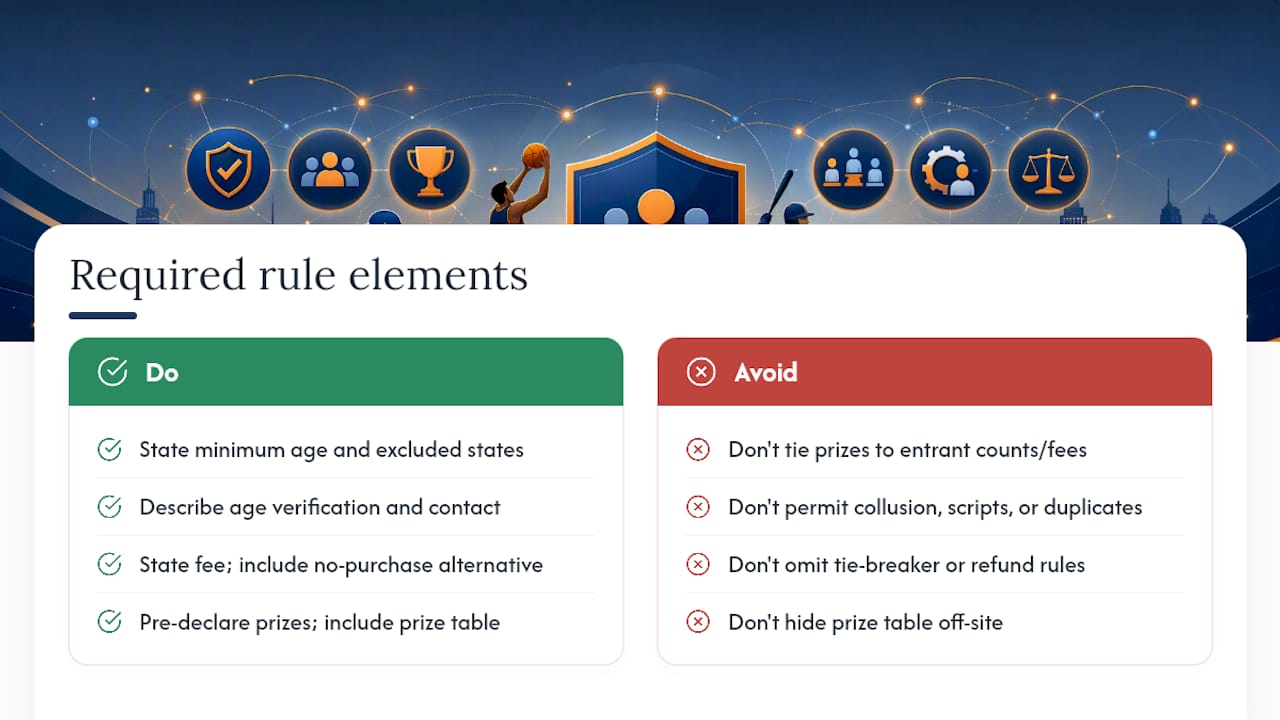
Eligibility sets the outer boundary of who can play. State the minimum age explicitly. Many states accept 18 as the floor, but LegalClarity's registration guidance notes that Arizona, Iowa, Louisiana, Massachusetts, and Virginia require participants to be 21. Pennsylvania requires 21 inside casinos. List every excluded state by name, exclude employees and immediate family members of the operator, and describe the age-verification method used at registration. For accessibility, note that participants who need accommodations may contact support at [contact email].
Entry and consideration covers how someone gets in and what they pay. If the contest charges an entry fee, state the amount clearly. Include a no-purchase-necessary alternative entry path when required by state law, and specify accepted payment methods. The UIGEA carve-out requires that prizes cannot depend on the number of entrants or fees collected, so a guaranteed prize pool is the cleanest structure.
Prizes and payout schedule demand the most precision. Pre-declare every prize value before the contest opens. Here is a sample prize table that meets UIGEA-style disclosure:
For contest prize ideas and structure options, the prize table must appear in the rules document itself, not just on a separate landing page.
Tie-breakers, refunds, and cancellations need their own clause. State the tie-breaker method (most points scored in the final scoring period, for example). Specify what triggers a refund: contest canceled due to insufficient entries, underlying sporting event postponed beyond a defined window, or operator error. If a minimum player count is required, disclose it before entries open.
Participant conduct and IP should prohibit scripted entries, collusion, and multiple accounts. State who owns user-submitted content (typically the operator retains a license; participants retain authorship). Include a short accessibility accommodation notice.
Pro Tip: Phrase winner-determination language as "accumulated statistical results of real-world athlete performances across multiple events" rather than "the player with the most points." The former mirrors the exact language regulators use to classify contests as games of skill.
What scoring design proves predominant skill to U.S. regulators?
Accumulated-statistics scoring across multiple real-world events is the single most defensible design. A contest that resolves on one player's single-game performance looks a lot like a bet. A contest that aggregates points across a full week of MLB games, an NBA conference slate, or an NFL week looks like a season-long strategy exercise.
Concrete scoring patterns that hold up to scrutiny:
- Per-yard/per-point formulas: 1 point per 10 rushing yards, 4 points per passing touchdown, 6 points per receiving touchdown. These tie outcomes to measurable, verifiable statistics.
- PPR (points per reception) variants: reward roster decisions that require knowledge of target share and usage rates, not just box-score totals.
- Cap-and-budget roster constraints: a salary cap forces participants to make trade-off decisions that favor sports knowledge over random selection.
- Team-composition caps: limiting roster selections to a maximum of 75% from any one real-world team forces diversification and reduces single-game variance.
- Minimum roster size: requiring a full roster (e.g., 8 players across at least 3 positions) prevents single-player concentration.
The FIFS Charter for Online Fantasy Sports Platforms requires that contests lock before the underlying events begin, prohibits live edits during play, and restricts auto-fill features in contests marketed as skill-based. Build those mechanics into the rules language, not just the platform code.
For deeper guidance on fantasy scoring systems and formula variants, the scoring section of your rules should list every statistic tracked, the point value assigned to each, and the official data source used to verify results.
Pro Tip: Write the scoring section as: "Winners are determined by accumulated fantasy points, calculated using the following statistics: [list stats and point values]. All statistics are sourced from [named data provider] and are final as of [timestamp rule]."
What U.S. regulatory requirements apply before you launch?
Check federal rules first, then every state where participants can enter. The OSU law review on U.S. fantasy sports law documents how states diverged after UIGEA: some apply a favorable predominant-skill test, others use a stricter "any chance" standard, and many have enacted standalone fantasy sports statutes that require licensing or registration.
Key compliance checkpoints:
- UIGEA carve-out criteria: prizes pre-declared, outcomes based on accumulated stats, prizes not dependent on entry count or fees collected.
- State filings: the Iowa Racing and Gaming Commission and the New York State Gaming Commission both have oversight roles for fantasy sports operators. Some state commissions require prior submission of contest rules and may have a short review window before a new format can be offered. Consult the specific commission directly.
- IRS and excise tax: the OSU analysis notes that daily-frequency products with large groups of strangers and operator fee retention can attract IRS excise-tax scrutiny. If your contest structure resembles daily fantasy sports, get tax counsel before launch.
- Recordkeeping: retain signed registration forms, payment receipts, scoring exports, and timestamped result logs. The LegalClarity registration form guidance specifies that forms must confirm rule acknowledgment, prize structure acceptance, and age verification.
- Privacy: collect only the participant data you need, state your retention period in the rules, and describe how PII is secured and deleted.
Pro Tip: Keep registration records, scoring exports, and payment receipts for a minimum of five years. Store them in a format that can be exported on request by a state regulator.
This section is general information, not legal advice. Consult qualified counsel for jurisdiction-specific questions.
What do partners who embed or link contests need in their terms?
Partners must require that the full contest rules, including eligibility, prize disclosure, scoring, and dispute resolution, appear verbatim wherever the contest is embedded. Paraphrasing or shortening legal clauses creates liability for both the partner and the operator.
Embed contract checklist:
- Liability cap: cap the operator's liability to the partner at the total fees paid in the preceding 12 months.
- Indemnity clause: the partner indemnifies the operator for regulatory fines arising from partner modifications to the rules or entry flow.
- Branding guidelines: the partner may display the contest but may not alter the operator's name, logo, or rules text.
- Data ownership: participant PII collected through the partner's embed routes back to the operator's secure environment; the partner retains no independent copy.
- API/iframe parameters: specify the required iframe dimensions, timestamp synchronization method, and the endpoint that delivers live prize-table data.
- Age verification: partners who collect entries on their own domain must run the same age-verification checkpoint the operator uses before passing entries to the platform.
- SLA: define uptime expectations and the maximum delay for publishing final results.
For partners building their own pools, user-generated pool guidance covers the operational steps for hosting contests on a third-party site while preserving rule integrity.
How should you handle moderation, disputes, and enforcement?
Follow a four-step documented workflow: detect, preserve evidence, adjudicate, publish outcome.
- Detect: automated flags for duplicate accounts, abnormal entry patterns, or scoring anomalies trigger a manual review queue.
- Preserve evidence: collect server logs, entry timestamps, trade history, and any communication records. Maintain chain-of-custody documentation.
- Adjudicate: a designated commissioner or review panel evaluates the evidence. The rules must name who holds decision authority and state that their decision is final and binding.
- Publish outcome: post the result, the reason for any change, and the effective timestamp in a public change log.
Dispute resolution clause requirements:
- State the appeals window (e.g., 72 hours after results are published).
- Require appeals to be submitted in writing with supporting evidence.
- Include finality language: "The commissioner's decision is final. No further appeals will be accepted after the stated deadline."
When a result changes or a refund is issued, notify affected participants by email within 24 hours. The message should state the original result, the corrected result, the reason, and the refund timeline if applicable.
Pro Tip: Publish a timestamped public change log for every rule amendment and every result correction. Regulators treat a visible audit trail as evidence of good-faith operation.
Copy-paste contest rules template for U.S. fantasy sports
[CONTEST NAME] Official Rules Operated by: Megasports Arena | Effective Date: [DATE]
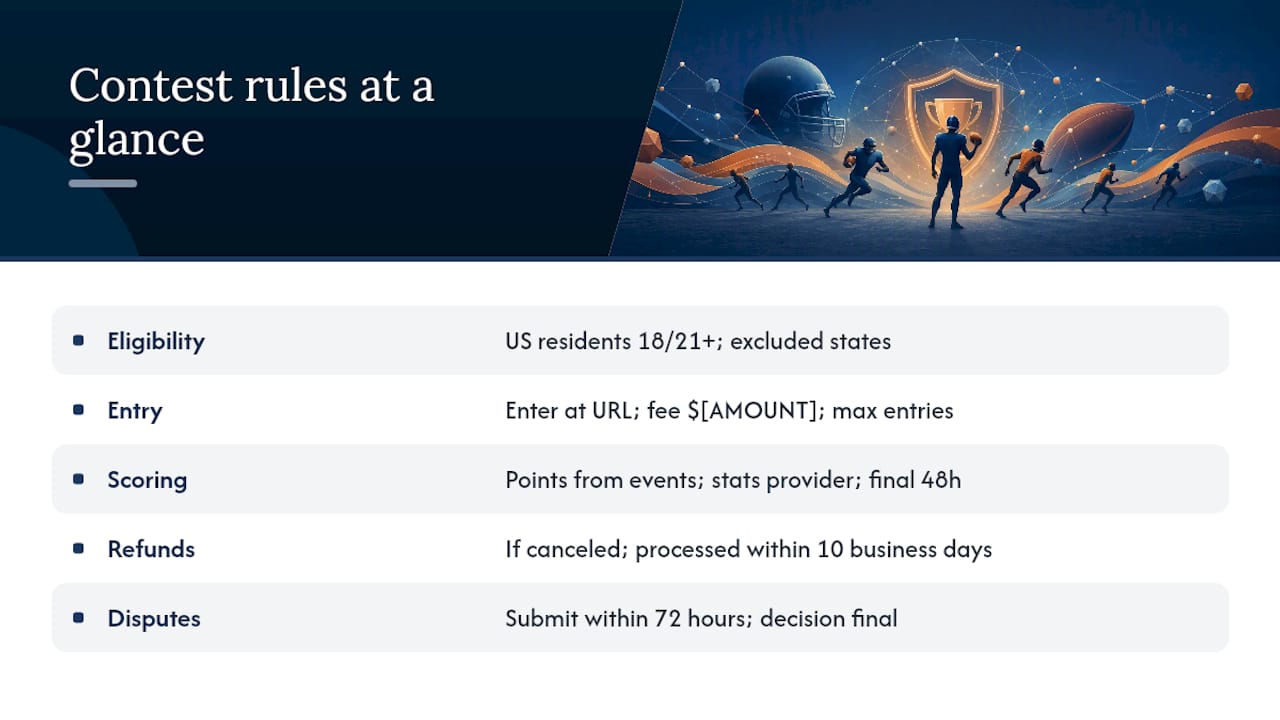
1. Eligibility. Open to legal U.S. residents aged [18/21] or older in states where permitted. Not available in [LIST EXCLUDED STATES]. Employees of Megasports Arena and their immediate family members are ineligible. Participants must complete age verification at registration.
2. Entry. Enter at [URL] by [DEADLINE]. Entry fee: $[AMOUNT] per entry. No-purchase-necessary alternative: [DESCRIBE METHOD]. Maximum entries per participant: [NUMBER].
3. Scoring. Winners are determined by accumulated fantasy points across all contest events. Point values:. Statistics sourced from [DATA PROVIDER]. Scores are final 48 hours after the last contest event unless under review.
4. Tie-breakers. In the event of a tie, the participant with the highest score in [FINAL SCORING PERIOD / DEFINED TIEBREAKER STAT] wins. If a tie remains, prizes are split equally.
5. Prizes.
Prize pool is guaranteed regardless of entry count. Prizes cannot be transferred or exchanged.
6. Refunds and cancellations. Refunds are issued if the contest is canceled due to [OPERATOR ERROR / INSUFFICIENT ENTRIES / EVENT CANCELLATION BEYOND X DAYS]. Refunds are processed within 10 business days.
7. Dispute resolution. Submit disputes in writing to [EMAIL] within 72 hours of result publication. The commissioner's decision is final.
8. Intellectual property. Megasports Arena retains a non-exclusive license to display participant usernames and scores on public leaderboards. Participants retain authorship of any original content submitted.
9. Privacy. Participant data is collected and retained per Megasports Arena's Privacy Policy at [URL]. Data is retained for [PERIOD] and deleted thereafter.
10. State-specific terms. [NOT AVAILABLE IN: list states.] [SUBJECT TO PRE-APPROVAL BY: state commission name, if applicable.]
11. Contact. Questions: [EMAIL] | Registration records stored at: [URL] | Timestamps generated by: [SYSTEM/METHOD].
For a live example of how rules are formatted and ordered, see the Megasports Arena rules page.
What most contest rule guides get wrong
The conventional advice is to copy a template and add your state's name. That approach fails in two predictable ways.
First, operators treat the skill-versus-chance distinction as a checkbox rather than a design constraint. The language in your rules only holds up if the underlying mechanics actually support it. A contest that resolves on a single player's single-game performance will not survive regulatory scrutiny regardless of how the rules are worded. The scoring design and the rule language have to match.
Second, partners who embed contests routinely strip or paraphrase legal clauses to fit their site's layout. That is the single fastest way to void the indemnity protection the operator thought they had. The full rule text must appear verbatim, every time, everywhere the contest is offered.
The piece most operators skip entirely is the public change log. Regulators do not just want records; they want evidence that the operator treated participants fairly in real time. A timestamped log of every rule amendment and result correction is the clearest signal of that.
Megasports-arena makes compliant, embeddable contests faster
Megasports-arena gives partners pre-built, rule-compliant contests with prize tables already declared, scoring mechanics already locked, and audit logs already running. You skip the blank-page problem entirely. Partners get an embeddable iframe or API, sample rules text they can adapt, leaderboard integration, and direct access to archived results for recordkeeping.

The platform covers MLB, NBA, NFL, NHL, and more, with contests like Sports Rummy and Sports Match ready to embed on your site today. Every game ships with a rules page, a public leaderboard, and scoring documentation partners can reference when drafting their own contract clauses. Start by browsing the Sports Rummy play page to see the full rules-and-prize-table format in action, then contact the Megasports-arena partner team to request embed credentials and a sample contract.
Sources
- Nelson Mullins - Regulation of Fantasy Sports in the United States
- How to Create a Fantasy Sports Registration and Payment Form - LegalClarity
- Charter for Online Fantasy Sports Platforms (OFSP)
Article by Peter, Megasports-arena.
This article is general information, not a substitute for advice from a qualified lawyer. Consult a qualified legal professional about your own circumstances before acting on anything here.