"Sports contest timezones" covers how a game's start time gets calculated, displayed, and sometimes distorted as it moves from the venue clock to your phone. The verdict: never trust a bare abbreviation like "7 PM EST" at face value, and always check whether a listing shows local venue time or a fixed market time before you set your alarm. The gold standard is the IANA time zone database, which broadcasters like CBS Sports and FOX Sports use to auto-convert times, and the 2026 FIFA World Cup is the clearest live example of why this matters.
- Local kickoff time and "market time" on your app are often not the same thing.
- Daylight Saving Time can silently shift a listing by an hour if you check it weeks in advance.
- Calendar auto-conversion beats mental math, every time.
Key Takeaways
Reading a sports schedule correctly means checking whether a listing shows local venue time or fixed market time, verifying DST status for both your zone and the event's zone, and using IANA-based tools instead of manual math.
| Point | Details |
|---|---|
| Check the display type | Confirm whether a listing shows local venue time or a fixed market time before trusting it. |
| Use IANA identifiers | Calendar invites built on IANA time zones adjust automatically for Daylight Saving Time changes. |
| Watch DST mismatches | Mexico's DST rules differ from the U.S., which can shift host-city offsets during tournaments. |
| Plan around travel gaps | Teams crossing multiple zones in under 72 hours face higher fatigue risk before matches. |
| Bookmark one reliable source | Rely on a consistent schedule source, like a platform's own live calendar, instead of comparing conflicting listings. |
Table of Contents
- What "Sports Contest Timezones" Actually Changes on a Schedule
- Why Viewers and Broadcasters Both Fight the Clock
- How Crossing Time Zones Affects the Teams Themselves
- Tools and Habits That Keep You From Missing Kickoff
- Quick U.S. Time Zone Reference for Game Day
- Scheduling Rules Broadcasters and Planners Should Follow
- Which Time Zones Actually Cover U.S. Sports Contests
- How Global Time Differences Reshape Broadcasting Rights
- How Leagues Stagger Games to Reach Every Time Zone
- Get Every Kickoff Right, Then Get in the Game
- The Real Skill Is Reading the Clock, Not Debating It
- Frequently Asked Questions
- Sources
What "Sports Contest Timezones" Actually Changes on a Schedule
A time zone shift doesn't just relabel a number. It changes which market sees a game live, which one gets tape delay, and how a broadcaster chooses to print the listing. FOX Sports and CBS Sports typically auto-convert kickoff times to the viewer's detected location on digital platforms, but printed schedules and social posts often default to Eastern Time, the traditional U.S. broadcast anchor.
Daylight Saving Time adds another layer. The United States shifts clocks on a set schedule, but Mexico no longer observes DST the way it once did, which means a Mexico City kickoff and a Dallas kickoff can drift out of their usual one-hour alignment depending on the calendar. That single quirk has already created confusion around World Cup 2026 scheduling.
- A 3:00 PM kickoff in Los Angeles airs several hours later in New York due to the Pacific-to-Eastern time difference.
- A host city using Central Standard Time in Mexico can sit an hour off from a U.S. Central Time city once DST kicks in stateside.
- Tournament brackets spanning four zones mean the "same" match slot looks completely different depending on where you live.
Why Viewers and Broadcasters Both Fight the Clock
Ratings drive scheduling decisions more than any other factor, and time zones are the variable networks can't control but must plan around. A league wants prime-time eyeballs in the largest markets simultaneously, which is nearly impossible once you're spread across four U.S. time zones plus international audiences.
That's why leagues stagger start times rather than clustering every game in one window. An early afternoon slot on the East Coast can land in prime time out West, and a late West Coast game becomes a late-night watch for East Coast fans who stayed up anyway.
Listings compound the confusion because platforms handle display differently:
- Some apps auto-detect your device location and show local start time without you asking.
- Others default to a single market time (often Eastern) and expect you to do the math yourself.
- International broadcasts sometimes show UTC or the host country's local time with no conversion at all, which is exactly the kind of gap Optimove's coverage of event time formatting flags as a fixable display problem, not an unavoidable one.
The practical fallout: two fans checking two different platforms for the identical game can walk away with two different kickoff times in their heads, and only one of them is right.
How Crossing Time Zones Affects the Teams Themselves
Time zones don't just confuse fans. They mess with the athletes actually playing. Crossing multiple zones in a short window disrupts circadian rhythm, and peer-reviewed research on travel and sleep disruption links that kind of disruption to measurable dips in physical and cognitive performance. A separate line of clinical research on circadian timing reinforces the same pattern: the body's internal clock doesn't adjust as fast as a flight itinerary does.

The 2026 World Cup is a real-world test case. With 16 host cities spread across four time zones, national teams are choosing base camps specifically to limit how often they cross zones between matches, rather than bouncing coast to coast on short rest. Fewer jumps mean less accumulated sleep debt heading into elimination rounds.
Pro Tip: If you're tracking a team's travel schedule as an analyst, flag any stretch with more than one time-zone crossing in under 72 hours. That's historically when fatigue-related lapses show up.
Tools and Habits That Keep You From Missing Kickoff
Stop converting time zones in your head. It's the single biggest source of missed first quarters and blown fantasy lineups. Reliable conversion starts with the IANA time zone database, which automatically accounts for regional DST rules instead of relying on a fixed offset that goes stale the moment clocks change.
- Use a browser or calendar app that auto-detects your local time zone rather than reading a static graphic.
- Add contests to your calendar using an IANA identifier (like America/Chicago), not an abbreviation like CST.
- Cross-check unfamiliar international kickoffs on Timeanddate, which handles obscure regional DST rules well.
- For recurring multi-zone planning, a visual overlap planner like Koalendar's or Whenest shows color-coded overlaps that make late-night or early-morning slots obvious at a glance.
- Bookmark your platform's own live schedule, such as Megasports Arena's sports calendar, so you're checking one consistent source instead of five conflicting ones.
- Default to 24-hour format for any international matchup to avoid AM/PM mix-ups entirely.
Pro Tip: Never trust "EST" or "CST" labels on a schedule graphic made months in advance. Abbreviations don't shift with Daylight Saving Time. IANA identifiers do.
Quick U.S. Time Zone Reference for Game Day
Here's the conversion math fans actually need on a Sunday afternoon.
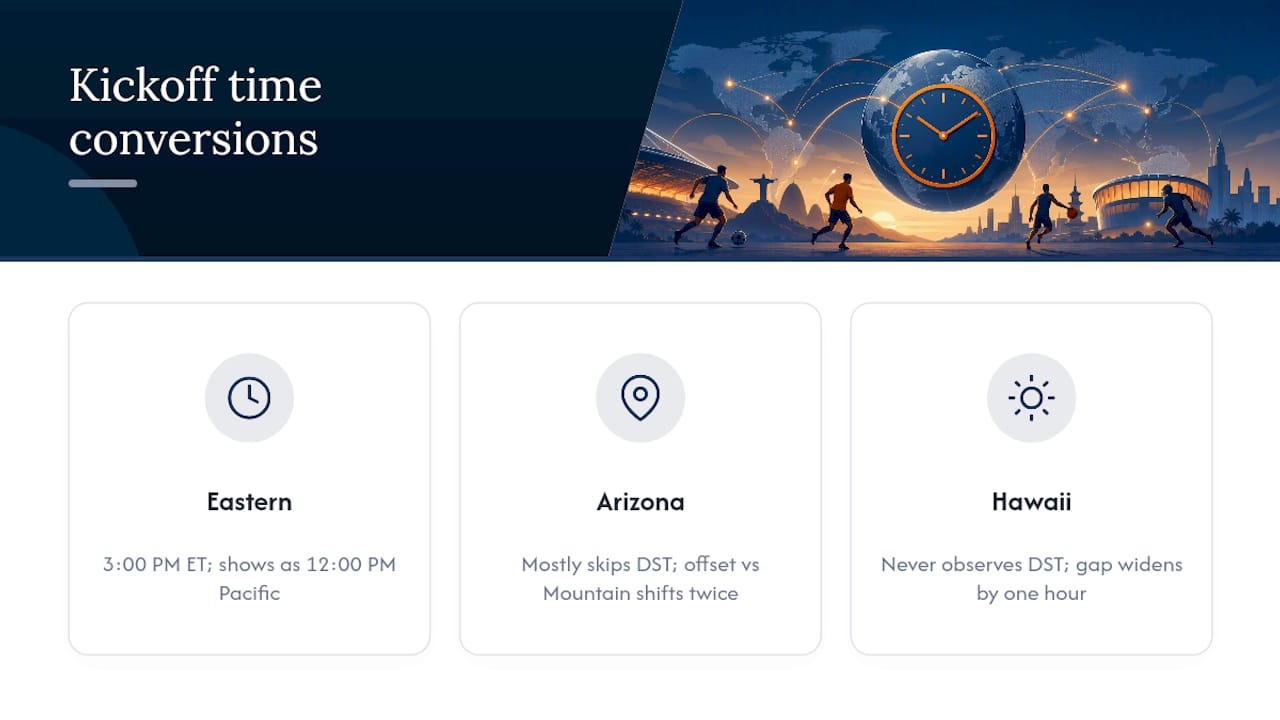
Arizona mostly skips Daylight Saving Time, so its offset from Mountain neighbors shifts twice a year. Hawaii never observes DST at all, which means its gap from the mainland widens by an hour every spring. A single 3:00 PM ET kickoff can show as "12:00 PM" on a West Coast app and "3:00 PM Eastern" on a national broadcast graphic, same game, two labels.
Scheduling Rules Broadcasters and Planners Should Follow
Confusion is preventable. A short checklist keeps listings honest across every platform:
- Publish times using IANA identifiers, not regional abbreviations, so DST transitions handle themselves.
- Show both local venue time and one universal reference point (UTC works well) side by side.
- Offer a shareable calendar invite that carries the correct time zone data embedded in it.
- Use a visual overlap tool internally before locking a broadcast window, the same logic Koalendar's planner applies to global meetings.
- Flag any host city with nonstandard DST rules explicitly in the listing copy, the way CBS Sports has done for World Cup 2026's mixed DST zones.
Pro Tip: Before publishing a schedule, test the conversion on at least two devices set to different regions. A time that displays correctly on your desktop can still break on someone else's phone.
Which Time Zones Actually Cover U.S. Sports Contests
Six zones handle nearly every major U.S. sports broadcast: Eastern, Central, Mountain, Pacific, Alaska, and Hawaii. Eastern and Central carry the heaviest broadcast load simply because most franchises and networks are based there, which is why national schedules default to Eastern almost by habit.
Mountain Time creates the most confusion for casual fans because it sits close enough to Central that people assume a one-hour gap everywhere, when Arizona's partial DST exemption occasionally erases that gap entirely for part of the year. Pacific Time games routinely start in the 10 PM Eastern range for prime-time slots, which is exactly why West Coast fans complain about late finishes almost every football season.
Alaska and Hawaii rarely host major professional franchises, but they matter for college sports, exhibition games, and any national broadcast trying to reach every U.S. market at once. A night game airing at 7 PM Pacific hits 9 PM Central, 10 PM Eastern, and only 4 PM in Hawaii, four very different viewing experiences from a single broadcast decision. Analysts tracking national engagement need to account for that spread when reading attendance or streaming numbers, since a "primetime" slot for one coast is a workday afternoon for another.
How Global Time Differences Reshape Broadcasting Rights
International tournaments turn time zones into a rights negotiation problem, not just a viewing inconvenience. A broadcaster paying for exclusive rights in one region wants kickoff times that hit prime time locally, but a single kickoff can't be prime time everywhere at once when the audience spans a dozen zones.
The 2026 World Cup illustrates this directly: matches across the three host countries span four time zones, so a kickoff tuned for East Coast prime time airs in the middle of the workday in parts of Asia, and vice versa for matches scheduled with European audiences in mind. Rights holders often negotiate specific kickoff slots into their contracts precisely because the difference between a 3 PM and 8 PM local start can swing viewership by a wide margin.
This is also where DST mismatches create real financial stakes. Mexico's shift away from traditional DST observance means a match scheduled months in advance for a "consistent" time gap between U.S. and Mexican host cities can drift by an hour once the calendar hits the actual tournament dates. Rights holders and advertisers who locked in ad slots based on an assumed offset can find their prime-time buy landing an hour off from where they planned it.
How Leagues Stagger Games to Reach Every Time Zone
Staggered scheduling is the industry's main fix for a country that spans three continental time zones plus Alaska and Hawaii. Instead of clustering every contest into one window, leagues spread start times across the afternoon and evening so no single region gets ignored.
A typical Sunday slate uses early afternoon Eastern windows, followed by late afternoon windows that hit Pacific prime time, then a standalone night game that serves as the day's marquee broadcast. That structure means East Coast fans get a full day of football while West Coast fans still get a true prime-time anchor game rather than an afternoon rerun of someone else's schedule.
International tournaments use a variant of the same logic. World Cup organizers spread kickoffs across the day specifically so European, U.S., and Latin American audiences each get at least one match in a convenient local window, rather than concentrating everything around a single continent's prime time. It's an imperfect compromise. Someone always ends up with a very early or very late kickoff, but staggering spreads that inconvenience around rather than dumping it entirely on one region every time.
Get Every Kickoff Right, Then Get in the Game
Reading a schedule correctly is only half the fun. Once you know exactly when a game starts in your zone, Megasports Arena gives you a reason to actually plan around it. Jump into Sports Rummy for a fast-paced contest tied to real matchups, or check the Sports Rummy how-to guide if you're new to the format. Either way, you'll never wonder what time the game actually starts.
The Real Skill Is Reading the Clock, Not Debating It
Most advice on this topic gets stuck arguing which time zone is more "fair" for national broadcasts, and that argument misses the point entirely. The actual skill worth building is reading a schedule correctly the first time, checking whether a listing reflects local venue time or a market default, and never assuming an abbreviation like EST accounts for Daylight Saving Time.
Conventional coverage treats World Cup 2026's four-zone spread as a logistics headache for organizers. It's really a preview of what every fan now deals with regularly: schedules built for a national audience but consumed by people scattered across six U.S. zones and dozens more internationally. The DST mismatch between the U.S. and Mexico isn't a footnote. It's the exact kind of quiet error that turns a confirmed kickoff into a missed first half.
If you take one thing from this, prioritize the tool over the habit. Manual conversion fails eventually, no matter how careful you are. IANA-based calendar invites and visual overlap planners don't.
Frequently Asked Questions
What time zone do most U.S. sports broadcasts default to? Eastern Time is the default for most national listings, since the majority of major U.S. leagues and networks are headquartered there.
How do I know if a listing is showing local kickoff time or market time? Check whether the platform auto-detects your location. If it shows the same time regardless of where you are, it's likely displaying a fixed market time rather than your local time.
Why did the World Cup 2026 schedule confuse so many fans? Matches span 16 host cities across four time zones, and Mexico's differing DST rules created irregular one-hour gaps that shifted depending on the calendar date.
Should I trust abbreviations like EST or CST on a schedule? No. Abbreviations don't automatically update for Daylight Saving Time. IANA time zone identifiers do, which is why calendar tools and broadcasters increasingly rely on them.
Do time zones really affect how teams perform? Yes, to a measurable degree. Research on circadian disruption and travel-related sleep loss links multiple time-zone crossings to changes in recovery and performance, which is why national teams increasingly choose base camps to limit travel between matches.
Sources
- 2026 FIFA World Cup - Wikipedia
- World Cup 2026: Navigating the chaos of four time zones - CBS Sports
- Sports: Event Time Formatting and Time Zones - Optimove Academy
- Free Meeting Time Zone Planner | Koalendar