
The highest-leverage sports gamification ideas right now are matchday prediction widgets, season-long fantasy leagues, live trivia, tiered leaderboards, and loyalty reward wallets — each one proven to lift daily active users, deepen first-party data capture, and build the kind of habit loop that keeps fans coming back after the final whistle. According to SportsFirst, a structured fan engagement program needs content, interaction, timing, and feedback loops working together — not a single feature dropped in isolation. Deloitte's sports loyalty research reinforces this: personalization, year-round engagement, and recognizing loyalty are the five tenets that separate programs that stick from ones that fade after opening weekend. Sportradar adds a third dimension: moment-triggered activations that fire in seconds during live play outperform scheduled messaging on attention and click-through.
Start with one thing: add a three-question matchday prediction widget tied to a season leaderboard. That single move gives you DAU data, first-party opt-ins, and a retention hook before you build anything else.
Key Takeaways
Season-long prediction leagues, live trivia, and tiered leaderboards are the three formats with the clearest, most measurable impact on fan retention and daily active users in U.S. sports marketing.
| Point | Details |
|---|---|
| Start with one mechanic | Pick predictions, trivia, or leaderboards first; prove lift before adding complexity. |
| Season-long formats drive retention | Participants in season-long prediction leagues return at 4.2x the frequency of non-participants. |
| Unify your data before you launch | Data silos are the top failure point; connect CRM, ticketing, and app data before instrumenting events. |
| Match timing to live moments | Moment-triggered activations outperform scheduled messages on attention and click-through. |
| Megasports-arena shortens time-to-launch | Embeddable prediction games, leaderboards, and trivia are ready to configure across MLB, NBA, NFL, and NHL. |
30-day pilot checklist
- Define one primary KPI (DAU, D30 retention, or email opt-ins).
- Choose one mechanic (prediction widget, halftime trivia, or season leaderboard).
- Unify user IDs across app, web, and CRM.
- Instrument your event list (
prediction_submitted,badge_unlocked,reward_redeemed). - Set up a control cohort (50% exposed, 50% held back).
- Soft-launch to your most recently active fans (last 30 days).
- Review participation rate and session length at day 7; adjust reward or question difficulty if needed.
- At day 30, calculate lift versus control and present findings to stakeholders with a scale/iterate/kill recommendation.
Table of Contents
- The Best Sports Gamification Ideas, Organized by Use Case
- How gamification maps to your actual business goals
- How to design a gamification program step by step
- What to measure and how to instrument gamified features
- Tech stack, privacy guardrails, and integration pitfalls
- Ready-to-use templates using Megasports-arena
- What actually works in U.S. sports marketing right now
- Megasports-arena gets you to launch faster
- Sources
The Best Sports Gamification Ideas, Organized by Use Case
The ideas below are grouped by context so you can scan for what fits your situation and pilot one fast. Each entry covers how it works, who it suits, a reward example, a quick tech note, and the first KPI to watch.
Live match engagement
1. Matchday prediction games
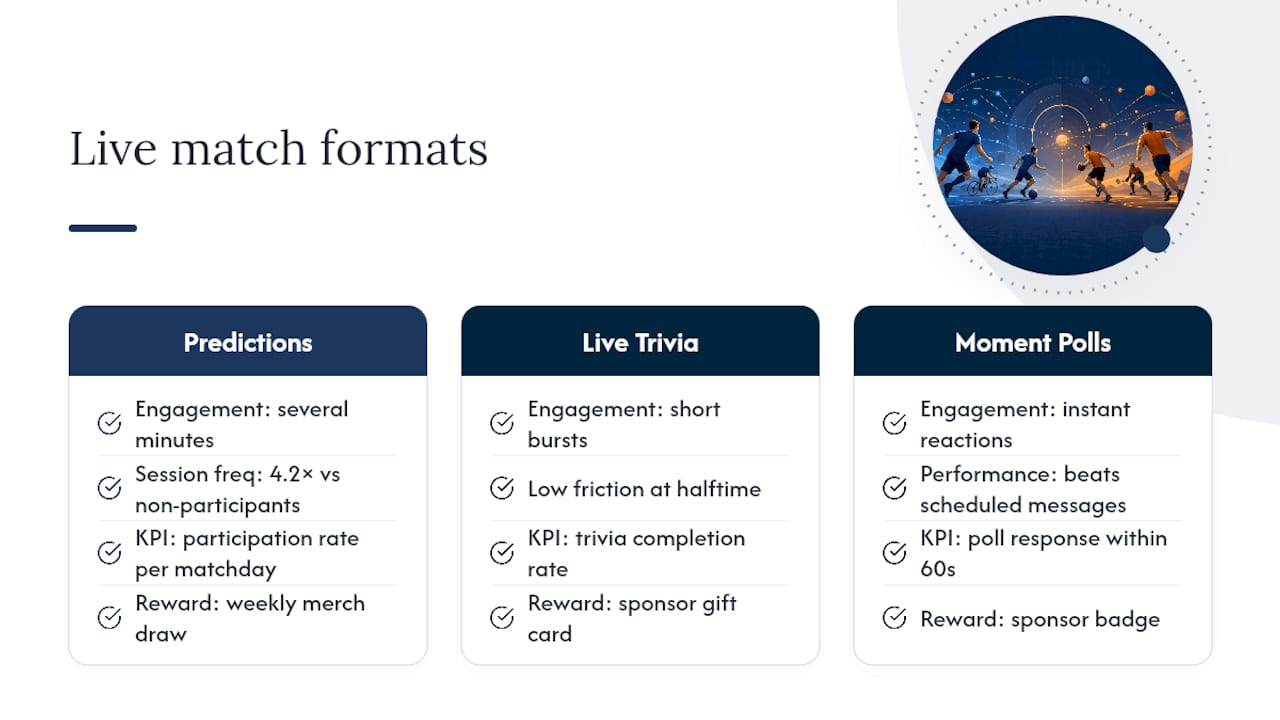
Fans predict specific in-game outcomes before or during play: first scorer, total points, quarter-by-quarter results. The key is going beyond a simple win/lose guess. Bricqs reports that multi-faceted predictions generate several minutes of engagement per session versus roughly 30 seconds for a basic pick, and participants in season-long prediction leagues show 4.2x higher session frequency than non-participants. Best for: team apps, sports media properties, and second-screen experiences. Reward example: weekly merch prize draw for correct predictions. Tech note: connect to a live match-data feed via API; surface the widget on mobile web or in-app. First KPI: prediction participation rate per matchday.
Pro Tip: Design prediction questions around moments fans already debate — "Will the QB throw for 300+ yards?" beats "Who wins?" every time. Debate-worthy questions drive social sharing before the game even starts.
2. Live in-game trivia
Push a three-to-five question quiz during natural attention windows: pre-game warmup, halftime, and the post-game cooldown. SportsFirst notes that halftime quizzes are among the lowest-friction formats for pilots because they map to moments fans are already idle and receptive. Best for: stadium apps, broadcast second-screen products, and sponsor activations. Reward example: fastest correct answer wins a sponsor-branded gift card. Tech note: WebSocket push or Firebase Cloud Messaging (FCM) to deliver questions in sync with broadcast. First KPI: trivia completion rate. For ready-made question pools, daily sports trivia content can cut your content production time significantly.
3. Real-time polls and moment-triggered challenges
A goal is scored. Within seconds, a push notification asks: "Will they score again in the next 10 minutes?" Moment-triggered activations that detect live events and fire creative instantly produce materially better attention and campaign performance than scheduled messages, per Sportradar's analysis. Best for: apps with real-time event feeds and sponsor integrations. Reward example: sponsor-branded badge for participation. Tech note: event-detection layer reads match context (not just score) and triggers push via APNs/FCM. First KPI: poll response rate within 60 seconds of trigger.
Season-long retention
4. Fantasy leagues and draft contests
Season-long fantasy is the gold standard for retention because fans have skin in the game every single week. About 85% of fans use a second screen during live matches, and fantasy gives that behavior a structured home. Best for: NFL, NBA, MLB, and NHL properties with weekly game schedules. Reward example: season champion gets VIP tickets or a signed jersey. Tech note: roster management requires a player-stats feed and a scoring engine; daily fantasy formats reduce the commitment barrier. First KPI: weekly lineup submission rate (a proxy for weekly active users).
5. Season-long prediction leagues
Different from weekly fantasy: fans submit predictions for the full season (division winners, MVP, total wins) and accumulate points as outcomes resolve. The standing updates weekly, pulling fans back to check their rank. Pair this with a public leaderboard and you get organic social sharing every time standings shift. Best for: casual fans who find full fantasy too complex. Reward example: top-10 finishers get exclusive digital collectibles or early ticket access. First KPI: leaderboard check-in rate (how often participants return to view standings between matches). For a deeper look at leaderboard design strategies, the mechanics of tiering and reward scarcity matter more than most teams realize.
6. Badges and streak rewards
Award badges for consecutive correct predictions, weekly participation streaks, or milestone achievements (first prediction, 10th trivia completed). Streaks create a loss-aversion hook: fans return not just for the reward but to avoid breaking the streak. Best for: any format where you want to convert one-time participants into habitual users. Reward example: a "Perfect Week" badge unlocks a discount code for the team store. Tech note: badge logic sits in your rewards wallet; trigger on event completion. First KPI: D7 and D30 retention rates for badge holders versus non-holders.
Stadium and venue activations
7. In-venue QR challenges and scavenger hunts
Place QR codes around the stadium that unlock trivia questions, mini-games, or digital collectibles. Fans scan, play, and earn points toward a venue leaderboard. This works especially well for pre-game dwell time when fans arrive early and have nothing structured to do. Best for: venue operators, team experience teams, and sponsor activations at the gate. Reward example: highest scorer at the end of the game wins a concession credit. Tech note: QR codes link to mobile-web experiences; no app download required lowers the entry barrier. First KPI: unique QR scans per event.
8. Sponsor-branded wheel spins and instant-win games
A digital prize wheel — triggered by a purchase, a check-in, or a correct trivia answer — gives sponsors a branded activation moment and fans an immediate dopamine hit. The Wheel of Sports format on Megasports-arena is a ready-made example of this mechanic, embeddable in venue kiosks or sponsor microsites. Best for: brand activations, halftime entertainment, and concession-linked promotions. Reward example: spin prizes range from branded merchandise to free food items. First KPI: spin-to-redemption conversion rate.
Player and training gamification
9. Game-based training challenges

Coaches assign skill challenges (shooting accuracy targets, sprint time goals) and players log results through an app. Points accumulate on a team leaderboard, and top performers earn recognition or small privileges. This is one of the cleaner game-based training techniques because it ties measurable athletic output to visible social standing. Best for: youth academies, college programs, and professional development squads. Reward example: weekly "Training MVP" badge displayed on the team's internal dashboard. Tech note: wearable integrations (GPS vests, heart-rate monitors) can automate data capture. First KPI: daily training log submission rate.
10. Peer-vs-peer skill tournaments
Structure short skill competitions between teammates or fan-facing challenges where fans predict whether a player will hit a specific target in a training clip. This blurs the line between player gamification and fan engagement, creating content at the same time. Best for: social media teams and clubs with strong player-personality brands. First KPI: video completion rate and prediction participation per clip.
Social and UGC mechanics
11. User-generated contest pools
Let fans build and run their own prediction pools for friends, coworkers, or fan communities. The host sets the questions, invites participants, and the platform handles scoring. This is one of the most cost-efficient sports engagement strategies because your users do the distribution work. Guidance on running user-generated pools covers moderation rules and contest structures that keep things fair and legally clean. Best for: media properties, team apps, and any platform that wants organic growth. Reward example: pool winners earn points redeemable in a loyalty wallet. First KPI: number of pools created per month and average pool size.
12. Social sharing leaderboards and referral tournaments
Award bonus points for sharing a prediction result, inviting a friend, or posting a badge on social. Tie the referral bonus to a tournament entry so new users land in an active competitive context rather than an empty leaderboard. Best for: acquisition campaigns around season openers, playoff runs, or marquee events. Reward example: each successful referral earns the inviter one bonus prediction entry. First KPI: referral conversion rate (invites sent vs. new accounts activated). For prize structures that convert participation into commercial outcomes, contest prize ideas offers a practical breakdown of what actually motivates fans at different engagement levels.
How gamification maps to your actual business goals
Every mechanic above moves a different set of metrics. Knowing which one to prioritize before you build saves you from launching a leaderboard when what you actually need is email opt-ins.
| Gamification Format | Primary Business Outcome | Sample KPI Target | Sponsor/Revenue Lever |
|---|---|---|---|
| Prediction games | DAU, first-party data | Moderate participation rate of MAU | Sponsor-branded question sets |
| Season-long fantasy | Weekly retention, ARPU | Weekly lineup rate >60% of registrants | Paid entry tiers, prize sponsorships |
| Live trivia | Session length, halftime engagement | Completion rate >50% of starters | Sponsor-branded quiz rounds |
| Leaderboards | D30 retention, social sharing | Top-10% share rate >15% | Sponsor-named tiers ("Powered by X") |
| Badges and streaks | D7/D30 retention, habit formation | D30 retention lift vs. control | Sponsor-unlocked badge sets |
| Referral tournaments | Acquisition, CAC reduction | Referral conversion high | Co-branded invite creative |
| Venue QR challenges | In-venue dwell time, concession lift | Scans per event >10% of attendance | Sponsor-gated prize redemption |
The retention signal to watch: Bricqs data shows season-long prediction league participants return at 4.2x the frequency of non-participants. That single figure makes the case for season-long formats over one-off activations when retention is your primary goal.
Predictions and live trivia are your fastest paths to first-party data because every submission is a consent event: the fan gives you an email or phone number to receive results and standings. Leaderboards and badges work differently — they create social proof and loss aversion that pull fans back without requiring a new data exchange each session.
On the commercial side, sponsor-branded challenges and reward redemption are where gamification converts to ARPU. A sponsor pays for a named prediction round or a branded badge set; every fan who participates is an impression, and every redemption is a trackable conversion. Life Inside's fan engagement research shows clubs that integrate personalization and matchday activations with unified CRM see measurable conversion improvements — the data connection between the game and the CRM is what turns engagement into revenue.
How to design a gamification program step by step
A pilot that launches in 30 days and teaches you something is worth more than a six-month build that launches perfect. Here is the sequence that works.
Step 1: Set one measurable objective
Pick a single metric: DAU, D30 retention, email opt-ins, or sponsor impression volume. One objective forces you to choose the right mechanic instead of building everything at once. If your goal is acquisition, you need social-sharing mechanics and referral tournaments. If it is retention, you need streaks and season leaderboards.
Step 2: Select mechanics and timing
Match the mechanic to the moment. Live prediction and trivia need a match schedule; season-long formats need a roster or standings feed. Asynchronous formats (badges, UGC pools) work year-round and are easier to pilot in the off-season. SportsFirst's framework is explicit: timing and feedback loops are as important as the mechanic itself.
Step 3: Design your reward economy
Tiered rewards outperform flat prizes. Structure three levels: a low-friction participation reward (a digital badge), a mid-tier weekly prize (merch discount, concession credit), and a season-end grand prize (VIP tickets, signed memorabilia). Scarcity matters: "Only 50 fans can earn the Playoff Predictor badge" drives urgency that "Earn a badge for predicting" does not.
Step 4: Build event triggers and personalization
Segment your audience before you build triggers. Casual fans respond to low-commitment formats (single-question polls, spin-to-win). Hardcore fans want depth (multi-round predictions, fantasy draft tools). Deloitte's five tenets put "know your target" first for a reason: a mechanic designed for the wrong segment will underperform regardless of how well it is built. Moment-triggered push notifications — firing within seconds of a live event — consistently outperform scheduled messages on open rate, per Sportradar's analysis.
Step 5: Run a 30-day pilot with a control cohort
Measure DAU, session length, and your primary KPI for both groups over 30 days. A sample size of at least 1,000 users per cohort gives you enough signal to read lift with reasonable confidence. At day 30, compare and decide: scale, iterate, or kill.
Pro Tip: Segment by recency before you launch. Fans who attended or watched in the last 30 days are your best pilot cohort — they are already primed to engage and their lift will be cleaner to read than a cold audience.
Pro Tip: Reward scarcity is your most underused lever. Capping a badge or prize tier at a fixed number creates urgency that open-ended rewards never generate. Test a "first 500 correct predictions win" structure against an unlimited reward and the capped version will almost always outperform on participation rate.
What to measure and how to instrument gamified features
Tracking the wrong metrics is how gamification programs get killed by stakeholders who see "lots of plays" but no business impact. Here are the metrics that actually matter.
Core KPIs to track
- DAU/MAU and stickiness ratio (DAU ÷ MAU): the baseline health metric for any gamified product
- D7 and D30 retention: compare badge holders and prediction participants against non-participants
- Session length: does gamification extend time-on-platform or just add a quick tap?
- Prediction participation rate: active predictors ÷ total MAU, per matchday
- Reward redemption rate: of fans who earn a reward, what percentage actually redeem it?
- ARPU and CPM for sponsors: revenue per engaged user and impression volume for branded activations
- Referral conversion rate: invites sent vs. new accounts activated
Sample event list for your analytics pipeline
Fire these events to your analytics or BI tool (Google Analytics 4, Amplitude, Mixpanel, or a custom pipeline):
prediction_submitted(with properties: match_id, question_id, answer, user_segment)trivia_answered(with: quiz_id, question_number, correct, time_to_answer)badge_unlocked(with: badge_id, trigger_event, user_id)reward_redeemed(with: reward_id, reward_type, sponsor_id)session_startandsession_end(with: source, feature_context)leaderboard_viewed(with: leaderboard_id, rank_position)share_triggered(with: content_type, destination_platform)
| Analytics Event | KPI It Feeds | Suggested Dashboard Widget |
|---|---|---|
prediction_submitted | Participation rate, DAU | Daily participation trend line |
badge_unlocked | D7/D30 retention | Retention cohort chart |
reward_redeemed | Conversion rate, ARPU | Funnel: earned → redeemed |
leaderboard_viewed | Return visit frequency | Weekly active leaderboard viewers |
share_triggered | Referral conversion, CAC | Share-to-signup funnel |
Reading lift correctly
Establish a two-week baseline before launch. After the pilot, calculate lift as: (exposed cohort metric − control cohort metric) ÷ control cohort metric.
Instrumentation checklist
- Unify user IDs across app, web, ticketing, and CRM before launch. Life Inside's research identifies data silos as the primary failure point for fan engagement initiatives — without a unified identity graph, your event data cannot be tied to purchase behavior or ticket history.
- Tag every gamification surface with a
feature_contextproperty so you can filter analytics by mechanic. - Set up a real-time dashboard for the first two weeks of the pilot so you can catch drop-off points before they compound.
Tech stack, privacy guardrails, and integration pitfalls
You do not need to build everything from scratch, but you do need the right components connected in the right order.
Typical tech stack components
- Match-data feed: a licensed sports data API (real-time scores, player stats, event triggers)
- Event-detection layer: middleware that reads match context and fires triggers based on defined conditions (goal scored, quarter ended, player milestone)
- Real-time push delivery: WebSocket for in-browser, FCM for Android, APNs for iOS
- Rewards wallet: tracks points, badges, and redemption history per user
- CRM and identity graph: ties gamification behavior to fan profiles, purchase history, and communication preferences
- Analytics pipeline: event stream to your BI tool for KPI dashboards
Integration checklist
- Unify user IDs across every touchpoint (app, web, ticketing system, merch store) before you instrument any events.
- Map ticketing and merchandise purchases to fan profiles so reward redemption can trigger personalized follow-up.
- Avoid building gamification as a standalone module with its own user table — that is how data silos form and why personalization fails.
- Test your event-detection layer against historical match data before going live; a trigger that fires 90 seconds after a goal is a stale activation.
- Build a fallback for delayed or interrupted data feeds so the prediction widget degrades gracefully rather than showing wrong answers.
Pro Tip: Use progressive profiling instead of a mandatory registration form at entry. Gate a small reward (a badge, a bonus prediction entry) behind a single data field — email, favorite team, zip code — and collect profile depth over multiple sessions. Fans who opt in this way convert at higher rates and churn less than those forced through a long form upfront.
US privacy and ethical guardrails
If your gamification product collects data from users under 13, COPPA compliance is mandatory: no behavioral tracking, no targeted push notifications, and verifiable parental consent before any data collection. For users 13 and older in California, CCPA/CPRA gives fans the right to know what data you collect, opt out of its sale, and request deletion. Build opt-out flows into your rewards wallet and CRM from day one, not as an afterthought. Minimal data retention is both a legal best practice and a trust signal: retain prediction and session data for the period needed to calculate standings, then archive or delete.
Ready-to-use templates using Megasports-arena
These templates are designed to get you from zero to live in under a week. Each one maps to a Megasports-arena feature you can configure without custom development.
Template 1: Matchday prediction widget
- Objective: Lift DAU and capture email opt-ins on matchday
- Duration: Single matchday (repeat weekly)
- Entry method: Free, email opt-in required for results
- Questions (default): First team to score, total points over/under, player to record most assists
- Reward: Weekly prize draw entry for correct predictions; season leaderboard points
- Sponsor slot: Branded question header ("This prediction round is brought to you by [Sponsor]")
- Sample copy: "Think you know tonight's game? Make your picks before tip-off and climb the season leaderboard."
- KPI dashboard (30-day pilot): Daily participation rate, email opt-in volume, leaderboard check-in rate
For NBA-specific prediction content, NBA prediction game formats offer question templates and scoring structures you can drop straight into this widget.
Template 2: Halftime trivia activation
- Objective: Extend session length during halftime; sponsor impression volume
- Duration: 12-minute halftime window
- Entry method: No registration required (low friction for first-time users)
- Format: 5 questions, 30 seconds each, multiple choice
- Reward: Fastest correct streak wins a sponsor-branded prize; all participants earn a participation badge
- Sponsor slot: Branded intro screen and prize
- Sample copy: "15 minutes. 5 questions. How well do you really know this team?"
- KPI dashboard: Trivia completion rate, sponsor impression count, badge unlock rate
For question depth and difficulty tiering, sports trivia question pools cover 200+ questions across skill levels.
Template 3: Season leaderboard tournament
- Objective: D30 and D90 retention; season-long habit formation
- Duration: Full season (weekly scoring updates)
- Entry method: Free registration; optional paid premium tier for bonus predictions
- Format: Weekly prediction sets (5 questions per matchday); cumulative season points
- Reward: Top 10 at season end win VIP tickets or signed merchandise; weekly mini-prizes for top movers
- Sponsor slot: Named leaderboard tier ("Gold Tier, Powered by [Sponsor]")
- Sample copy: "Every correct pick moves you up. Every wrong one keeps things interesting. The season leaderboard is live."
- KPI dashboard: Weekly active predictors, leaderboard view frequency, D30 retention vs. control, reward redemption rate
The Sports Rummy leaderboard on Megasports-arena illustrates how season-long standings and reward tiers can be displayed to keep fans checking back.
What actually works in U.S. sports marketing right now
The conventional wisdom says "add gamification and fans will engage." The reality is more specific: the format, the timing, and the reward structure each have to match the fan segment, or the mechanic flatlines within two weeks.
Live moment triggers are the single most underused lever in U.S. sports marketing. Most teams schedule their push notifications like they are running an email newsletter — fixed times, fixed content, no connection to what is happening on the field. The SportsBusiness Journal's participation research makes the case plainly: fans are already on their phones during games, already predicting and discussing. The teams winning on engagement are the ones that intercept that behavior with a structured product rather than hoping fans find their app organically.
Season-long prediction leagues are also consistently underestimated relative to their retention impact. A single matchday prediction widget is a good pilot, but it does not create the cross-match investment that pulls fans back week after week. The standing on a season leaderboard does. Once a fan has 12 weeks of points at stake, they are not churning before the playoffs.
Do this: Launch one mechanic, instrument it properly, and read the lift before adding a second. The teams that struggle with gamification almost always built too much at once and could not isolate what was working.
Do not do this: Build a complex reward economy with five tiers, three currencies, and a redemption catalog before you have proven that fans will submit a single prediction. Complexity kills pilots. Start with one reward, one leaderboard, one question set.
Do not do this either: Launch gamification without unifying your user IDs first. A prediction submitted in the app that cannot be tied to a ticket purchase or a CRM record is a missed personalization opportunity and a data silo in the making.
Megasports-arena gets you to launch faster
If you have read this far and the blocker is build time, Megasports-arena removes it. The platform gives you prediction games, live trivia, season leaderboards, and fantasy contest pools across MLB, NBA, NFL, NHL, and more — all free to play, all configurable without custom development, and all embeddable on your own site or app to keep your audience on your property.

The fastest path to a 30-day pilot: embed the Sports Rummy prediction game as your matchday widget, connect it to the season leaderboard, and add a sponsor-branded trivia round at halftime. That is three of the highest-impact formats from this article live in one week, with no engineering sprint required. Megasports-arena also supports DIY custom pools, contest scheduling, rewards points, and archived results — so your data infrastructure grows with your program. Head to Megasports-arena and configure your first prediction widget today.
Sources
- Sports Fan Engagement Strategy: How Teams Turn Fans into DAUs | SportsFirst
- Fan Engagement: How Sports Clubs Build Lasting Connections in the Digital Era | Life Inside
- How Does Sports Moments Marketing Work? The technology behind real-time fan engagement - Sportradar
- Sports loyalty: A new game plan (Deloitte)
- The next wave of fan engagement is participation (SportsBusiness Journal)