
Sports news predictions give you two things: a probability estimate for an outcome and a ranked pick based on where that estimate diverges from the betting market. That's the whole engine. The moment you read a pick, your first move should be converting the posted odds into implied probability and comparing it to the model's stated confidence.
That comparison is where value lives or dies. A pick with no confidence rating, no edge percentage, and no sample size behind it is an opinion, not an analysis.
- Check the confidence or edge label attached to the pick
- Convert the odds to implied probability before you compare anything
- Confirm your stake matches your bankroll rule, not your gut
If a model puts that team at 66%, you've found a 6-point edge worth investigating further. Bankroll discipline and transparent model performance metrics separate profitable long-run bettors from everyone else. Megasports-arena's free prediction games are a solid place to practice this math before any money is involved.
Key Takeaways
Sports news predictions work when treated as probability estimates you verify against market odds, not as guaranteed outcomes to follow blindly.
| Point | Details |
|---|---|
| Convert odds first | Turn American or decimal odds into implied probability before trusting any pick's edge claim. |
| Demand real metrics | Favor sources publishing Brier score, ROI, and closing-line value over raw win/loss claims. |
| Stake by rule, not feeling | Use flat 1 to 3% bankroll staking or fractional Kelly regardless of how confident a pick sounds. |
| Match the sport to the model | Weigh MLB pitching data, NBA rotations, and NFL sample-size limits differently in every pick. |
| Practice before you pay | Test your own prediction instincts on free contests before wagering real money. |
Table of Contents
- What Do Daily Sports News Predictions Actually Look Like?
- How Are Sports Predictions Actually Generated?
- How Do You Turn a Prediction Into a Smart Bet?
- Which Sports Are Hardest to Predict?
- How Do You Spot a Trustworthy Prediction Source?
- Practice Your Predictions Without Risking a Dime
- What Should You Actually Trust in a Prediction Feed?
- Sources
What Do Daily Sports News Predictions Actually Look Like?
Open any prediction feed and you'll see a handful of recurring formats: moneyline picks, point spread calls, over/under totals, player prop bets, and season-long futures. Each one gets a confidence signal attached, whether that's a units rating, a stated edge percentage, a "Sweet Spot" label, or a plain 1 to 5 confidence score.
These labels aren't decoration. They tell you how much conviction the model or analyst has relative to the market price, which matters more than the pick itself.
- Moneyline: straight win/loss probability, often the cleanest read on model confidence
- Spread: accounts for margin, more sensitive to injury news and line movement
- Totals: driven by pace, weather, and matchup tendencies
- Player props: usage-dependent and volatile, need the tightest scrutiny
- Futures: longest time horizon, hardest to grade in real time
Here's the part casual readers miss: picks have a shelf life. A confident NFL spread pick posted Tuesday can flip completely by Sunday if a starting quarterback is ruled out Friday. Editorial hubs that update picks throughout the day, factoring in injuries, weather, and line movement, are more reliable than static morning lists that never get revisited.
Pro Tip: Bookmark the pick's timestamp. If it's more than a few hours old and there's been injury news since, treat the confidence rating as stale until you re-check it.
How Are Sports Predictions Actually Generated?
Most credible prediction systems start with a quantitative base and layer human judgment on top. Elo ratings track team strength as a single evolving number, similar to chess rankings. Logistic and Poisson regression models estimate win probability and scoring totals from historical inputs like offensive efficiency and pace. Monte Carlo simulations run a matchup thousands of times to generate a distribution of outcomes rather than one deterministic winner, which is why serious forecasting platforms present ranges, not certainties.
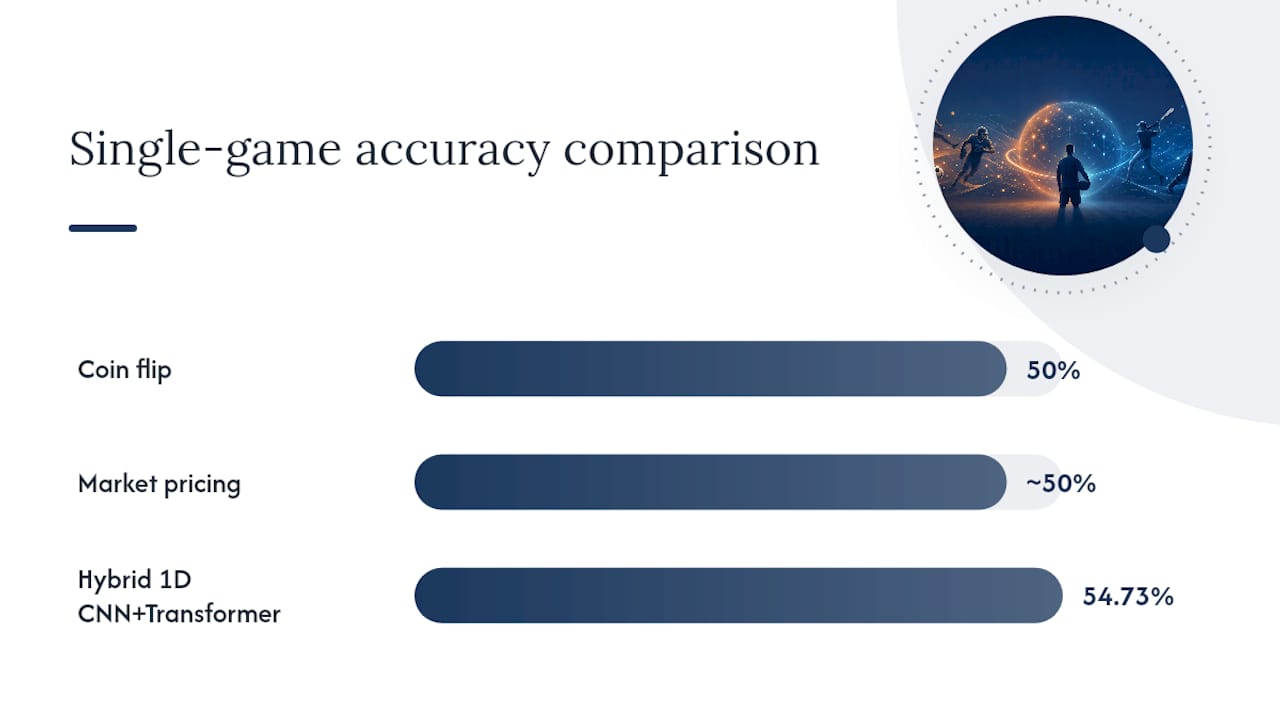
The newer wrinkle is hybrid deep learning. Some research teams now combine 1D convolutional neural networks with Transformer layers to capture sequential patterns in team performance data, like a hot streak or a slumping bullpen. It sounds impressive, and it is, technically. But the results keep this honest: one benchmark study measured a top accuracy of just 54.73% for a hybrid 1D CNN plus Transformer model, only modestly better than a coin flip. That's the real ceiling on single-game prediction right now, no matter how sophisticated the architecture sounds.
What should you actually look for when judging a model's track record?
- Accuracy with context: 55% sounds low until you remember the market itself is priced near 50/50 on most games
- Brier score: measures how well-calibrated the probabilities are, not just whether the pick won
- ROI and units: the actual financial outcome over a meaningful sample
- Closing-line value (CLV): whether the pick beat the market's final price, a stronger long-run signal than raw win rate
Treat model output as one strong input, not a verdict. Model-based bettors build their own probability estimates precisely because no single system, hybrid or otherwise, has solved this outright.
How Do You Turn a Prediction Into a Smart Bet?
A prediction is just a number until you run it through a process. Here's the sequence that separates disciplined bettors from people chasing hunches.
- Convert the odds. American odds of -150 imply roughly 60% win probability; +150 implies about 40%. Decimal odds convert to implied probability as 1 divided by the decimal price.
- Compare to your model or the pick's stated probability. If the model says 66% and the market implies 60%, you've identified a 6-point edge. Guides on building your own model recommend treating anything under a 3 to 5% edge as noise.
- Size the stake to your bankroll, not your confidence level. Flat staking at 1 to 3% of your bankroll per bet, or a fractional Kelly approach, protects your funds through inevitable losing streaks.
- Check for late news and line movement before you place anything. A pick made at 9 a.m. can be dead wrong by kickoff.
Our internal EV playbook walks through the implied-probability math in more detail if you want a step-by-step reference.
The gap between recreational bettors and long-term winners usually isn't smarter picks. It's a written staking plan they actually follow when a losing streak tests their nerve.
Pro Tip: Never let a "lock of the week" talk you into betting above your normal stake size. Confidence language sells clicks; it doesn't change your bankroll math.
If betting starts feeling less like entertainment and more like a compulsion, the National Council on Problem Gambling offers free, confidential support.
Which Sports Are Hardest to Predict?
Prediction reliability shifts a lot depending on the sport, and treating every league the same way is a common mistake.
- NFL: only 17 regular-season games per team means small samples and high variance. Lean on closing-line value over single-week accuracy, and keep stakes conservative.
- NBA: 82 games gives you a bigger dataset, but rest management and rotation changes swing outcomes fast. Track minutes shares and lineup news right up to tip-off.
- MLB: pitching drives everything. Starting pitcher FIP and xFIP, park factors, and weather can swing a win-probability estimate by double digits.
- Soccer and hockey: low-scoring formats mean draws matter and small sample sizes distort raw win/loss records. Expected goals (xG) and shot-quality metrics tell you more than the scoreline history.
- Player props: usage rate and injury risk make these the toughest bets to model well. Props typically need a bigger edge than moneyline or spread bets to justify the risk.
Our MLB prediction hub breaks down pitcher-specific factors in more depth if baseball is your primary focus.
How Do You Spot a Trustworthy Prediction Source?
Not every prediction feed deserves your trust, and a few quick checks separate the credible ones from the noise.
- Look for published methodology. Reputable sources explain how their model works, at least at a high level, and disclose sample sizes.
- Demand out-of-sample testing. A model that only "works" on the data it was trained on tells you nothing about future performance.
- Check for CLV and units tracking, not just a win/loss record. Anyone can cherry-pick a hot streak.
- Watch for red flags: guaranteed returns, "can't-lose locks," or accuracy claims above 60 to 65% sustained over time. No credible long-run source supports persistent 90% accuracy claims; those numbers almost always come from cherry-picked short samples.
Simple test: track any provider for 50 to 200 picks yourself, log the CLV, and compare the actual variance to what they publish. That's enough volume to separate a real edge from luck.
Practice Your Predictions Without Risking a Dime
Megasports-arena runs free prediction games across MLB, NBA, NFL, and NHL, built specifically for fans who want to test their read on a matchup before ever touching a sportsbook. You get contest pools, leaderboards, archived results to check your own track record, and DIY custom pools if you want to build a challenge for your group.
- Free-to-play prediction contests across major leagues with no entry cost
- Leaderboards that let you benchmark your picks against other players
- Archived results so you can measure your own accuracy over time, the same way you'd judge any provider
- Embeddable games that partner sites use to keep sports fans engaged longer
If you want to stress-test a staking theory or just see how your gut read on a Sunday slate holds up, play a round on Megasports Arena and check the leaderboard against your own predictions.
What Should You Actually Trust in a Prediction Feed?
The industry sells accuracy as the headline number, and that's backwards. A 55% hit rate on well-calibrated moneyline picks with tracked closing-line value beats a 70% claim from a source that won't show its sample. The hybrid deep-learning models getting attention right now confirm this: even sophisticated architectures top out modestly above a coin flip on genuinely hard predictions, which tells you something the marketing copy won't.

Conventional betting advice spends too much time on "who to pick" and not enough on "how much to risk." That's backwards. Bankroll discipline, not model sophistication, is what keeps a bettor solvent long enough for any real edge to show up in the numbers. Start there before you obsess over which algorithm generated a pick.
If you're new to this, don't start with real money. Run your predictions through a free contest, track your own accuracy the way you'd judge any provider, and only move to actual stakes once your process, not your gut feeling, is producing consistent results.
— peter
This article is general information, not a substitute for advice from a qualified financial advisor. Consult a qualified financial professional about your own circumstances before acting on anything here.
Sources
- Sports Betting: How to bankroll management | Sportsbook Review
- Predicting sport event outcomes using deep learning - PMC
- Build Your Own Sports Betting Model: A Step-by-Step Data Guide (2026) - Practical Web Tools
- National Council on Problem Gambling (NCPG)