
Consistency beats upside, conservative sizing beats bold bets, and disciplined tracking beats gut feel. The best streak game strategy favors players with steady opportunity and contact over occasional big-ceiling names, sizes picks small enough to survive a bad week, and logs every result so you can see whether you actually have an edge. Applied to daily streak or pick-a-player formats, that combination is what separates players who last months from players who reset every ten days. The sections below cover pick selection, bankroll rules, the probability math behind long sequences, and a workflow you can copy starting tomorrow morning.
TL;DR:
- Maintaining a small, conservative stake of 1% to 3% of your bankroll per pick helps prevent large losses and keeps you in the game longer.
- Focusing on players with high contact and opportunity rates outpredicts raw power, especially when matchups and lineup changes are regularly checked near game time.
- Applying de-vigged odds and shrinkage adjustments ensures your probability estimates remain unbiased and realistic, avoiding overconfidence in your picks.
- Long streaks are statistically improbable because probabilities multiply, with even high-percentage picks yielding near-zero chances of extreme streak lengths.
- Logging every pick with outcome data and tracking metrics like hit rate and closing-line value give insight into your true edge and help refine your strategy over time.
Table of Contents
- What Makes a Strong Pick in Streak Games?
- How Should You Size Bankroll for a Long Streak?
- Why Do Long Streaks Almost Always Fail?
- Building a Daily Routine That Actually Tracks Results
- What I Think Actually Separates Winners From Everyone Else
- Practice Your Streak Strategy on Megasports Arena
- Sources
- FAQ
What Makes a Strong Pick in Streak Games?
Streak games punish variance. Opportunity and contact matter more than ceiling. A modeling breakdown of MLB's hitting-streak problem found that lineup position and contact-related features outpredicted raw season averages, and that a small set of well-chosen features beat a bloated one for picking winners day to day.
Matchup context changes the picture fast. A groundball-heavy contact hitter facing a fly-ball pitcher in a small park on a windy night is a different bet than the same hitter facing a strikeout artist in a pitcher's park. Late lineup swaps (a scratched starter, a batting-order shuffle) can flip a "safe" pick into a bad one within an hour of first pitch, so check lineups again close to lock time, not just in the morning.
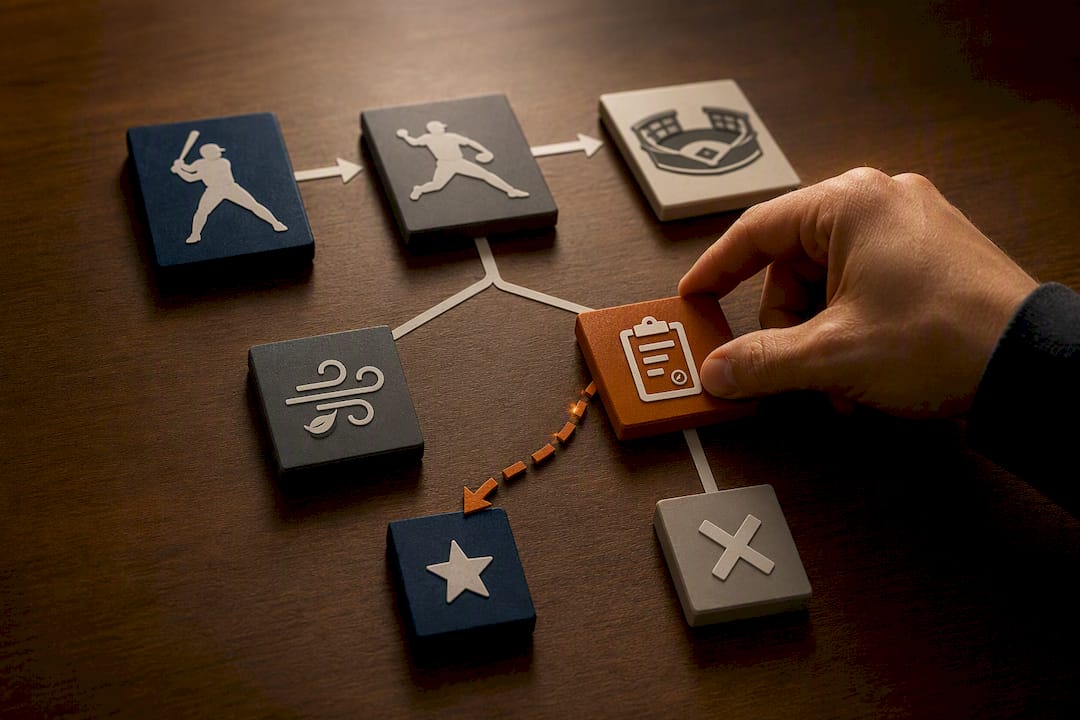
Use rolling windows instead of last night's box score. A hot game or two is noise. A player's trend over the last 7, 14, and 30 games tells you whether the underlying rate actually shifted or whether you're chasing a hot streak that's about to cool off.
When to double down versus play it safe:
- Early in a streak (games 1 to 5), a single high-confidence pick beats a double, since you have little built up to protect.
- Mid streak, once you've confirmed a genuine edge across several picks, a modest double on your highest-confidence matchup can accelerate progress without much added risk.
- Late in a long streak, when the payoff or leaderboard position is meaningful, dial back toward single picks. The math in the next sections shows why compounding risk gets dangerous fast.
Pro Tip: Keep a shortlist of 3 to 5 backup picks each day. Injury news and weather calls come in late, and having alternates ready beats scrambling ten minutes before lock.
How Should You Size Bankroll for a Long Streak?
Unit sizing decides how long you stay in the game after a bad stretch. The core idea, borrowed from disciplined betting systems, is to never risk enough on one pick to meaningfully damage your ability to keep playing. A Atswins recommends de-vigging odds to get fair probabilities, then sizing with fractional Kelly or a fixed cap rather than the full Kelly formula, since full Kelly assumes your probability estimate is exact, and it almost never is.
For entertainment-level streak play, three rules keep you in the game:
- Cap single-pick exposure. Treat each pick as a small fraction of your total bankroll or points pool, something in the 1% to 3% range, so one miss doesn't wreck your week.
- Use fractional Kelly, not full Kelly. A fraction between 0.1 and 0.25 of the full Kelly stake accounts for the fact that your win-probability estimate carries error, and it smooths out the swings that come from betting your exact theoretical edge.
- Set a drawdown trigger. After two or three consecutive misses, cut your stake size in half or pause entirely for a day. Resetting your head matters as much as resetting your bankroll.
A fixed unit sizing approach works well for pure entertainment play because it removes emotion from the equation. Fractional Kelly rewards you when your edge is real and shrinks your exposure automatically as confidence in your model wavers, which the ATSwins.ai system guide frames as the reason fractional Kelly and hard exposure caps outperform full Kelly for imperfect models over time.
Quick comparison: picture two players with the same 100-unit bankroll. Player A bet 10 units per pick and busts after four losses in five tries. Player B bets 2 units per pick, survives the same losing stretch with 92 units left, and is still in position to build a new streak the next morning.
Why Do Long Streaks Almost Always Fail?
Probabilities multiply, and that multiplication is brutal. Analysis of MLB's Beat the Streak contest shows exactly this collapse at scale: even elite per-pick probabilities in the 75% to 80% range produce vanishingly small odds of reaching a 57-game streak, which is why almost nobody ever has, despite millions of entries over the contest's history.
| Per-pick win probability | 5-game streak | 10-game streak | 20-game streak |
|---|---|---|---|
| 60% | 7.8% | 0.6% | 0.004% |
| 70% | 16.8% | 2.8% | 0.08% |
| 80% | 32.8% | 10.7% | 1.2% |
Two adjustments keep your own probability estimates honest. First, de-vig the sportsbook or platform odds to strip out the built-in margin and get an implied fair probability. Compare that fair number against your own read on the matchup. Second, apply shrinkage. That correction accounts for the overconfidence almost everyone brings to their own picks. Groups like SportAgent build this discipline directly into their workflow, cross-checking market prices against de-vigged consensus and running deterministic math instead of trusting a gut call.
- Run a simple Monte Carlo simulation, even 1,000 to 10,000 quick trials, to see how your chosen sizing and pick-selection rules hold up across simulated bad stretches. A production pipeline example uses walk-forward validation for exactly this reason: back-tested confidence that ignores real-world sequencing risk is misleading.
- Treat any streak beyond 15 or 20 games, even with strong picks, as a low-probability outcome you're playing for fun and leaderboard position, not as something you should bankroll like a sure thing.
Building a Daily Routine That Actually Tracks Results
A repeatable routine beats a brilliant one-off pick. Start each morning with a quick scan of injury reports and lineup news, build a shortlist of your top candidates, run them through whatever quick model or heuristic you use, then check lines again right before lock in case something moved. Production-grade systems follow the same shape at larger scale, using morning briefings and last-minute alerts to catch late changes before they cost a pick, according to the Sport-suite pipeline documentation.
Log every pick with the same fields, every day:
- Date, player, and matchup context
- Your estimated probability, plus the shrinkage factor you applied
- Stake size and final outcome
- A one-line note on why you made the pick
Three metrics tell you whether you have a real edge: hit rate over a rolling window, Precision@K if you're ranking multiple candidates, and closing-line value, meaning whether the odds moved in your favor after you locked your pick. Tracking closing-line value is one of the most reliable checks for separating genuine skill from noise, a point ATSwins.ai's system guide makes clearly.
Pro Tip: Play cards, leaderboards, and archived results give you a free place to run this exact routine daily without risking anything but bragging rights, which makes it a solid low-stakes proving ground for a new sizing rule before you rely on it anywhere else.
What I Think Actually Separates Winners From Everyone Else
Most people chase whoever is hot right now instead of whoever is consistently getting good at bats. That is backward. The math above shows why: a small, honest edge sized conservatively survives; a big claimed edge sized aggressively gets wiped out by one bad week. Treat every streak as entertainment with a scoreboard, not a paycheck, budget accordingly, and log results even when they embarrass you. That honesty is the whole system.
— peter
Practice Your Streak Strategy on Megasports Arena
A free practice ground for everything covered above provides contest cards to test pick-selection rules without financial risk, leaderboards to see how your streak stacks up against other players, and archived results so you can review past picks the same way the logging section recommends.

Start on the Sports Rummy play page to try a live streak card, or check the how-to-play guide first if you want the format rules laid out before you jump in. Once you're comfortable, the leaderboard gives you a free way to benchmark your hit rate against other players using the exact tracking metrics discussed above. Pick a small shortlist, size it conservatively, and log the result before you play your next card.
Sources
A few technical sources shaped the probability math and workflow recommendations in this guide:
For sizing discipline outside sports specifically, Dropskin's guide to conservative stake sizing covers the same 0.5% to 2% exposure logic applied to a different game type, and the EV playbook on probability for sports picks walks through the fair-odds math in more depth.
FAQ
What Is the Best Streak Game Strategy for Beginners?
Pick players with high opportunity and contact rates rather than big-name upside, size each pick at 1% to 3% of your bankroll, and log every result so you can see your real hit rate over time.
How Do Odds Multiply Across a Long Streak?
You multiply the per-pick probability by itself for each game in the sequence.
When Should You Double Down on a Streak Pick?
Only double down once you've confirmed a genuine edge across several prior picks, generally in the middle of a streak rather than the start or the late stages when protecting progress matters more.
What Is Shrinkage and Why Does It Matter?
Shrinkage means adjusting your subjective probability estimate downward before acting on it, correcting for the overconfidence almost every player brings to their own picks.
Can You Practice Streak Strategy Without Risking Money?
Yes. Free play cards, leaderboards, and archived results let you test pick-selection and sizing rules and track your hit rate before applying the same discipline anywhere else.