
Sports logic puzzles, in the sense that matters for publishers and partner sites, are free-to-play interactive widgets: prediction pools, pick'em contests, trivia rounds, leaderboards, and sports-themed puzzle games that turn passive readers into daily participants and first-party data sources. Megasports-arena builds exactly these, and the case for embedding them is direct. Interactive content converts at roughly 50% higher rates than static forms, and with an estimated 57 million fantasy players in the U.S. and Canada alone, the audience is already primed.
What you get from a working embed:
- Daily active users (DAU) lift from habitual return visits tied to streaks and leaderboards
- First-party behavioral data (team preferences, confidence levels, prediction patterns) that broadcast metrics miss
- Compliance-friendly engagement in U.S. markets where wagering regulations are complex
- Email and SMS capture at the moment of highest emotional investment
If you run a sports site or a content platform with a sports vertical, the fastest test is a two-week daily predictor pilot. Measure DAU before and after. The signal is usually clear.
Key Takeaways
| Point | Details |
|---|---|
| Choose mechanics by objective | Use prediction/pick'em for DAU, trivia for email capture, leaderboards for long-term retention. |
| Mobile-first is non-negotiable | Widgets that miss the one-second interactive paint target on mobile lose repeat players before the first submission. |
| Wire real-time events before launch | Connect game_start and prediction_submitted to your CRM; batch architectures lose the same-session conversion window. |
| Measure DAU, repeat rate, and email captures | Run a two-week pilot and track these three KPIs daily before scaling placement or promotion. |
| Megasports-arena as embed partner | Megasports-arena provides embed-ready, free-to-play sports game widgets covering major U.S. leagues with leaderboard and real-time event support. |
Table of Contents
- Why do free-to-play sports games outperform static content?
- Which game mechanic fits your goal?
- How to embed a sports game widget in 6 steps
- What does good technical and UX execution look like?
- What should you measure?
- Where do sports logic puzzles drive the most value for publishers?
- What to hand your developer before integration
- The case for treating this as a product, not a feature
- Megasports-arena gives you embed-ready sports games today
- Sources
Why do free-to-play sports games outperform static content?
The short answer: habit formation plus emotional stake plus data capture, all in one mechanic.
Static articles get read once. A matchday predictor gets visited before kickoff, checked at halftime, and revisited for the result. That three-touch session is structurally impossible with a standard editorial page. Daily mini-games with leaderboards and streaks convert casual readers into habitual visitors, and when the game is tightly tied to the publisher's beat, the effect compounds over a season.
The compliance angle matters in the U.S. specifically. Free-to-play prediction games capture the same user psychology as betting markets while letting publishers collect first-party behavioral data without touching wagering regulations. That is a meaningful distinction as state-by-state sports betting law continues to evolve.
Publisher benefits at a glance:
- Longer average session duration per visit
- Higher page-per-session counts when widgets link to related articles
- Social sharing driven by leaderboard bragging rights
- Newsletter signups captured at the moment of peak engagement
- Reduced churn during off-seasons when live games are scarce
Pro Tip: Run a tournament leaderboard for the duration of a major event, like the NFL playoffs or March Madness. Time-limited campaigns concentrate attention, generate social urgency, and give sponsors a clean, bounded activation window.
Which game mechanic fits your goal?
Pick the format based on what you need to move, not what sounds most exciting.
Prediction/pick'em is the workhorse for live traffic. Tie it to a fixture and you get pre-match visits, in-match check-ins, and post-match result views. Best for DAU lift and session depth. NBA prediction games are a clean example of how a sport-specific hub concentrates this traffic.
Trivia rounds are the newsletter mechanic. Gate a weekly quiz behind an email signup and you get a qualified list of fans who self-identify by sport and knowledge level. The daily sports trivia format works particularly well for morning newsletters, where a quick five-question quiz fits naturally before the day's first game.
Spin-to-win is the fastest email capture tool in the set. Variable reward psychology (the user does not know what they will win) drives submission rates higher than fixed-prize offers. Use it for acquisition campaigns, not retention.
Leaderboards and streaks are the retention engine. A user who has a seven-day streak has a reason to come back tomorrow that has nothing to do with the content quality. Leaderboard gamification works best when you seed early competitors, set periodic resets to keep the board competitive, and tie rewards to milestones rather than just rank.
Mechanic-to-objective mapping:
- Acquisition: spin-to-win, one-click prediction with email gate
- Retention: daily streaks, season-long leaderboards, puzzle series
- Email capture: trivia with newsletter gate, pick'em with results delivery
- Social shares: leaderboard rank cards, prediction result graphics
Pro Tip: Keep all mechanics free-to-play with no purchase required to participate. Beyond the compliance benefit, free entry removes the single biggest friction point for casual fans who would otherwise skip the game entirely.
How to embed a sports game widget in 6 steps
Hand this to your product or dev team as a working checklist.
- Plan your mechanics and schedule. Choose one primary format (prediction, trivia, or leaderboard) and map it to your editorial calendar. Tie game launches to fixtures or news moments for maximum organic traffic.
- Choose placement. Above-the-fold on a matchday hub page outperforms in-article embeds for DAU. In-article placement works better for email capture tied to specific content.
- Technical prep. Drop in the embed script, set the container ID, define width and height rules, and configure your auth token. Confirm the widget loads via CDN and passes a mobile render test on at least three device sizes.
- Wire real-time event hooks. F2P mechanics drive higher conversion only when game events feed a real-time data layer that can fire same-session CRM triggers. Batch architectures lose the emotional moment. Connect
game_start,prediction_submitted, andstreak_incrementedevents to your CRM or marketing automation platform before launch. - Privacy and compliance. Add a clear data-collection disclosure inside or adjacent to the widget. Confirm your consent flow covers the data you are capturing (email, behavioral signals). Free-to-play is the compliance-friendly path in U.S. markets; confirm no purchase is required to play or win.
- Test, launch, and iterate. Run a two-week pilot. Measure DAU uplift, session duration, and email capture rate. Adjust placement and promotion cadence based on what the data shows, not assumptions.
Roles to assign before launch: one editor owns content and scheduling, one developer owns the embed and event schema, one analytics owner confirms event firing, and legal signs off on the privacy disclosure.
What does good technical and UX execution look like?
Mobile-first, fast-loading, and low-friction are the non-negotiable baseline. Slow or ad-heavy widgets actively reduce trust and lift friction for repeat play. A widget that takes three seconds to become interactive on a mid-range Android phone will lose a large share of your mobile audience before the first prediction is submitted.
Technical checklist for developers:
- Target under one second to interactive paint on a 4G connection
- Use lazy loading so the widget does not block page render
- Keep the JavaScript bundle small; avoid loading the full widget framework on pages where it is not visible
- Serve assets from a CDN with edge caching
- Use WebSockets or Server-Sent Events for real-time score and leaderboard updates
- Implement an SEO fallback (server-side rendered summary or static preview) so search engines index the page content
- Add ARIA labels and full keyboard navigation for accessibility compliance
Privacy and consent notes: display a one-line data-collection disclosure inside the widget frame, not buried in a footer. Handle consent-driven data flows so the widget degrades gracefully when a user declines tracking. Minimize PII collection to what you actually use.
Pro Tip: Pair the widget with strong internal links to related articles and a "new games" feed. Embedded games increase session duration and internal navigation when they are supported by good internal linking. Without it, a user who finishes the game leaves the site.
What should you measure?
Primary KPIs for any sports prediction or trivia embed:
- DAU/MAU ratio: target a ratio above 0.2 for a healthy habitual-use signal
- Session duration: compare widget sessions against non-widget sessions on the same page type
- Repeat rate and streak length: the share of users returning on consecutive days
- Prediction submission rate: completions divided by widget loads
- Email captures per session: for gated formats
- Same-session conversion: for any upsell or newsletter offer triggered by a game event
The 50% higher conversion rate for interactive content versus static forms is the benchmark to beat on email capture. That figure is illustrative of what real-time CRM integration unlocks, not a guarantee, but it signals the order of magnitude possible when the data layer is wired correctly.
Reporting cadence: review DAU and submission rate daily during the first two weeks, then shift to weekly cohort analysis. Track attribution with a 7-day window for email-driven conversions and a 30-day window for any premium upsell.
Pro Tip: A/B test widget placement before committing. Above-the-fold embeds on matchday pages typically outperform in-article placements for DAU, but in-article placement often wins on email capture because the reader is already engaged with the content.
Where do sports logic puzzles drive the most value for publishers?
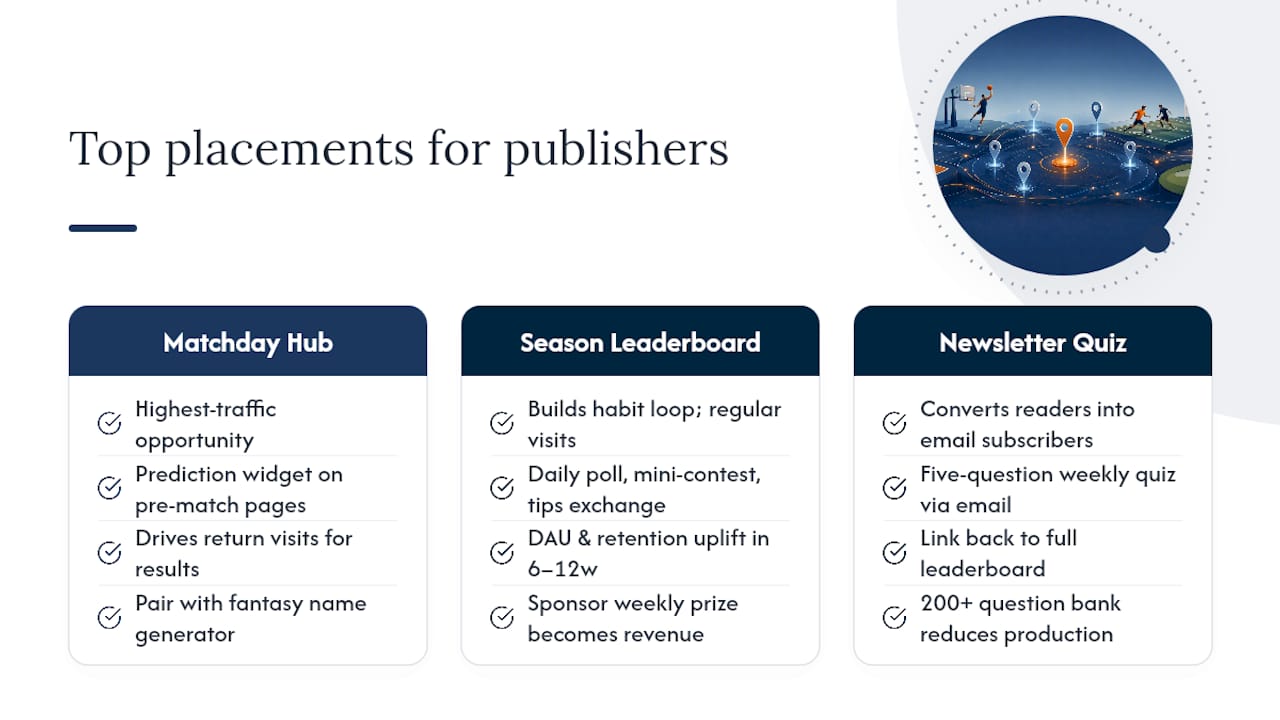
Three placements consistently outperform the rest.
Matchday hub embeds are the highest-traffic opportunity. A prediction widget on a pre-match page captures fans at peak intent, drives return visits for results, and gives sponsors a clean, time-bounded activation. Pair it with a fantasy team name generator for social sharing hooks around season openers or playoff brackets.
Season-long leaderboards build the habit loop that keeps users coming back week after week. Publishers who run a small pilot combining a daily poll, a mini-contest, and a tips exchange commonly see DAU and retention uplifts within 6–12 weeks. Sponsor a weekly prize and the leaderboard becomes a revenue line, not just an engagement metric.
Newsletter-gated trivia series convert engaged readers into qualified email subscribers. A five-question weekly quiz, delivered via email with a link back to the full leaderboard, creates a reason to open every send. The sports trivia question bank at Megasports-arena covers 200+ questions across skill levels, which cuts editorial production time significantly.
Promotion channels that amplify each placement: push notifications for matchday reminders, social posts with leaderboard rank cards, and influencer cross-posts during major tournaments. Sponsor-funded prize pools let you run weekly contests at no direct cost while giving a brand partner a measurable activation.
What to hand your developer before integration
- Embed script or snippet from the games vendor, with version pinned
- Container ID and size rules (max-width, aspect ratio, mobile breakpoints)
- Auth token or API key scoped to your domain
- Analytics event names to fire:
game_start,prediction_submitted,game_result_displayed,streak_incremented - Privacy callback URL for consent-driven data flows
- CRM webhook endpoint for same-session trigger events
Privacy disclosure checklist for the widget frame:
- One-line statement of what data is collected (email, prediction history)
- Link to your full privacy policy
- Consent toggle if your platform serves EU/EEA users under GDPR (not required for U.S.-only audiences, but good practice)
QA sign-off matrix: test on iOS Safari, Android Chrome, and desktop Chrome at minimum. Test on a throttled 3G connection to confirm load performance. Confirm all four analytics events fire correctly in your tag manager before going live. API-driven game creation tied to fixtures lets you automate daily puzzle refreshes without manual editorial work once the pipeline is set up.
The case for treating this as a product, not a feature
Most publishers treat interactive games as a content garnish. That framing is why most embeds underperform. The publishers who see real DAU lifts treat the game as a product with its own roadmap: scheduled resets, seeded leaderboard competitors, seasonal campaigns, and a dedicated analytics dashboard. The editorial team owns the content calendar; the product team owns the mechanic and the data layer.
The other thing most articles on this topic miss: the compliance advantage of free-to-play is not just a legal hedge. It is a positioning asset. A publisher that runs a free prediction contest during the NFL season is offering something a wagering platform cannot: a zero-risk, zero-cost way for a casual fan to feel invested in a game. That audience segment is larger than the active bettor segment, and it is far easier to convert into a newsletter subscriber or a returning daily visitor.
Megasports-arena gives you embed-ready sports games today
The fastest path from "we want interactive sports content" to a live widget is Megasports-arena's game library. The platform covers MLB, NBA, NFL, NHL, and more with prediction pools, trivia contests, leaderboards, and sports-themed puzzle games built for embedding. Every game is free-to-play, mobile-first, and designed to fire the analytics events your CRM needs for same-session triggers.

Partners get embed-ready code, real-time leaderboard pages like the Sports Rummy leaderboard, and a live game library you can preview and test right now. The Sports Rummy play page is the fastest way to see how an embed behaves on mobile before you commit to integration. Drop in the widget, run a two-week pilot, and let the DAU data make the case for a full rollout.
Sources
- What the World Cup prediction market boom tells us about the future of fan engagement
- Use cases: Mini-games retention playbook
- Gamification as a customer acquisition engine: how enterprise brands use free-to-play mechanics to drive growth
- How embedded games increase website engagement | GameSpa