For most contests, the recommended tiebreaker order is: head-to-head result → secondary performance stat (point/goal difference or countback) → extra play or sudden-death round → closest-number question → drawing of lots. That sequence covers the vast majority of situations, moves from most to least skill-based, and gives participants a fair shot at every stage before randomness decides anything.
Paste this into your rulebook: "In the event of a tie, the following tiebreakers apply in order: (1) head-to-head result between tied participants; (2) point/goal difference or countback statistic; (3) a playoff round or sudden-death question; (4) closest-number tiebreaker question; (5) drawing of lots. All tiebreakers are applied sequentially until one participant advances."
Why this order? Head-to-head puts the result in the hands of the participants who already played each other. Secondary stats reward consistent performance across the whole event. Extra play or a sudden-death question keeps skill in the equation. Drawing of lots comes last because it is random, and random should be a last resort, not a first instinct.
Typical resolution times by tier:
- Head-to-head check: generally quick (about a couple of minutes)
- Stat comparison (point difference, countback): a few minutes
- Closest-number question: usually under a couple of minutes
- Sudden-death round: several minutes
- Playoff match: duration varies, can last a full session
- Drawing of lots: typically very fast
Key Takeaways
A fair, fast tiebreaker system starts with publishing the ordered sequence before the event and ends with a documented record of how the tie was resolved.
| Point | Details |
|---|---|
| Publish the sequence first | Post the full ordered tiebreaker list on the event page at least 48 hours before the contest. |
| Head-to-head comes first | Always apply head-to-head results before any stat comparison or random method. |
| Prepare a question bank | Keep 3–5 estimation-based tiebreaker questions ready so delays never stall the event. |
| Pick a fast last resort | Drawing of lots or a coin toss should always close the list as the final, documented fallback. |
| Megasports-arena | The platform's rules fields, live leaderboards, and results archive support a complete tiebreaker workflow out of the box. |
Table of Contents
- Common contest tiebreaker methods and when to use them
- How to pick and order tiebreakers for your specific contest
- Ready-to-paste tiebreaker rule templates
- How to run, record, and communicate tiebreakers fairly
- What to do when all tiebreakers still produce a tie
- How Megasports-arena configures and enforces tiebreakers
- An organizer's perspective on what actually prevents disputes
- Megasports-arena makes contest tiebreakers easy to configure
- Sources
Common contest tiebreaker methods and when to use them
A tiebreaker is a supplemental criterion used to determine a single winner when scores or results are identical. The method you choose shapes how fair, fast, and satisfying the resolution feels to everyone in the room.
| Method | Best for | Main downside | Typical time cost |
|---|---|---|---|
| Head-to-head result | Leagues, round-robins, any format where tied teams met | Doesn't help if tied teams never played each other | Under 2 min |
| Point/goal difference | Leagues, score-based contests | Rewards blowout wins; can feel punishing | 2–5 min |
| Number of wins | Round-robins with draws | Ignores margin of victory | 2–5 min |
| Strength of schedule (Buchholz) | Chess, Swiss-system tournaments | Complex to calculate manually | 5 min |
| Extra play / overtime | Sports, elimination brackets | Requires time, space, and fresh participants | Variable |
| Penalty shootout / sudden-death | Sports, elimination brackets | Luck element; pressure-sensitive | 5–15 min |
| Additional question / closest-number | Trivia, quiz nights, leaderboard contests | Needs a prepared question bank | Under 2 min |
| Coin toss / drawing of lots | Final resort, any format | Pure chance; feels arbitrary to participants | Under 1 min |
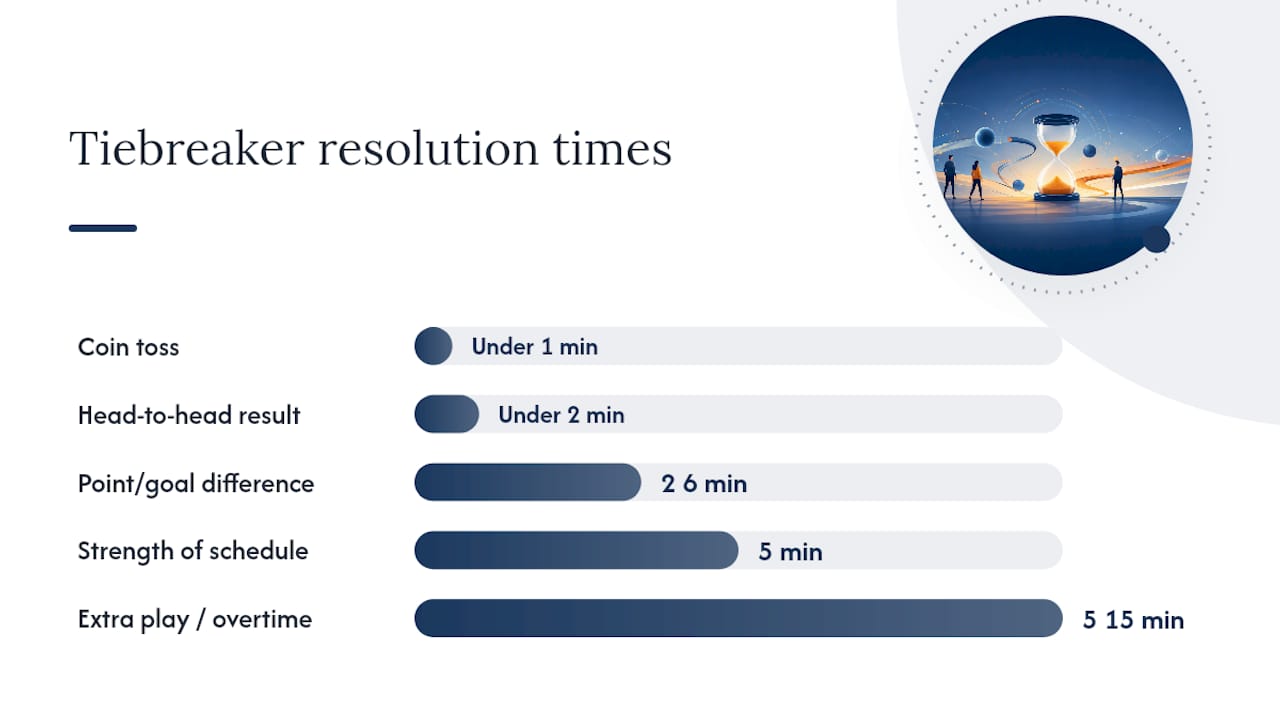
Stat-based methods (head-to-head, point difference, countback) work best when you have clean records and enough data. Extra-play methods (overtime, shootout, sudden-death) keep skill central but cost time and energy. Random methods (coin toss, draw) are fast and indisputable but should only appear at the end of your ordered list.
For multi-way ties involving three or more participants, apply each tiebreaker only among the tied group, not the full field. If head-to-head results among three teams produce a circular result (A beat B, B beat C, C beat A), move immediately to the next criterion rather than looping.
Pro Tip: For trivia and quiz contests, avoid easily searchable facts as tiebreaker questions. Estimation questions ("How many miles of coastline does Alaska have?") are harder to Google quickly and produce a clear winner almost every time.
How to pick and order tiebreakers for your specific contest
Before you write a single rule, run through this checklist:
- What format is the contest? League, bracket, trivia night, leaderboard, or judged event each has a natural tiebreaker fit.
- How much time do you have? A playoff match is ideal for a weekend tournament; it is impractical for a 90-minute quiz night.
- What records will you have? Head-to-head and stat-based methods require clean scorekeeping. If your recordkeeping is informal, lean on sudden-death or closest-number methods.
- Who is watching? Spectators and participants both prefer skill-based resolution over a coin flip. Save random methods for when nothing else works.
- Are prizes or advancement spots at stake? Higher stakes demand more defensible, documented methods.
Three sample ordered sequences:
League / round-robin: Head-to-head record among tied teams → goal/point difference → goals/points scored → playoff match → drawing of lots. This sequence mirrors what major soccer and hockey leagues use, and participants generally accept it because every step reflects actual performance.
Single-elimination bracket: Head-to-head result (the tied match itself) → overtime period → penalty or sudden-death round → coin toss. Brackets rarely need more than three steps because the tied match already happened; overtime and sudden-death extend that same contest rather than introducing new data.
Trivia / quiz night: Closest-number question → second closest-number question (from your prepared bank) → speed round (first correct answer wins). Trivia hosts widely recommend the closest-number format because it is fast, virtually impossible to tie again, and easy to judge without bias.

For ties that affect multiple advancement positions simultaneously (say, three teams tied for the final two playoff spots), apply tiebreakers among all three together. If the first criterion separates one team but leaves two still tied, apply the full sequence again for just those two.
Pro Tip: FIDE requires organizers to publish the ordered tiebreaker list before the tournament begins. Follow that standard for any contest with prizes or rankings: post the full sequence on your event page and announce it at sign-in. If time runs short, cut the list to three methods maximum and make sure the last one is always a fast, decisive option.
Ready-to-paste tiebreaker rule templates
Copy, adjust the bracketed fields, and drop these into your event documents.
Template 1: League / round-robin
Template 2: Single-elimination bracket
Template 3: Score / leaderboard contest
Template 4: Quiz / trivia sudden-death
Template 5: Multi-stage tournament
Worked example: Three teams finish a round-robin with 9 points each. Step 1: check head-to-head records among the three. Team A beat Team B, Team B beat Team C, Team C beat Team A. Circular result, so move to Step 2: goal difference. Team A: +7, Team B: +3, Team C: +2. Team A advances. Teams B and C remain tied, so apply Step 2 again for just those two: Team B's +3 beats Team C's +2. Final order: A, B, C.
Formatting guidance: Place tiebreak rules in a clearly labeled section titled "Tiebreaker Procedures" immediately after the main scoring rules. Use numbered lists, not paragraphs, so participants can follow the sequence at a glance. Always include a deadline line: "Tiebreakers will be resolved no later than [time] on [date]."
| Method | Typical resolution time |
|---|---|
| Closest-number question | Usually a few minutes or less |
| Sudden-death question round | Several minutes |
| Stat comparison (countback, point difference) | A few minutes |
| Penalty shootout | Several minutes |
| Playoff match | Duration varies widely |
| Drawing of lots | Typically very fast |
The Toastmasters Table Topics tiebreaking guide is a useful model for judged contests: it provides a ballot form and step-by-step instructions for adjudicators, showing exactly how to document a tie and record the resolution. Adapt the same structure for any contest where judges score participants subjectively.
How to run, record, and communicate tiebreakers fairly
Good tiebreaker rules mean nothing if participants find out about them after a dispute starts. The implementation steps matter as much as the rules themselves.
Pre-event checklist:
- Publish the full tiebreaker sequence on the event page, registration confirmation, and printed program at least 48 hours before the event.
- Announce the tiebreaker procedure verbally at sign-in or the opening briefing.
- Designate a named, impartial adjudicator (not a participant or their coach) to oversee any tiebreaker resolution.
- Prepare your tiebreaker question bank in advance. Trivia hosts recommend keeping 3–5 ready questions so a delayed search never stalls the event.
- Set up your recordkeeping format before play begins: a shared spreadsheet, a paper log, or a platform with an audit trail.
Sample announcement text (read this at the start of the event or post it on the event page):
"In the event of a tie, we will apply the following tiebreakers in order: [list your sequence]. All tiebreaker decisions are made by [adjudicator name/role] and are final. Results will be posted to [leaderboard/event page] within [X minutes] of resolution."
Recordkeeping formats that hold up:
- Paper ballots with adjudicator signature and timestamp (good for judged contests; mirrors the Toastmasters ballot model)
- Timestamped spreadsheet entries showing each tiebreaker step applied and the result
- Screenshots of digital leaderboard states before and after resolution
- Written log noting which criterion resolved the tie and who witnessed it
Pro Tip: Assign your tie adjudicator before the event, not during a dispute. When a challenge arises, the adjudicator's role is to apply the published rules, not to make a judgment call. If a participant challenges a result, the adjudicator reviews the written record and applies the next listed criterion. Document the challenge and the outcome in the same log.
Transparency is the single most effective dispute-prevention tool. Participants who knew the rules in advance and watched them applied in order rarely contest the outcome, even when they lose.
What to do when all tiebreakers still produce a tie
It happens. You work through every criterion on your list and two participants are still level. Here is what to do, in order of preference:
- Schedule a playoff match or rematch at a later date or time, if the contest format and timeline allow. This is the most skill-respecting option and the one participants are most likely to accept.
- Drawing of lots (random draw from a hat, numbered cards, or a digital random selector): fast, indisputable, and widely accepted as a final resort. Document the draw: note who was present, what method was used, and who drew.
- Coin toss: equivalent to drawing of lots. Conduct it in front of both participants and a neutral witness. Record the result.
- Alphabetical order by registered team or participant name: use this sparingly. It is deterministic and requires no equipment, but participants whose names fall late in the alphabet may reasonably object to a system that disadvantages them by accident of naming.
- Shared prize or co-championship: when the contest allows it and both participants agree, splitting the prize or declaring co-champions is a clean resolution that preserves goodwill. Get written consent from both parties before announcing the result.
A note on legal and fairness considerations: when a random draw determines who receives prize money, document consent from all affected participants before the draw. Some jurisdictions treat prize contests differently from sweepstakes, and a documented, transparent random process protects the organizer. State in your published rules whether ties can ever be left unresolved or shared, so participants know before they enter.
Per FIDE's regulations, when a published tiebreaker list is exhausted, drawing of lots is the default unless the rules explicitly state otherwise. That standard is a reasonable model for any formal contest.
How Megasports-arena configures and enforces tiebreakers
Megasports-arena's platform is built around structured contest formats with visible rules, live leaderboards, and archived results, which makes it a practical environment for organizers who want tiebreaker procedures baked into the contest workflow rather than managed by hand.
Relevant platform features for tiebreaker management:
- Rules fields on each game page: organizers can publish the full tiebreaker sequence directly on the contest page, so participants see it before they enter. The contest rules format used across Megasports-arena games shows how to structure numbered tiebreaker steps clearly.
- Automated leaderboards: the platform updates standings in real time, which means stat-based tiebreakers (point totals, win counts) are visible to all participants without manual calculation. The leaderboard display makes the current ranking and any tied positions immediately apparent.
- Archived results: past contest outcomes are stored and accessible, giving organizers a documented record of how ties were resolved, which supports the recordkeeping requirement for any formal event.
How to configure an ordered tiebreaker list on Megasports-arena:
- Open the contest setup or rules page for your game.
- In the rules field, paste your ordered tiebreaker sequence using the templates from the section above.
- Specify the adjudicator role and the resolution deadline in the same field.
- Publish the rules before the contest opens so participants can review them at sign-in.
- After any tiebreaker resolution, update the leaderboard and post a brief announcement noting which criterion was applied.
The how-to-play format used in Megasports-arena's elimination-style games shows a clean model for presenting tiebreak steps in plain language that participants can follow without confusion. For leaderboard contests, the sports at the track rules page demonstrates how to attach tiebreak procedures directly to a timed or score-based format.
An organizer's perspective on what actually prevents disputes
Most tiebreaker disputes are not really about the tiebreaker method. They are about surprise. A participant who loses a coin toss after a hard-fought contest is not usually angry about the coin. They are angry because nobody told them a coin toss was possible. That distinction matters more than any specific method you choose.
Over-communicate the procedure, even when it feels redundant. Say it at sign-in, put it on the event page, and repeat it before any tiebreaker is applied. Participants who heard the rules three times rarely challenge the outcome.
Test your tiebreaker procedure before the event. If your plan calls for a closest-number question, run a practice round with a volunteer to confirm the question is genuinely hard to Google and that your rounding rule produces a clear winner. If your plan calls for a stat comparison, verify that your scorekeeper's records are clean enough to support it. A tiebreaker that looks good on paper but fails in practice is worse than no tiebreaker at all.
Keep a bank of 3–5 tiebreaker questions ready, not just one. A single question is a single point of failure: if it leaks before the event or produces another tie, you have nothing to fall back on.
Limit subjective judging in tiebreakers wherever possible. When a judge must choose between two participants based on impression or style, the losing participant has no objective record to review. Estimation questions, stat comparisons, and extra play all produce a result the participant can verify themselves.
On appeals: accept them only on procedural grounds (the wrong criterion was applied, a score was recorded incorrectly) and only within a short, stated window (15–30 minutes after the result is posted). Substantive appeals ("I think I played better") have no place in a well-run contest. State that policy in your published rules so participants know the window before they need it.
Sometimes the right call is to share the result. When two participants are genuinely inseparable after a full tiebreaker sequence and the prize allows it, co-championship is not a failure of the rules. It is the rules working exactly as intended.
Megasports-arena makes contest tiebreakers easy to configure
Running a contest with clear, enforceable tiebreaker rules is straightforward when the platform handles the structure for you. Megasports-arena's free-to-play contest environment gives organizers a rules field for publishing the full tiebreaker sequence, automated leaderboards that surface tied standings in real time, and archived results that serve as your audit log.

Three features organizers use most for tiebreaker workflows: the rules field (paste your ordered sequence before the contest opens), the live leaderboard (participants see tied positions without waiting for a manual update), and the results archive (your documented record of how every tie was resolved). No spreadsheet juggling, no disputed scorecards.
Head to Sports Rummy on Megasports-arena to see a live contest format with a built-in leaderboard and rules page, and use it as a starting point for configuring your own tiebreaker sequence. The how-to-play page shows exactly how to phrase rules so participants understand them before play begins.
Sources
- Tiebreaker — Wikipedia
- FIDE Handbook 07. Play‑Off and Tie‑Break Regulations (effective from 1 March 2026)
- Table Topics™ Contest Tiebreaking Guide/Ballot — Toastmasters International
- Trivia Tiebreaker Questions: Types, Strategies & Examples — TriviaHostHelp
- 25 Creative Quiz Tie Break Questions to Settle Close Competitions — Camp New York