
The best daily picks strategy is a repeatable morning routine, not a hot streak. Scan the slate, run every candidate through a four-filter funnel, grade what survives on a 1 to 5 confidence scale, then place flat-unit bets only after lineups confirm. A pick earns its spot through model edge, favorable line movement, and clean lineup news, not gut feel. Megasports Arena and contributor Pete Korner treat this as a procedure to run daily, and the payoff shows up in your closing line value over time, not in any single bet.
Table of Contents
- What Does a Daily Picks Strategy Routine Look Like Each Morning?
- How Do You Build a Repeatable Six-Step Morning System?
- How Do the Four Filters and Confidence Grades Actually Work?
- What Bankroll and Staking Rules Keep a Daily Approach Sustainable?
- When Should You Place Bets and Shop for Better Lines?
- Which Tools and Trackers Speed Up the Daily Routine?
- What Do Practice-Tested Examples From the Field Look Like?
- How Should You Adjust When Market Conditions Shift?
- How Do You Handle a Losing Streak Without Abandoning the System?
- What Makes a Game Worth Targeting for a Daily Pick?
- Author Perspective: Discipline Over Frequency
- Put This Routine to Work With Megasports Arena
- Sources
- FAQ
What Does a Daily Picks Strategy Routine Look Like Each Morning?
A working daily picks strategy fits inside about an hour, and most of that hour is spent saying no.
- Open the boards (15 minutes). Scan every game or slate on your target sports and flag anything with an obvious price discrepancy or lineup question mark.
- Run the four-filter funnel. Check value against your own numbers, confirm lineups, see if the market agrees or disagrees with you, and watch for correlated risk across your candidates.
- Grade the survivors. Anything that clears all four filters gets a confidence score. Anything that does not gets dropped, no exceptions.
- Assign stakes and shop the market. Higher grades get full units, lower grades get half units or nothing, and you check at least two or three sportsbooks before locking a number.
- Wait for confirmation before placing. Bets go down after lineups post, not before.
Some mornings this process spits out zero picks. That is not a failure of the system. A slate with no clean edges is a slate you skip, and Sports Command's daily picks framework backs the same idea: the funnel exists to protect you from forcing action on a weak day.
How Do You Build a Repeatable Six-Step Morning System?
Treat the morning as a checklist with a clock attached, not an open-ended browsing session.
- Bankroll check (5 minutes). Confirm your total bankroll and calculate the day's risk ceiling before looking at a single game.
- Slate scan (15 minutes). Pull every game across your target sports and note anything with a number that looks off.
- Filter pass (10 to 20 minutes). Run each flagged game through the value, lineup, market, and correlation checks.
- Grading (10 minutes). Score survivors 1 to 5 and drop anything under a 3.
- Line shopping (10 minutes). Compare odds across sportsbooks for anything graded 3 or higher.
- Lock and log (5 minutes). Place the bet, then immediately record it in your tracker with the timestamp and odds.
The constraint that trips people up is patience. Locking a bet at 9 a.m. because the number looks good feels productive, but a scratch or weather update at noon can erase that edge. Stagger your bets so the highest-confidence, least lineup-dependent plays go first and the rest wait for confirmation. If a step produces nothing worth grading above a 3, the correct move is to abort for the day. That discipline is what protects your bankroll on the slates that do not cooperate.
How Do the Four Filters and Confidence Grades Actually Work?
Grading only works if the filters underneath it are specific enough to apply the same way every day.
- Value filter: Your model or line comparison needs to show a real gap, not a rounding error. A half-point or a few cents of implied probability is not enough on its own.
- Lineup filter: Confirm the starting lineup or projected participants are set, with no unresolved injury designation.
- Market agreement filter: Check whether sharp money or line movement supports your read. A number moving against you is a reason to double-check, not necessarily a reason to fold.
- Correlation filter: Make sure your picks for the day are not all riding on the same outcome (same game, same weather system, same star player's health).
From there, a simple points rubric keeps grading consistent: award a point for each filter cleanly passed, plus a bonus point if the market is moving in your direction. Four or five points is a full unit. Three points is a half unit. Anything under three gets skipped, full stop.
Pro Tip: Write your grading criteria down before the season starts, not while you're staring at a game an hour before lock. Deciding thresholds in the moment is how confirmation bias sneaks into a 5-grade pick that was really a 3.
What Bankroll and Staking Rules Keep a Daily Approach Sustainable?
Flat staking within a daily risk cap is the simplest rule that actually survives a losing week.
- Set a daily ceiling. Cap total daily exposure at a small percentage of your bankroll to manage risk, regardless of how many picks clear your filters.
- Divide by confidence, not by feel. A 5-grade pick might get a full unit, a 3-grade pick a half unit, and your daily cap absorbs both without you needing to recalculate on the fly.
- Keep the unit size flat. Don't scale up your unit after a win or a loss. The grading system already accounts for confidence.
- Never chase. A losing day does not justify doubling tomorrow's stakes to recover faster. That's how a manageable downswing turns into a bankroll problem.
The math behind flat staking is not exciting, but it is what keeps a bad week from becoming a bad month.
When Should You Place Bets and Shop for Better Lines?
Timing separates a good process from a good process that gets undermined by an early click.
- Early scan window: Do your slate scan and initial grading a few hours before first lock, giving yourself time to research without pressure.
- Confirmation window: Wait for official lineups, starting pitchers, or injury reports before finalizing any grade above a 3.
- Final lock window: Place your highest-confidence, least lineup-sensitive bets first, and hold anything dependent on a late scratch until closer to game time.
Late-breaking news moves lines in ways that matter. ESPN's betting coverage notes that lineup changes and injury updates can shift a closing number meaningfully, which is exactly why staggering your bets protects you from locking a stale price. Shopping across two or three sportsbooks before you place a bet matters more than most bettors assume. A half-point on a spread or a few cents on a moneyline compounds across a season, and it costs you nothing but a few extra minutes.
Which Tools and Trackers Speed Up the Daily Routine?
You don't need a dozen apps. You need four categories that cover the whole workflow.
- Odds scanner: Something that surfaces line movement across your target sports quickly, so the 15 minute scan window stays 15 minutes.
- Line comparator: A tool that shows the same market across multiple sportsbooks side by side, so line shopping takes seconds instead of tabs.
- Lineup or injury feed: A reliable source for confirmed starters and late scratches, checked right before your lock window.
- Tracking spreadsheet: The backbone of the whole system.
Your tracker needs to log the sport, market, odds you placed, the closing odds, your stake, a timestamp, the result, and a note on your CLV. MLB Picks Today's daily selection breakdown treats closing line value as the clearest long-term signal of whether your process is actually working, more useful than your win rate on any given week. When you evaluate a new tool, judge it on latency (how fast it updates), coverage (does it include your sports), and whether its pricing is transparent up front.
What Do Practice-Tested Examples From the Field Look Like?
Pete Korner's guidance on matching pick'em tactics to contest format applies directly here: a morning routine built for NFL Sundays needs different timing than one built for a nightly MLB slate, but the funnel itself doesn't change. A sample morning card might run two NBA picks that cleared the value and lineup filters early, plus one MLB total that only cleared after the starting pitcher confirmed at noon. Logging that card inside a picks hub, then checking it against closing lines the next morning, is how the routine turns into an actual track record instead of a string of one-off bets.
How Should You Adjust When Market Conditions Shift?
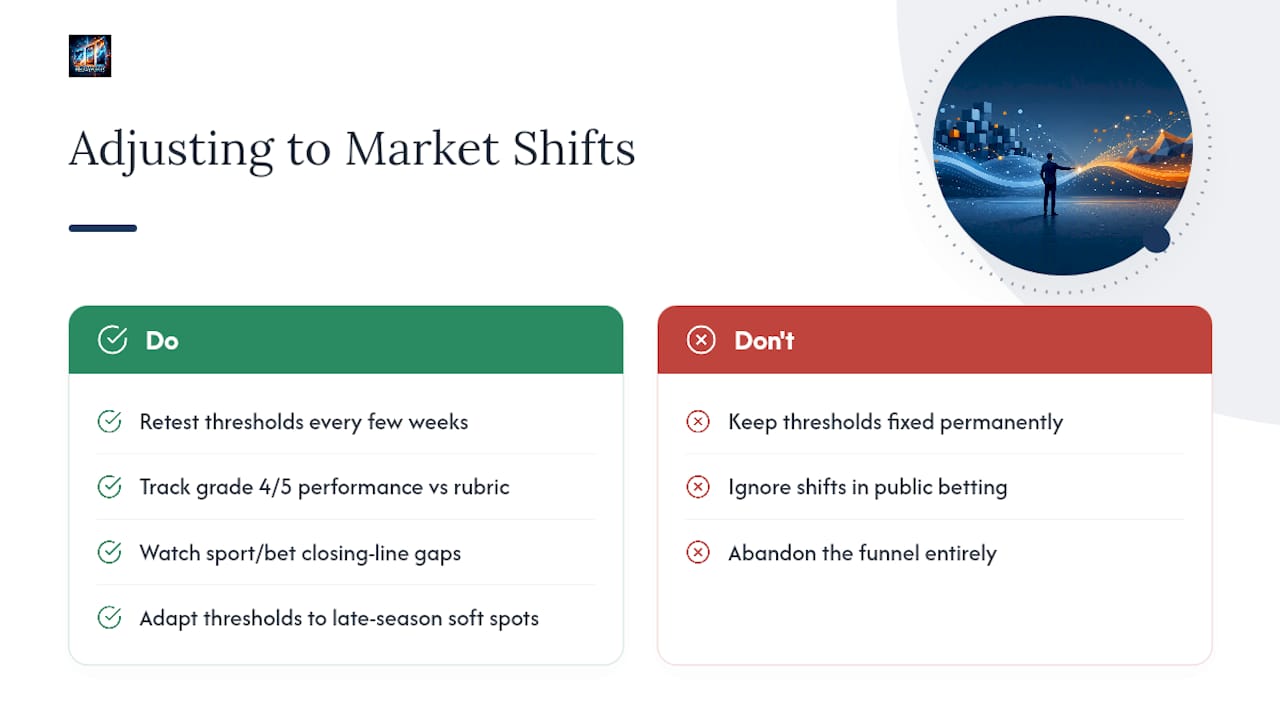
A daily picks strategy that never changes is a strategy that eventually gets picked apart by the market. Sportsbooks adjust their pricing models constantly, and the same filter thresholds that found value in September might find nothing in December once oddsmakers catch up to a trend everyone else already spotted.
Watch for a few signals that it's time to recalibrate. If your grade 4 and 5 picks start losing more often than the rubric implies they should, your value filter's threshold is probably too loose for the current market. If a specific sport or bet type keeps clearing your filters but underperforming against closing lines, that market has likely tightened and stopped rewarding whatever inefficiency you were exploiting. Public betting patterns shift by season too. Early-season markets tend to carry softer numbers because books have less data, while late-season lines sharpen as more information accumulates.
The fix isn't to abandon the funnel. It's to re-test your thresholds every few weeks against your own tracked results. If your minimum value gap was a full point in October, check whether that same threshold is still producing 4 and 5 grade picks in January, or whether it's quietly become a pipeline for 3s dressed up as 4s. Markets that were efficient a month ago can develop new soft spots too, often around late-season lineup changes, tanking storylines, or contest formats where public money floods in predictably. A strategy that adapts its thresholds to those shifts stays sharp. One that treats last season's rubric as permanent starts bleeding edge without anyone noticing until the tracker shows it.
How Do You Handle a Losing Streak Without Abandoning the System?
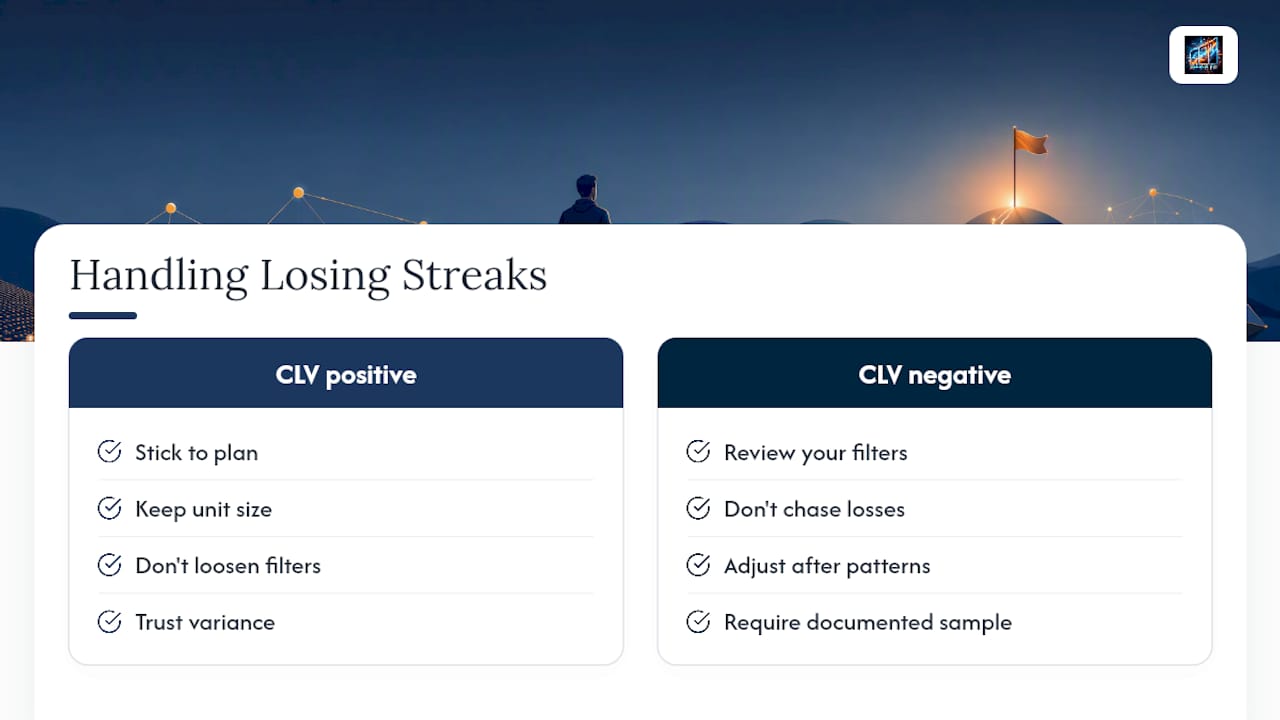
Losing streaks happen to every disciplined bettor, and the instinct to change your process mid-streak is usually the wrong instinct. A well-graded 4 or 5 pick can lose. That's not a flaw in your system, it's variance doing what variance does. The problem starts when a string of losses convinces you to loosen your filters, increase your stakes to recover faster, or start betting on games your funnel never would have flagged in the first place.
The tracker is your best defense against panic. If your closing line value stays positive through a losing stretch, that's a strong sign your process is fine and the results just haven't caught up yet. If your CLV turns negative alongside the losses, that's a different conversation, one about your filters, not your luck. Separating those two scenarios requires the discipline to actually check the numbers instead of trusting how the week felt.
Set a rule before a losing streak happens, not during one. Decide in advance that you won't change your unit size, your filter thresholds, or your daily pick count based on a bad week, and that you'll only adjust based on a documented pattern across a real sample. A single bad week tells you almost nothing. Weeks of negative CLV tell you something worth acting on. Keeping those two thresholds separate is what allows you to sit through a rough stretch without dismantling a system that was working.
What Makes a Game Worth Targeting for a Daily Pick?
Not every game on a slate deserves your attention, and picking the right games to even evaluate saves you time before you ever run the four-filter funnel. Start with games where you have genuine information advantage or model confidence, not just games that happen to be on television. A mid-week matchup between two teams you track closely often has more value than a marquee game the entire betting public has already priced efficiently.
Look for games with a clear catalyst. That could be a lineup change, a scheduling spot like a back-to-back or short rest, a weather factor in an outdoor sport, or a line that hasn't moved despite news that should have shifted it. Games without any of those catalysts tend to be efficiently priced already, which means your value filter is unlikely to find anything worth grading above a 3.
Correlation across the slate matters at the selection stage too, not just at the grading stage. If you're already leaning toward a game involving a certain team or player, be cautious about adding a second pick that depends on the same outcome. Spreading your attention across genuinely independent games, rather than stacking multiple angles on the same storyline, keeps your daily card diversified even before you start filtering. The games worth your time are the ones where your own research says something the closing line hasn't priced in yet.
Author Perspective: Discipline Over Frequency
Most bettors chase pick count because volume feels like progress. It isn't. A tight funnel that produces one graded pick a day and tracks positive CLV will outlast a habit of grinding out ten mediocre plays. Run the routine for 30 days, log everything honestly, and judge yourself by your closing line value, not by how busy your slate looked.
— Pete Korner
Put This Routine to Work With Megasports Arena
Running this funnel by hand in a notebook works, but it's slower than it needs to be, and slow is the enemy of a routine you're supposed to finish before lineups drop. This system runs on the principle that fewer, better-supported picks beat a flood of guesses, whether grading a bet or filling out a pick'em card.

The Betting Tools page gives you a place to set up the tracker this article walks through, logging odds, stakes, and outcomes in one spot instead of a scattered spreadsheet. If you want to test the grading and staking discipline on a lower-stakes format first, the Active Contests page has formats that mirror the same selectivity this routine rewards, letting you practice the funnel without your full bankroll on the line. Start with the Betting Tools page, set up a tracker for your next slate, and run the six-step system tomorrow morning.
Sources
- Best Daily Picks System: 6 Steps to Your Top 3 Bets 2026 — Sports Command
- ESPN — Sports betting coverage
- MLB Picks Today — The Expert Daily Selection Process
FAQ
What's the best strategy for daily fantasy?
Apply the same funnel used for sports betting: scan the full slate, filter for lineup certainty and value, and build a small, correlated-risk-aware lineup rather than spreading picks across every available option.
What is the best strategy for winning at PrizePicks-style games?
Confirm player lineups and injury status before locking any prop, and treat each leg with the same 1 to 5 confidence grading used for straight bets rather than picking based on name recognition.
What's the best bet of the day?
The best bet of the day is whichever pick clears all four filters (value, lineup, market agreement, correlation) with the highest grade, not necessarily the most popular or highest-profile game on the slate.
How do you win a multi-leg daily bet?
Keep the leg count to three or four on most slates, apply a preset confidence threshold to every leg before adding it, and skip the parlay entirely on days when fewer than two or three picks clear your grading system.
Does Megasports Arena help with tracking daily picks?
Yes. Megasports Arena's picks hubs let you log your daily card and review results over time, which supports the tracking and closing line value habits this routine depends on.