
Match your risk to your pool: play favorites in small office pools, go contrarian once entry counts climb into the hundreds or thousands. In confidence pools, stack your top points on one or two picks the field is getting wrong instead of spreading them evenly. In spread pools, check whether the line posted in your contest still matches the live market before you lock anything. Those three moves cover most of what separates the pool winner from everyone else guessing.
TL;DR:
- Playing contrarian picks is crucial in large pools with hundreds or thousands of entries because everyone tends to pick favorites, reducing the chance of winning with common choices.
- Tracking line movement against the posted spread helps identify valuable opportunities, especially when the line crosses key numbers like 3, 6, or 7, indicating market shifts.
- Concentrating confidence points on a few strong, differentiated picks yields better results than spreading points evenly across multiple games, especially in confidence pools.
- Adjusting strategies based on pool size and prize structure is essential, with small pools favoring favorites and large fields requiring unpredictable, contrarian plays.
- Consistently matching your risk approach to the contest type and rechecking spread lines before deadlines improve chances of outperforming the field.
Table of Contents
- What Are the Main Pick'em Formats and Which Tactics Matter for Each?
- How Do You Choose a Baseline Strategy by Pool Size and Prize Structure?
- How Should You Allocate Confidence Points to Maximize Separation?
- How Do You Find Stale-Line Value in Spread Pools?
- Should You Play Differently for Weekly Prizes Than Season-Long Prizes?
- How Do You Use Public Pick Popularity to Find Better Value?
- Where Can You Practice These Tactics Before Committing to a Real Pool?
- Why Does Risk Tolerance Wreck More Pick'em Cards Than Bad Information?
- What Mistakes Cost Pick'em Players the Most Value?
- What Do Successful Pick'em Runs Actually Look Like?
- Try a Megasports Arena Practice Pool to Test This Week's Strategy
- Three Things to Do This Week
- Sources
What Are the Main Pick'em Formats and Which Tactics Matter for Each?
Pick'em contests aren't one game with four names. They're four different math problems, and the winning move in one format can lose you the other three.
- Straight-up pools: pick the winner, no spread. Public pick percentage is your main lever, since everyone gravitates toward the same favorites and ties get decided by tiebreaker margin. Format-specific tactics change the entire approach, and straight-up pools punish anyone who treats them like a spread contest.
- Spread pools: pick against the number. Line movement between when your contest locked and today's market is the real edge, especially once a line crosses a key number like 3, 6, or 7.
- Confidence pools: rank every pick from most to least confident, with points assigned accordingly. Your top three or four rankings decide the week; everything else is noise management.
- Pick X pools: choose a fixed number of winners from the full slate, often against the spread. Scoring rewards volume of correct picks over any single high-value call, so differentiation matters less here than consistency.
How Do You Choose a Baseline Strategy by Pool Size and Prize Structure?
Pool size changes the math more than any single game does. In a 10 person office pool, the field is small enough that going with the chalk most weeks and staying error free beats getting cute with upset picks nobody asked for. Pool size and rules materially change what the best strategy looks like, and that holds whether the format is confidence, straight-up, or Pick X.
Once a contest opens to hundreds or thousands of entries, the calculus flips. Beating a field that large by picking the same favorites everyone else picks is nearly impossible, because ties for first go to whoever else also got everything right. You need separation, and separation only comes from picks the field isn't making.
- Under 20 entries: default to favorites, minimize variance, let attrition and bad luck eliminate rivals.
- 20 to 100 entries: mix in two or three calculated contrarian picks per week, especially on close spreads.
- 100+ entries: build your whole week around differentiation; safe picks alone will not separate you from a crowded leaderboard.
Prize structure matters as much as field size. A winner-take-all pool demands more risk than one that pays the top 10%, because a podium finish in a flat payout structure is worthless.
Pro Tip: Track where you sit in the standings starting around Week 12. If you're outside the payout range with six weeks left, that's your signal to start taking real chances instead of protecting a position you don't have.

How Should You Allocate Confidence Points to Maximize Separation?
Confidence pools reward concentration, not balance. Your top ranked pick, if scored on a standard 1 through 16 scale, is worth roughly six times more than your lowest ranked pick. That's not a minor edge. Most of a confidence pool's weekly points come from the top few ranked picks, which means getting your top three or four rankings right (and different from what everyone else is ranking highly) is worth more than getting the rest of the slate technically correct.
Two templates work well depending on the stakes:
- Season template: put your highest point values on the clearest favorites, week after week, and accept smaller separation in exchange for fewer disasters.
- Weekly contrarian template: concentrate your top two rankings on games where you have a genuine read the public doesn't, then spread the remaining points conservatively across low-risk games.
A low-popularity upset earns your top confidence slot when the win probability gap between the public's pick and your read is narrow but the reward for being right is large. That's a rare, once-or-twice-a-month situation, not a weekly habit.
How Do You Find Stale-Line Value in Spread Pools?
A stale line is a spread your contest is still using that no longer matches where the actual betting market has moved. Contests often lock lines days before kickoff, and injuries, weather, and sharp money can shift a number by a point and a half or more before Sunday. Stale-line value shows up reliably once a line crosses a key number, because outcomes cluster around 3, 6, and 7 more than any other margins in football.
- Check your contest's posted spread against the current live line every Thursday and again Saturday night.
- Flag any game where the gap is a full point or more, especially if it crosses 3 or 7.
- Ignore gaps under half a point. They rarely move the needle and burn time better spent on matchup research.
- Lock in games where the line hasn't moved first, then revisit volatile lines right before your contest's deadline.
Pro Tip: A half-point move rarely changes anything. A move that pushes a game from minus 2.5 to minus 3.5, though, jumps the favorite across the single most common margin in football and is worth acting on. For a deeper primer on how sharp money moves numbers, tracking line movement before your contest locks is worth the extra ten minutes.
Should You Play Differently for Weekly Prizes Than Season-Long Prizes?
Weekly and season-long contests reward opposite instincts, and playing them the same way is one of the more common ways people leave value on the table.
- Weekly prizes: a boom-or-bust approach usually wins, since you only need one great week and a single bad week costs nothing beyond that week's entry.
- Season-long prizes: consistency compounds. A conservative, low-error approach across 18 weeks tends to beat a volatile one, because variance evens out and the steady player simply accumulates fewer disasters.
- Endgame checklist: with five or six weeks left, calculate the win total you actually need, check how far back you sit, and only then decide whether to keep playing safe or start swinging for separation.
Early season weeks, especially Week 2, tend to carry outsized public overreaction to Week 1 results. Recency bias creates real leverage in Week 2, since the public overweights a single small sample and fades teams that looked bad in a game that meant very little.
How Do You Use Public Pick Popularity to Find Better Value?
Public pick data tells you where the field is crowding, and crowding is exactly what you're trying to avoid in large-field contests. Most pool tools and pick'em sites publish rough popularity percentages for each game, and data-driven tools that track public pick percentages, live win odds, and stale lines have been shown to improve prize outcomes over time compared with picking on gut feel alone.
- Fade any pick sitting above 70% public support unless your own read strongly agrees with it.
- Look for unpopular favorites in close games. A slight favorite that the public is splitting close to 50/50 is often worth backing at full confidence.
- Cross-reference popularity against matchup fundamentals. A contrarian pick with no underlying logic is just a coin flip; one backed by an actual read on the game is where the expected value edge actually lives.
The single biggest lever in any pick'em strategy isn't which team you like. It's how differentiated your card is relative to what the rest of your pool is doing.
Where Can You Practice These Tactics Before Committing to a Real Pool?
Reading about confidence allocation and stale lines only gets you so far. Running the numbers in a live scoring environment is where the strategy actually sticks. Megasports Arena's pick'em strategy guide breaks down pool-size and format decisions in more depth than a single article can, and it's a useful companion to the confidence templates above.
If your interest runs toward last-man-standing formats instead of weekly scoring, the survivor pool strategy playbook and the accompanying survivor pool rulebook cover how those contest rules change the calculus. A practical test: build a confidence allocation for an upcoming slate, run it in a low-stakes practice pool, then check the leaderboard against how a conservative allocation would have scored the same week. That side-by-side is the fastest way to see whether concentration actually paid off.
Why Does Risk Tolerance Wreck More Pick'em Cards Than Bad Information?
Most pick'em losses trace back to psychology, not a lack of football knowledge. Loss aversion pushes people toward the safe, popular pick even in large pools where safe picks guarantee you finish in the middle of the pack. That instinct feels smart in the moment and is often the exact reason a player never separates from the field.
Recency bias is the other repeat offender. A team that looked terrible in Week 1 gets overwhelmingly faded in Week 2, even when the underlying matchup favors them, because the memory of one bad performance overrides the actual point spread. The public falls for this every single season, which is precisely why fading a recent overreaction can be one of the more reliable contrarian plays available.
Confirmation bias shows up in a subtler way. Once you've picked a team, you start noticing every reason it will win and dismissing evidence against it. Writing down your reasoning before checking public pick percentages helps catch this, because you're forced to defend the pick on its merits rather than backfilling justification after the fact.
Overconfidence after a hot streak is the last major trap. Three or four good weeks in a row convinces a lot of players they've cracked the format, right before a five pick losing week resets the standings. Treat any hot streak as variance until proven otherwise, and keep applying the same allocation discipline regardless of how the last few weeks went.
What Mistakes Cost Pick'em Players the Most Value?
The single costliest mistake is playing every pool the same way regardless of size or format, treating a 12 person office pool identically to a 3,000 entry public contest. The tactics that win one lose the other.
Ignoring confidence point structure is close behind. Spreading points close to evenly across a 16 game slate wastes the entire mechanical advantage confidence scoring offers, since your best read on the week deserves your highest point value, not a number close to average.
Chasing last week's result is a habit that shows up constantly. A team that covered big last week gets overbet this week purely on momentum, even when the matchup and line have both shifted against repeating that performance.
Locking picks too early in spread pools throws away free equity. A line posted Wednesday can move meaningfully by Sunday, and locking every pick the moment the contest opens ignores information that arrives for free over the following days.
Finally, panicking late in a season-long standings race and abandoning a working conservative approach with three weeks left, right when the sample size of "working" finally means something, undoes months of disciplined play in a single week of forced risk.
What Do Successful Pick'em Runs Actually Look Like?
A conservative-template player in a 15 person office pool who defaults to favorites and avoids confidence point spreading typically wins on consistency: fewer than five missed picks across an 18 week season, with confidence points concentrated on the clearest lines each week, is usually enough to hold a top spot without ever hitting a spectacular week.
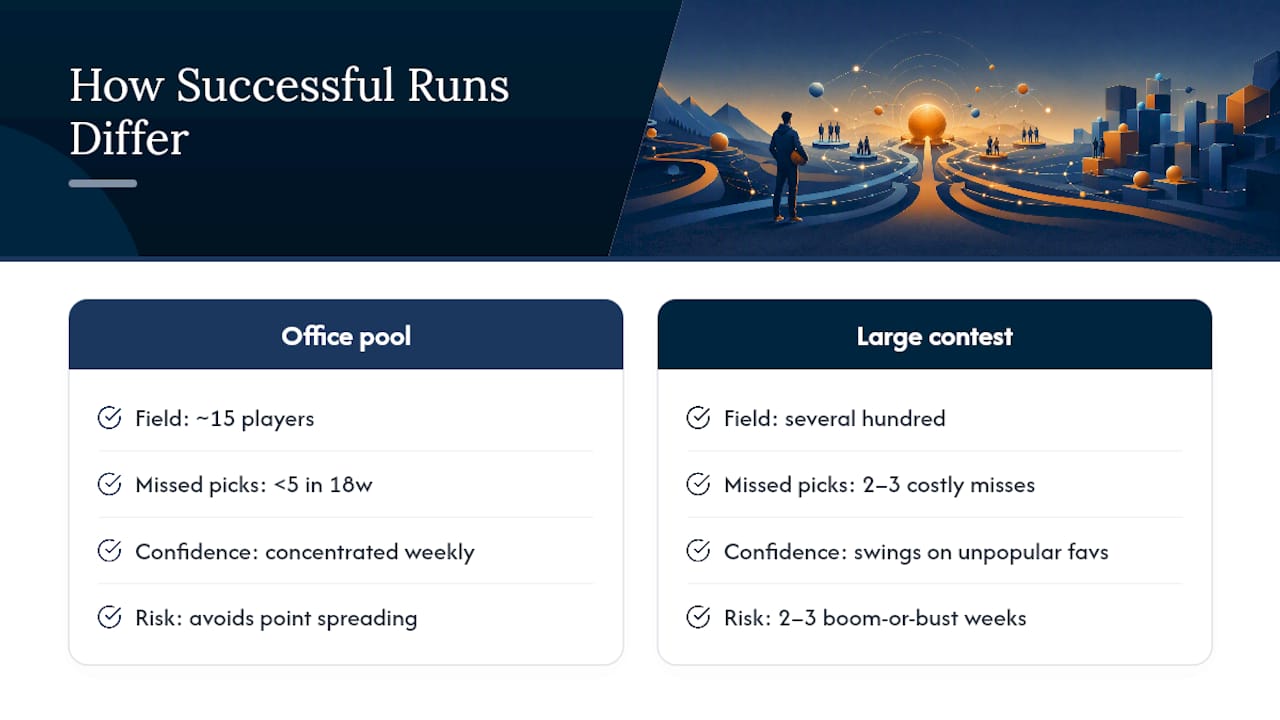
Contrast that with a large public contest of several hundred entries. There, a genuinely winning approach usually includes at least two or three weeks where the player took a confidence point swing on an unpopular favorite in a close spot, missed on one of them, and still finished ahead of the field because the hits carried more separation value than the misses cost. That's the boom-or-bust math working exactly as intended in a format where standing still guarantees a mid-pack finish.
The common thread across both cases isn't talent evaluation. It's that the strategy matched the format and field size from Week 1, rather than getting adjusted reactively after a few bad weeks exposed the mismatch.
Try a Megasports Arena Practice Pool to Test This Week's Strategy
Reading about confidence allocation is one thing. Running it against a live slate, with a leaderboard that actually shows whether concentration beat balance, is what turns theory into a repeatable habit.

Megasports Arena gives you a free space to test exactly that, without any entry fee riding on a card you're still calibrating. Build a confidence allocation, submit it through Play, and check the leaderboard after the week closes to see how your differentiated picks actually scored against the field. If the rules of a specific format aren't clear yet, the how-to-play breakdown covers scoring mechanics before you commit a single pick. Run this week's slate through a practice pool now, compare your allocation against the leaderboard once games finish, and carry whatever you learn straight into your paid pool next week.
Three Things to Do This Week
Match your risk to your pool size before you touch a single pick. Then check public popularity on your top confidence picks and confirm your contest's spreads haven't gone stale against the live market.
Here's the checklist, in order: rank your pool size and pick a baseline (favorites or contrarian), concentrate confidence points on one or two differentiated reads rather than spreading them evenly, and recheck any spread that's more than a point off the current market before your deadline hits.
None of this works if you apply the same card to every pool you're in. A confidence pool and a straight-up pool with the same field size still call for different picks, because the scoring rewards different behavior entirely.
— peter
Sources
Gut instinct and watching highlights will get you roughly average results. The players who consistently finish near the top of large pools are pulling from a specific, repeatable set of inputs.
Public pick percentages come first, since knowing where the field is crowding is the entire basis for contrarian value. Live win probability and updated spreads come next. Odds and schedule data used across the industry ultimately trace back to feeds from providers like Gracenote, which supply the win probability and matchup data that power most consumer-facing pick tools.
Injury reports matter more in pick'em than casual fans assume, since a single downgraded starting quarterback can move a line a point and a half or more within 48 hours. Weather data matters specifically for point totals and passing volume in outdoor, cold-weather games late in the season.
Beyond raw data, a basic grasp of expected value calculation separates disciplined players from lucky ones. Understanding how to convert a spread differential into an approximate win-probability edge turns a vague hunch about "value" into an actual number you can compare across games, which is what lets you rank differentiation opportunities instead of just guessing which upset feels right.
- NFL pick'em pool strategy: Four things you need to know (Sporting News)
- NFL Pool Strategy 2025: How to Gain an Edge in Survivor and Pick’em Pools | FantasyLabs
- Football Pick'em Pool Picks 2026 - PoolGenius - Team Rankings