
Survivor pool rules boil down to this: pick one NFL team to win outright each week, never reuse a team, and a loss (usually a tie, too) eliminates your entry. Pools typically run from Week 1 through Week 18, with the last person standing winning the pot or splitting it among co-survivors. Before anyone submits a pick, the rules need to nail down three things: the weekly deadline, the tie policy, and the entry fee and payout split.
- One pick per week, straight-up, no point spread
- Each team usable only once per entry, all season
- A loss (and typically a tie) means elimination
Key Takeaways
A survivor pool works only when the tie policy, pick deadline, and payout structure are written down before Week 1 starts.
| Point | Details |
|---|---|
| Core rule | Pick one team per week to win outright; each team is usable only once per entry. |
| Tie policy | Confirm whether a tie eliminates the entry or just burns the team, since defaults vary by pool. |
| Deadline discipline | Lock picks before the first kickoff of the week to prevent late-pick disputes. |
| Everyone-loses plan | Decide in advance between splitting the pot, using an aggregate-margin tiebreaker, or continuing play. |
| Hosting option | Megasports Arena automates grading, standings, and pick tracking for commissioners running a survivor contest. |
Table of Contents
- What Are the Standard Survivor Pool Rules?
- What Rule Variations Do Hosts Use?
- How Do Weekly Deadlines and Ties Work?
- How Do Entry Fees and Payouts Work?
- How Do You Run a Survivor Pool as Commissioner?
- What Strategy Helps You Survive Longer?
- What Happens When Everyone Loses in the Same Week?
- What Sample Rule Sets Can You Copy?
- Why Clear Rules Matter Before Kickoff
- Host Your Survivor Pool Without the Spreadsheet Headaches
- Where to Read More on Survivor Pool Rules
- Frequently Asked Questions
- Sources
What Are the Standard Survivor Pool Rules?
Every credible NFL survivor pool operates on the same skeleton, even when the details shift from group to group. The picks are straight-up winners, not against the spread, which is what separates survivor pool strategies from a typical pick'em contest built around spreads and totals.
- Pick mechanics. You select one team to win outright each week. No spread, no total, just a winner. Each person runs their own entry unless the pool explicitly allows multiple entries per player.
- Team usage limit. Once you pick the Chiefs in Week 3, the Chiefs are gone for the rest of the season on that entry. Multi-entry players effectively get separate "banks" of teams, one per entry.
- Elimination trigger. A losing pick eliminates the entry immediately, and most house rules count a tie the same way. That last point trips up more people than anything else in the sport.
- Season window. Standard pools run through the regular NFL season weeks, though some hosts extend into the playoffs if enough entries survive.
Here's how team usage plays out in practice. Say you pick the Bills in Week 1, the 49ers in Week 2, and the Eagles in Week 3. All three teams are now locked out of future weeks on that entry, forcing you to plan around your remaining schedule instead of just chasing that week's best matchup.
- Week 1: Bills (win) → Bills locked for rest of season
- Week 2: 49ers (win) → 49ers locked for rest of season
- Week 3: Eagles (loss) → entry eliminated
What Rule Variations Do Hosts Use?
Standard rules work fine for a straightforward pool, but plenty of commissioners tweak the format to fit their group's size and appetite for risk.
- Mulligans/buybacks. Players who lose can pay a fee to re-enter, often capped at one or two buybacks and only available through a set week (commonly Week 4 or 5).
- Strike formats. Instead of single elimination, players get two or three losses before they're out. This keeps larger pools alive longer and usually means bigger prize pools survive to the playoffs.
- Double-pick weeks. Some pools require multiple winning picks in a single week, often during holiday periods or late in the season, adding difficulty right when team options are thinnest.
- Alternate formats. Against-the-spread survivor variants and "eliminator" or losers pools (where picking the loser wins) exist as sibling formats to the classic straight-up survivor.
Pro Tip: Strike formats work best for large office pools where you want engagement to last into December. For a tight group of 10 friends, stick with single elimination. It's cleaner and the ending actually means something.
How Do Weekly Deadlines and Ties Work?
Most disputes in survivor pools trace back to logistics, not strategy. Get these rules in writing before Week 1 and half your headaches disappear.
Pick deadlines are commonly set for kickoff of the first game in that week's slate, though some platforms allow deadlines up to individual game time for each specific matchup. State which one your pool uses. Missing picks need a defined outcome too: some pools auto-assign a default team, others eliminate you outright for a no-pick. Postponed or canceled games are rarer but not rare enough to ignore; decide in advance whether that pick grades as a loss or simply carries to the following week.
Tie handling deserves its own line in your rules. The two dominant approaches: tie counts as a loss (most common), or the entry survives but the tied team is still burned for the season. Neither is wrong, but leaving it unstated is where trust breaks down.
- Deadline: before kickoff of the first game in the weekly slate
- Missing pick: auto-pick, elimination, or grace period, choose one
- Postponed game: grades as loss, or the pick carries forward
- Tie: counts as loss, or survives with team burned
- Predefine: holiday slates, flexed games, international games
| Point | Details |
|---|---|
| Deadline clarity | State whether picks lock at the first game or each individual kickoff. |
| Tie policy | Confirm upfront if a tie eliminates or just burns the team. |
| Postponed games | Decide if a canceled game counts as a loss or rolls to next week. |
How Do Entry Fees and Payouts Work?
Registration typically opens before the season begins and closes near the season opener. Fees vary widely depending on the pool, from free play to paid buy-ins with various structures.
- Registration: opens pre-season, closes at or near Week 1 kickoff
- Fee structure: free, flat fee, or tiered entry options
- Payout: single winner takes all, or a split among co-survivors if the pool runs out of games
- Sample split: a 50-entry pool at $20 each ($1,000 pot) might pay 70% to the winner and 30% to a runner-up, or split evenly among final survivors
- Document upfront: refund policy, no-show handling, and how buyback money gets folded into the total pot
Whatever structure you pick, write it down before anyone pays. Verbal agreements about prize splits and payout structures are the fastest way to turn a fun contest into an awkward group chat in Week 12.
How Do You Run a Survivor Pool as Commissioner?
Running a clean pool comes down to deciding everything in advance and communicating it the same way, every week, without exception.
Commissioner checklist before Week 1:
- Pick deadline (exact time, exact reference point)
- Tie policy (loss or survive-with-team-burned)
- Buyback rules (allowed, cost, deadline)
- Multi-entry policy (allowed per person, and at what cost)
- Tiebreaker method for co-survivors
- Payout schedule and timing
- Dispute resolution process, in writing
- How and when standings get posted
- Choose your hosting method: a manual spreadsheet, a group chat, or a platform built for it.
- Set registration open and close dates, and collect fees before Week 1 kicks off.
- Publish the full rule set somewhere permanent, not buried in a text thread.
- Post picks and results weekly, on the same day and time, without fail.
- Handle disputes fast using the process you already wrote down.
A platform with auto-pick tracking and grading removes most of the manual error that sinks spreadsheet-run pools, especially the missed deadline that eliminates someone who simply forgot. If you're building this from scratch instead of using a hosted tool, look at how custom sports contests get structured so you're not reinventing the wheel.
What Strategy Helps You Survive Longer?
Survivor pools reward patience over cleverness. Treat the season as one long planning problem, not 18 separate weekly guesses, because the strategic value is conserving strong teams for matchups later in the year when your options thin out.
- Build a season grid mapping which teams you're saving for which weeks
- Watch for bye weeks, since they remove options exactly when you might need them
- Track home/away stretches, since road-heavy schedules make some contenders riskier than they look
- In small pools, a safer contrarian pick can beat the popular chalk pick if it protects your long-term team bank
Most players make the same mistake: burning a dominant team in Week 3 against a bad opponent instead of saving it for a tougher week later. By Week 14, that same team might be your only realistic option left.
Pro Tip: Map your remaining schedule four weeks ahead every time you make a pick. If a top team has two great matchups coming up, save the safer one for the tougher week and use a lesser team now.

What Happens When Everyone Loses in the Same Week?
Every survivor pool eventually faces a week where every remaining entry loses. Decide the outcome before it happens, not during the argument that follows.
- Split the pot. All players eliminated that week share the prize evenly. Simple, fair, and the most common choice.
- Aggregate margin tiebreaker. Rank eliminated players by how close their loss was (or combined score differential across the season) and pay based on that order.
- Continue play. Bring everyone back for one more week and keep going until a single winner emerges.
A 10-person pool where everyone loses in Week 15 might simply split the remaining pot ten ways, or rank by closest margin of defeat if the rules called for it. Either works. Just write it down first.
What Sample Rule Sets Can You Copy?
Simple (friends/office pool): One entry per person, one team per week, no repeats. Ties count as losses. Picks lock at kickoff of the first Sunday game. Last one standing wins the pot.
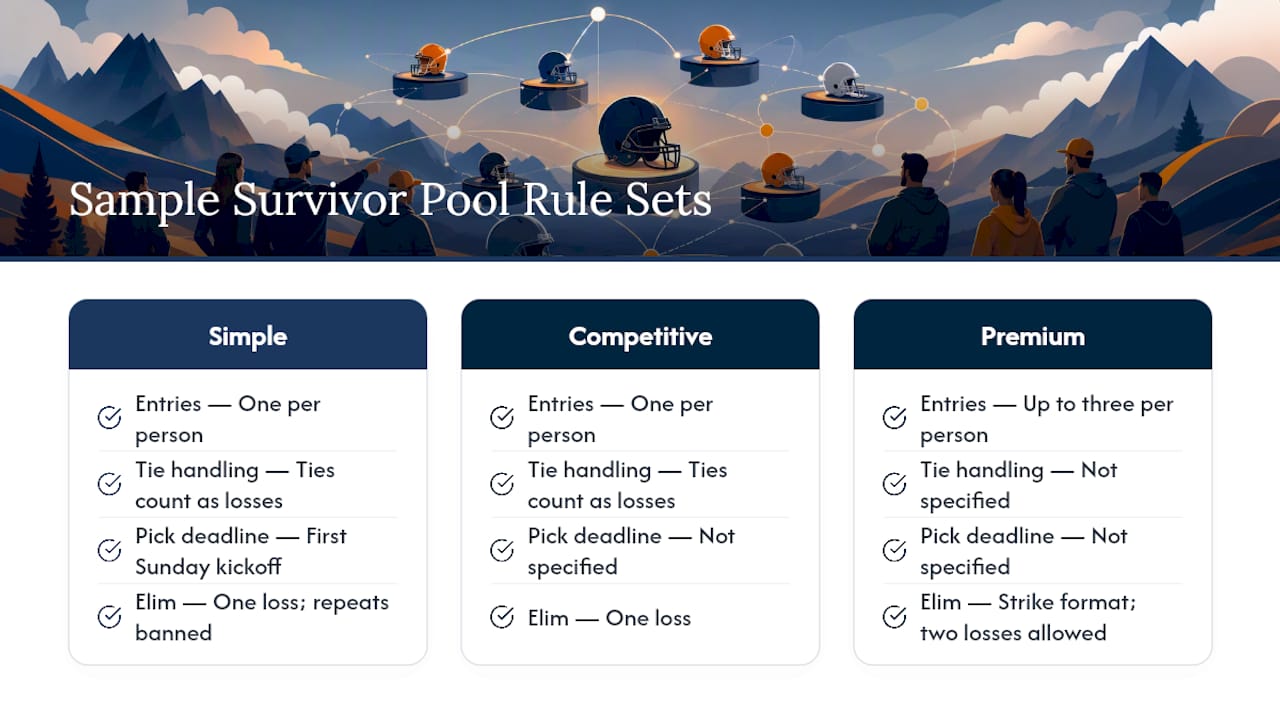
Competitive: Adds a one-time buyback through Week 5 ($20 fee, folded into the pot), ties as losses, and an aggregate-margin tiebreaker if multiple survivors remain after Week 18.
Premium: Multi-entry allowed (up to three per person), a strike format allowing two losses before elimination, double-pick required in Week 18, and a documented dispute process with a 48-hour resolution window.
Adjust any template for holiday slates or playoff extensions, but state the change in writing before the affected week begins.
Why Clear Rules Matter Before Kickoff
Publishing rules before Week 1, not after a dispute, is the difference between a pool people trust and one they quit. Automated grading and standings, the kind Megasports Arena's platform handles by default, remove the guesswork that causes most arguments.
Host Your Survivor Pool Without the Spreadsheet Headaches
Megasports-arena replaces the shared spreadsheet and group-chat chaos with a hosted survivor contest that grades picks automatically and posts standings the moment games end. No more chasing down who forgot to submit a pick or arguing about whether a tie counted.

Commissioners get customizable rule templates, automatic elimination tracking, and built-in tiebreaker handling, so the questions this article just walked through get answered by the platform instead of by you in a group chat. Players get a clean picks hub and live leaderboard instead of a text thread nobody can follow. Setup takes minutes, there's no manual grading, and prize tracking runs itself.
Ready to see it in action? Check out Megasports Arena's active contests to join a survivor-style pool already running, or start your own using the platform's pick tracking tools before your next Week 1 kicks off.
Where to Read More on Survivor Pool Rules
- PoolGenius's survivor pool guide covers formats and strategy in depth
- Survivor Pool Guide's FAQ answers common tie and tiebreaker questions
- BettingUSA's rules breakdown explains platform-by-platform deadline differences
- Splash Sports's official contest rules show how a licensed platform documents grading and eligibility
Frequently Asked Questions
What are the basic survivor pool rules? Pick one NFL team each week to win outright, never reuse a team, and a loss eliminates your entry. Most pools also eliminate on a tie.
What is a survivor pool exactly? It's a season-long elimination contest where every player picks one winning team weekly until only one entry (or a small group) remains.
Does a tie eliminate you in a survivor pool? In most pools, yes. Some hosts allow the entry to survive while still burning the tied team, so always confirm the specific rule before the season starts.
Can everyone lose in the same week? Yes. Standard resolutions include splitting the pot among those eliminated, ranking by aggregate margin of defeat, or continuing play for another week.
What happens if I miss a weekly pick? It depends on the pool. Some assign a default team automatically, others eliminate you for a missed deadline. Confirm this before joining.
Can you use the same team twice in a survivor pool? No. Each team can only be picked once per entry for the entire season, which is the core constraint that makes late-season picks difficult.
Sources
- How NFL Survivor Pools Work: Rules, Formats & Key Tips
- Survivor Pool FAQ (2026): Every Rule & Strategy Question Answered
- NFL Survivor Pools: How They Work, Rules & Where To Play
- Splash Sports NFL Survivor & Pick'Em Contest Rules