
An expected-value (EV) pick is any draft choice whose upside-adjusted odds of beating its average draft position cost produce a positive return. Practically: compare your own projection for a player against their consensus ADP, flag anyone your numbers like more than the market does, and draft those gaps before the room catches on.
TL;DR:
- Players with an expected value greater than their ADP by at least 10 to 15 points present the best chances for a profitable draft pick.
- Use multiple sources of projections, recent ADP data, and sportsbook lines to ensure your value assessments reflect the most current market conditions.
- Focus on value-oriented picks from rounds 4 to 7, targeting players with underpriced potential in committee backfields or unproven pass catchers.
- Manage risk by limiting your total number of upside darts and diversifying across different team situations to reduce the impact of variance.
- Practice identifying and testing your EV-based picks through free mock contests and track your success to refine your draft strategy over time.
Table of Contents
- Calculating Expected Value for a Fantasy Draft Pick
- Where to Find Reliable Data for Value Picks
- Draft Tactics for Finding +EV and Sleeper Picks
- Managing Risk: Variance and Sizing Your Upside Bets
- A Worked Example: One Draft Pick, Step by Step
- Author Perspective: Three Rules That Actually Hold Up
- Practice Finding Value Picks Before Draft Day
- Sources
- FAQ
Calculating Expected Value for a Fantasy Draft Pick
The core expected value formula used in prop betting and pick'em contests translates directly to fantasy drafting: EV equals (probability of an outcome multiplied by its payoff) minus what it costs you. In DFS pick'em math, a 2-pick entry at 3x payout with each leg carrying a strong win probability nets positive expected value per dollar risked. Swap "payout" for "fantasy points above replacement" and "cost" for "draft capital spent," and you have a workable model for any pick.
Here's how to adapt it round by round:
- Set your baseline. Pull the consensus projection for the players going around a given ADP slot. That average is your cost basis, what you're "paying" in draft capital.
- Estimate your own probability-weighted outcome. Instead of a single projection, weight a range of outcomes. A running back with three different plausible touch scenarios needs three projections blended by likelihood, not one guess.
- Subtract baseline from your weighted projection. A positive gap is a +EV pick. A player projected at 14 points per game against a baseline of 11 for that ADP slot is a clear value.
- Adjust for format. Points-per-reception leagues, superflex, and best-ball entries all shift the payoff side of the equation, so the same player can be +EV in one format and dead even in another.
For a live-draft shortcut, skip the spreadsheet. Take the midpoint of two or three trusted ADP sources, compare it to your gut-check projection, and if the gap exceeds half a round, you've likely found value worth acting on before the pick comes back around.
Where to Find Reliable Data for Value Picks
Good inputs beat clever math every time. You can build the world's most elegant EV formula and it still fails if the projections feeding it are stale or the ADP sample is too thin to mean anything.
Start with these sources:
- Projection aggregators that blend multiple analysts rather than a single source, which smooths out individual bias.
- ADP trackers updated within the last week of your draft, since early-summer ADP drifts hard once beat reporters start talking about camp battles.
- Sportsbook player-prop lines, converted to no-vig probabilities, for players where fantasy-specific projections feel thin. No-vig sportsbook numbers track actual outcomes within roughly 2 to 3 percentage points across large samples. This makes them a solid proxy for true probability once the bookmaker's built-in margin is stripped out.
- Snap counts and target share reports from the prior two to three weeks, which update faster than most projection systems.
Pro Tip: When a sportsbook prop and your projection system disagree by a wide margin on the same player, trust the sportsbook line for volume-driven stats like receptions and carries. Books have more real money forcing their lines toward accuracy than any free projection tool does.
For role auditing, a five-minute heuristic works: check snap percentage, red zone opportunity share, and whether a starting job is uncontested. Three green lights on all three usually means the market hasn't fully priced the player yet.
Draft Tactics for Finding +EV and Sleeper Picks
Hunting value isn't the same job in round two as it is in round fourteen. Early picks reward floor and certainty. Late picks reward variance, because a bust at pick 150 costs you nothing you'll miss.
Here's a round-by-round framework:
- Rounds 1 to 3: Prioritize proven volume over upside. The downside of a bust here is too costly to justify a speculative swing.
- Rounds 4 to 7: Start scanning for ADP-projection gaps. This is the range where committee backfields and unproven third-year receivers get systematically underpriced by drafters anchored to last year's stats.
- Rounds 8 to 12: Target specific sleeper profiles: a running back in a timeshare who profiles as the clear passing-down back if the starter falters, a rookie receiver whose summer buzz hasn't reached casual drafters, or a veteran returning from injury whose ADP hasn't recovered even though his role has.
- Rounds 13 and later: This is pure dart-throwing territory. Handcuffs to workhorse backs and rookie tight ends in crowded depth charts belong here, not earlier.
Watch for the traps, too. A cheap ADP is only a bargain if the underlying reason for the discount is fixable or temporary, not structural. A receiver dropping in ADP because of a genuinely crowded target tree, not just name recognition, is a value trap disguised as an opportunity. Cross-check any apparent bargain against snap share before you commit a pick to it.
Managing Risk: Variance and Sizing Your Upside Bets
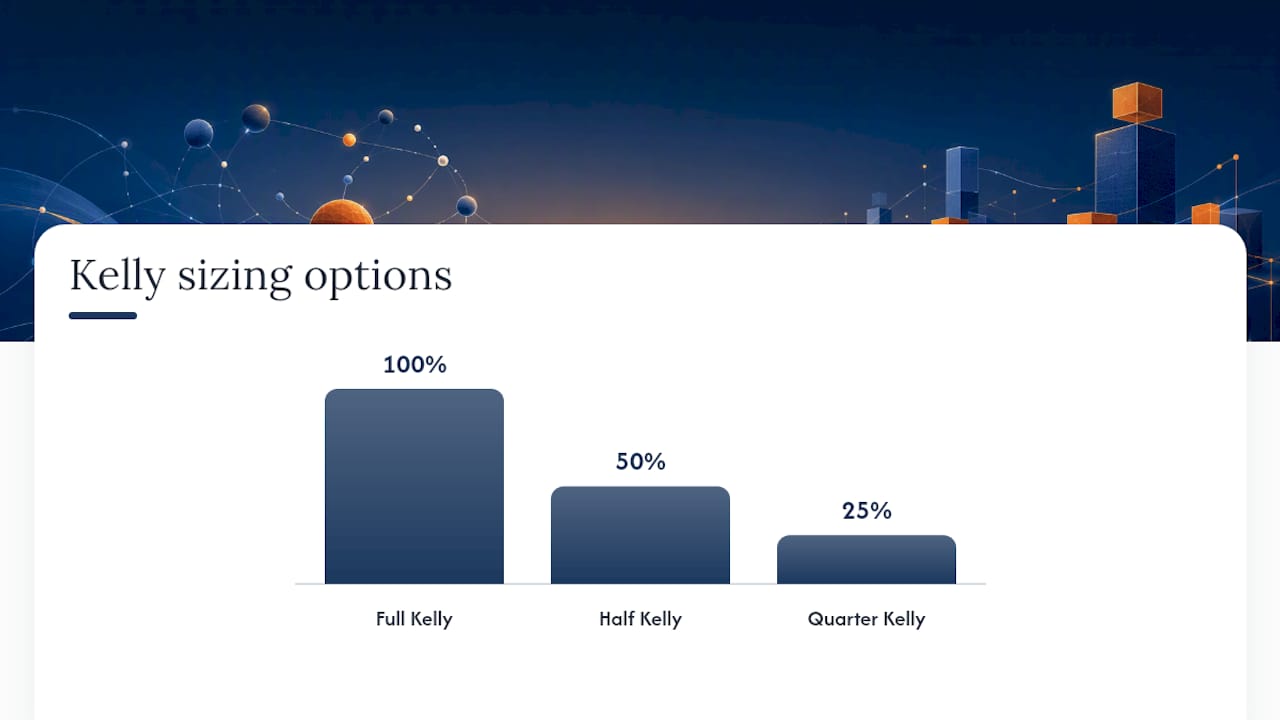
Even a well-identified +EV pick loses more often than you'd expect over a single season, because one fantasy season is a tiny sample. A player who's genuinely a 55% probability to outperform his ADP will still disappoint you close to half the time. That's not a broken model. That's variance doing exactly what variance does.
Professional bettors manage this with fractional Kelly, sizing bets at half or a quarter of what full Kelly criterion math suggests reducing drawdown risk when true probabilities are uncertain. Translate that to draft strategy:
- Cap your roster at three or four genuine "upside darts," not eight or nine, so one bad slate of variance doesn't wreck your whole team.
- Diversify those darts across different backfields, offenses, and injury situations rather than stacking correlated bets on one crowded depth chart.
- Track your picks after the season and revisit which types of gaps actually paid off, so next year's projections start from a sharper baseline.
Fractional Kelly sizing exists specifically because full-Kelly betting on uncertain edges produces brutal swings even when the underlying edge is real.
A Worked Example: One Draft Pick, Step by Step
Take a hypothetical wide receiver going at pick 95 (round 8) in a 12-team league, with a consensus projection of 145 points for the season. Your own model, weighting a likely target-share bump from an injured teammate, projects him at 172 points.
- Baseline for pick 95: other receivers going in that range project around 148 points.
- Your projection: 172 points, a 24-point edge over baseline.
- EV read: a 24-point gap at that draft slot is a clear +EV signal, well above the 10 to 15-point threshold that usually separates noise from a real edge.
- Decision: take him now rather than waiting, since a 24-point gap this size rarely survives two more rounds once other drafters notice the same target-share change.
Author Perspective: Three Rules That Actually Hold Up
Be conservative with how many upside swings you take. Cross-check every projection against at least one other source before trusting it. Practice spotting gaps in mock drafts before it counts. Keep a simple log of which +EV calls hit and which missed. That log, not any formula, is what sharpens your edge next season.
— peter
Practice Finding Value Picks Before Draft Day
Reading about EV math is one thing. Testing it against real player pools, without burning a real draft slot on a guess, is another. There are free spaces online for fantasy players to run that worked example through its paces before it counts.

The Game Room hosts free mock contests where you can apply the ADP-gap scanning method from this guide against live player pools, no entry cost attached. Track how your calls perform over time through the My Picks Hub, which keeps a running record of your picks so you can see which sleeper profiles actually paid off. Pair that with interactive betting tools and prediction games across NFL, NBA, NHL, and MLB to stress-test your projections against different formats before committing real draft capital. Start a free mock contest online this week and run your worked example against this year's ADP before your league's draft locks in.
Sources
The math and staking guidance above draw on the pick'em EV framework from Odds Reference, the Kelly criterion for fractional staking, BettingPros' market EV tool for spotting mispriced markets, and ESPN's fantasy cheat sheet format for how ADP-based sleeper lists are typically structured. For a per-leg break-even calculator, see SkegBets' pick'em EV tool.
- Pick'em Expected Value: How to Calculate Edge on Player Props | Odds Reference
- Kelly criterion − Wikipedia
FAQ
What Are the Best Value Fantasy Picks Right Now?
The best value picks shift weekly as ADP moves and injury news breaks, but the method stays constant: find players whose weighted projection beats the baseline production at their current draft slot by a meaningful margin.
How Do I Calculate an Expected Value?
Multiply the probability of an outcome by its payoff, then subtract the cost, using the formula (probability × payoff) − cost adapted to points above replacement instead of cash payouts.
Who Should I Pick in Fantasy Football in 2026?
Rather than a fixed name, prioritize players where your own projection diverges meaningfully from consensus ADP, particularly committee backs poised for a larger role and receivers whose target share is trending up faster than their draft price reflects.
Who Should I Pick in Late Rounds of a Fantasy Draft?
Late rounds reward variance over safety: target committee running backs one injury away from a workhorse role, rookie pass catchers with rising camp buzz, and veterans returning from injury whose ADP hasn't caught up to their restored role.