
Free-to-play games are legal across the United States in the vast majority of cases, but that status is conditional, not automatic. A game crosses into illegal gambling territory when it combines three specific elements: payment, chance, and a prize with real value. Beyond gambling law, operators and players also face separate risks from consumer-protection statutes, unauthorized in-app charges, and copyright rules governing downloads. The safest answer depends on your state and the exact mechanics of the game in question.
Table of Contents
- Free to Play Legality Starts With a Three-Part Gambling Test
- State Differences and the Court Cases That Shape Outcomes
- Sweepstakes Models and the Two-Coin Workaround
- Consumer Protection Risks Beyond Gambling Law
- When a Free Download Crosses Into Copyright Infringement
- A Compliance Checklist for Operators and a Safety Checklist for Players
- A Publisher's View on Responsible Design
- How Megasports Arena Supports Compliance-Minded Play
- Sources
- FAQ
Free to Play Legality Starts With a Three-Part Gambling Test
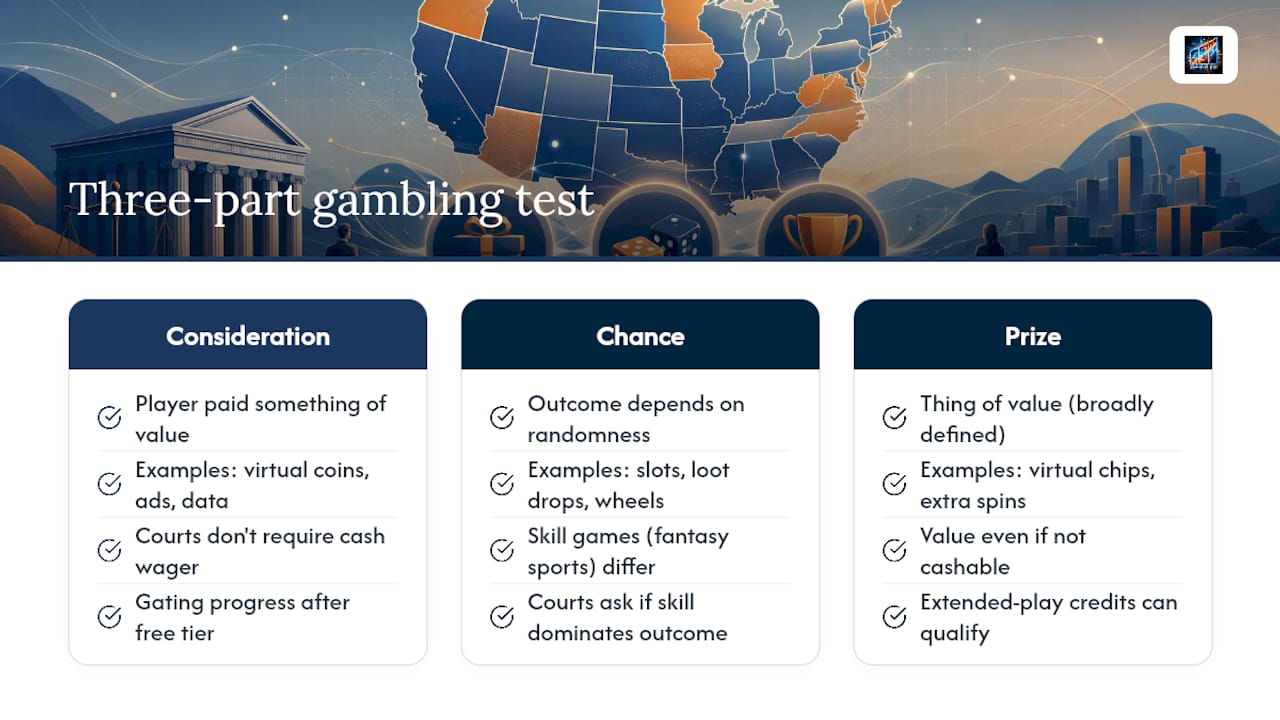
Every state uses some version of the same legal framework to decide whether a game is gambling or entertainment. The test has three parts: consideration, chance, and prize. If a court or regulator finds all three present in a game's design, that game can be classified as illegal gambling regardless of what the marketing copy calls it. This structure comes up in law-review analysis of free-to-play monetization, and it's the backbone of almost every dispute in this space.
Consideration means the player paid something of value to participate. It sounds simple until you look at how litigation actually plays out. Courts don't require a direct cash wager to find consideration. In several cases, plaintiffs have argued that buying virtual coins, watching a required ad, or even providing personal data in exchange for extra plays counts as consideration. A useful example is Soto v. Sky Union, where the core dispute turned on whether limited free-play allocations were generous enough to avoid the appearance that purchases were effectively required to keep playing. When a game gates meaningful progress behind a paywall after a token free tier, plaintiffs have a real argument that the "free" label doesn't match the mechanics.
Chance is usually the easiest element to prove or disprove. Slot-style mechanics, randomized loot drops, and spinning wheels are chance-based by design. Skill-based games like fantasy sports contests or prediction pools lean the other way, since outcomes depend on the player's knowledge and decisions rather than a random number generator. Courts generally look at whether skill is the dominant factor in the outcome, not merely a supporting one. This is why prediction-style games structured around real analysis, similar to the sports prediction formats built around statistical picks, sit on firmer legal ground than pure chance mechanics.
Prize is where free-to-play operators run into the most trouble, because the definition of "thing of value" has expanded well past cash payouts. Virtual chips, extra spins, or in-game currency that lets a player keep playing longer have been treated by courts as a prize with real value, even when that currency can't be cashed out. One recurring line of cases, often described as Kater-style litigation, found that virtual chips functioning as extended play credits can qualify as a thing of value under state law, exposing operators to gambling claims and, in some instances, significant settlements, according to legal commentary on pay-to-play game classification. The logic is straightforward from a court's perspective: if the currency lets you keep playing when you'd otherwise be locked out, it has value, whether or not you can sell it.
State Differences and the Court Cases That Shape Outcomes
Gambling law in the U.S. is a state-by-state patchwork, and that patchwork is the single biggest source of confusion for both players and small operators. There is no federal gambling statute that cleanly resolves whether a specific free-to-play mechanic is legal nationwide. Each state defines "lottery," "thing of value," and "gambling device" differently, and those definitions decide the outcome far more often than the game's own marketing language.
Washington State has taken one of the strictest positions in the country. The Washington State Gambling Commission's guidance on virtual casinos treats virtual chips that extend gameplay as a thing of value, a stance that has driven multiple social-casino operators to block Washington residents entirely rather than risk enforcement. Other states apply a looser standard, focusing more narrowly on whether currency can be redeemed for cash or merchandise, which gives social-casino apps more breathing room outside Washington's borders.
Statutory language matters as much as case outcomes. Some states define a lottery broadly enough to capture any scheme involving payment, chance, and a prize of any value, no matter how small. Others require the prize to have a market value above a certain threshold, or require a more direct cash-out mechanism before a game counts as a "gambling device." A mechanic that survives scrutiny in Nevada might not survive it in Washington, and a mechanic accepted in most of the country could still draw a cease-and-desist letter from a single aggressive state attorney general.
The practical takeaway for anyone building or operating a free-to-play title: legal exposure has to be mapped by user geography, not treated as a single national question. A game that's clearly entertainment in 45 states can still be a liability magnet in the handful that read "thing of value" expansively. That's why serious operators geofence certain mechanics or restrict specific states rather than assuming one national terms-of-service page covers them everywhere.
Sweepstakes Models and the Two-Coin Workaround
Social casino apps popularized a structure often called the two-coin or sweep-coin model, and it's worth understanding exactly how it's supposed to work, because the theory behind it is cleverer than most players realize. Players get two types of virtual currency: gold coins that can be purchased and used only for entertainment play with no prize value, and sweep coins that are given away for free (often as a bonus with a gold coin purchase, or through free daily claims) and can eventually be redeemed for cash prizes. The legal theory is that sweep coins function like a sweepstakes entry rather than a wager, since players can obtain them without paying, which is supposed to eliminate the "consideration" element of the gambling test entirely.

That theory holds up only when the free path to sweep coins is genuinely accessible and not just a token gesture buried behind a hard-to-find link. Litigation and regulatory attention have targeted operators whose free-entry paths were so limited or so poorly disclosed that they functioned as a formality rather than a real alternative. Once a court concludes the "free" option is illusory, the entire sweepstakes defense collapses, and the operator is back to facing a straightforward gambling claim.
The business risk extends past the courtroom, too. According to a Holland & Knight analysis of sweepstakes casino legal issues, payment processors and state regulators have moved to cut off services for operators they consider noncompliant, which can shut down revenue overnight regardless of how a lawsuit eventually resolves. Red flags that tend to draw this kind of scrutiny include marketing that emphasizes cash prizes over entertainment, sweep coin balances that are difficult to actually redeem, and free-entry mechanics that are technically available but practically hidden.
Consumer Protection Risks Beyond Gambling Law
Gambling classification is only one legal lane. A game can be perfectly legal under every state's gambling statute and still generate serious liability through consumer-protection law, especially around monetization and children's data.
The Federal Trade Commission has made clear that transparency in monetization is a central enforcement priority, and it has pursued action against unfair or deceptive practices tied to in-app purchases, including charges players didn't clearly authorize. State law adds another layer on top of federal enforcement. California's Consumer Legal Remedies Act gives players a private right to sue over deceptive marketing, and it has been used against free-to-play titles accused of unauthorized charges or manipulative "dark pattern" purchase flows, as detailed in the same law-review discussion of free-to-play consumer protection that outlines the gambling test.
The common thread in these claims is disclosure. Operators get into trouble when purchase flows are confusing, when children can rack up charges without a parent's knowledge, or when odds and monetization mechanics aren't stated plainly. Practical fixes are not complicated: clear price disclosures before every purchase, working parental controls, itemized digital receipts, and internal logs that can prove what a player actually saw and agreed to. None of that eliminates risk entirely, but it closes off the easiest arguments a plaintiff's attorney can make.
When a Free Download Crosses Into Copyright Infringement
Legal free-to-play distribution and piracy look similar to a casual player, but the legal consequences are nowhere near comparable. A free download authorized by the copyright holder, whether through an app store, a publisher's own site, or a licensed embed, carries no legal risk for the player. A download of the same game obtained through a cracked file, a pirated ROM, or an emulator that strips copy protection is a different matter entirely.
Title 17 of the U.S. Code sets statutory damages for copyright infringement that can reach $150,000 per infringed title in cases of willful infringement, separate from any criminal exposure that can attach to large-scale distribution. The DMCA's anti-circumvention provisions add another layer of risk specifically for anyone who cracks or distributes tools that bypass digital rights management, even if the underlying game itself is otherwise free. That risk applies whether you're the one doing the cracking or simply distributing the result.
For players, the safest path is straightforward: download only from official app stores, a publisher's own website, or verified embed partners. For operators embedding third-party content, that means securing actual licenses for any game elements you didn't build yourself, not just assuming that "free" content is fair to redistribute.
A Compliance Checklist for Operators and a Safety Checklist for Players
Reducing legal exposure comes down to a short list of design and disclosure decisions, made early and revisited often. Operators building or maintaining a free-to-play title should work through the following:
- Build a genuine free-entry path that isn't buried behind confusing menus or artificial friction.
- Avoid gating meaningful gameplay progress behind paid currency once a token free tier runs out.
- Disclose monetization mechanics and any odds plainly, before a purchase, not after.
- Add age verification and parental controls for any title likely to reach minors.
- Keep detailed logs and a publicly posted rules page for every contest or promotional mechanic.
- Get state-specific legal review before launching in states with aggressive gambling statutes, especially Washington.
Players can lower their own risk with a shorter list of habits: download only from authorized stores or verified publisher sites, turn on purchase authentication so charges require a deliberate confirmation, check account activity regularly for charges you didn't approve, and steer clear of cracked ROMs or emulators promising "free" versions of paid titles.
Pro Tip: Document every promotional mechanic in writing before launch, not after a complaint. A dated internal record of how a contest was designed, along with a public rules page, is often the single strongest piece of evidence an operator can produce if a regulator or plaintiff's attorney comes asking questions later. Operators looking for a starting framework can review a state-by-state guide to contest legality or a practical walkthrough for drafting contest rules before publishing a new game.
A Publisher's View on Responsible Design
Building free-to-play games responsibly means treating legal review as an ongoing task, not a one-time checkbox before launch. Monetization models change, state statutes get amended, and new case law shifts what counts as a thing of value. We favor transparent disclosure over clever workarounds, and we'd rather geofence a risky mechanic than gamble an entire platform on one aggressive state's interpretation. Operators should build in incremental legal checks as their models evolve, and always bring state-specific questions to actual counsel rather than a blog post.
— Pete Korner
How Megasports Arena Supports Compliance-Minded Play
The platform offers free interactive fantasy and prediction games built around skill-based formats like leaderboards, pools, and statistical picks rather than chance-driven mechanics. That design choice isn't incidental. It's the same distinction courts draw when separating entertainment from gambling: outcomes tied to sports knowledge and analysis sit in a different legal category than outcomes tied to a random number generator.

If you're an operator or small publisher trying to figure out where your own game mechanics stand, start with the resources built for that exact question. Our state-by-state contest legality guide breaks down jurisdictional variation, and our contest rules template shows what a publicly posted rules page should include, modeled on the live rules we publish for our own contests. We also work with partner platforms like Bingo's on broader questions of game format and accessibility. None of this replaces a conversation with a lawyer licensed in your state, but it gives you a real starting point instead of a blank page. Browse our active contests to see compliant, skill-based mechanics in action, and use our handicapping tools if you want to see how statistical analysis fits into a legal, entertainment-first design.
Sources
This article draws on Title 17 of the U.S. Code, FTC gaming industry guidance, the Washington State Gambling Commission's virtual casino guidance, and law-review analysis of free-to-play consumer protection.
This article is general information, not a substitute for advice from a qualified lawyer. Consult a qualified legal professional about your own circumstances before acting on anything here.
- The High Cost of Free-To-Play Games: Consumer protection in the New Digital Playground (SMU Law Review)
- Title 17, U.S. Code (Copyright)
- Federal Trade Commission — Gaming industry guidance
- Washington State Gambling Commission — Regarding virtual casinos
FAQ
Is Free-to-Play Gambling Under U.S. Law?
Not automatically. A free-to-play game only becomes illegal gambling when consideration, chance, and a prize with real value are all present, a standard drawn from law-review analysis of the three-part gambling test. Most fantasy and prediction games avoid this classification because skill, not chance, drives the outcome.
Are There Any Online Casinos in Illinois?
Illinois does not license or regulate online casino gaming the way it regulates sports betting, so real-money online casino play is not currently authorized in the state. Free-to-play social casino apps operate in a separate legal category, and their status still depends on whether virtual currency is treated as a thing of value under Illinois consumer and gambling statutes.
What Turns Virtual Currency Into an Illegal Prize?
Virtual currency becomes legally risky when it extends gameplay that would otherwise be blocked, since courts have treated that extended access as a thing of value in cases described in commentary on pay-to-play game classification. Currency that has no functional value and can't be redeemed for cash or extended play carries far less exposure.
Can I Get Sued for Downloading a Free Game?
Downloading a game through an official app store or a publisher's authorized site carries no legal risk. Downloading a cracked or pirated copy exposes you to civil liability under Title 17 of the U.S. Code, where statutory damages can reach $150,000 per infringed title, plus possible criminal exposure for large-scale distribution.
Does Megasports Arena Offer Real-Money Prizes?
Megasports Arena's core games are free interactive fantasy and prediction contests, not real-money wagering products. Rules and specifics for individual contests are published directly on each game's rules page, such as the one for sports at the track.