
Short answer: paid online fantasy-sports and skill-based contests are legal in most U.S. states, but legality turns on each state's legal test for skill versus chance and whether your contest mechanics actually deliver skill-predominant outcomes. The UIGEA fantasy-sports carve-out protects certain contests from federal payment prohibitions, but it does not preempt state law, and some states restrict or ban paid daily fantasy sports altogether.
Before you turn on paid entry in any state, run these three checks:
- Map every state where you plan to accept paid entries against that state's skill/chance test and known DFS restrictions.
- Turn on geofencing so entry is blocked automatically in any state where paid play is prohibited.
- Get a written legal opinion covering your specific contest mechanics before processing real-money entries.
Classic salary-cap DFS is currently legal in roughly 41 states plus Washington, D.C., while several states such as Hawaii, Idaho, Montana, and Washington effectively bar paid contests. Pick'em-style formats face narrower legality in several additional states, which is exactly the kind of detail a blanket "DFS is legal" assumption misses.
Key Takeaways
Online contest legality depends on state-specific skill tests and contest design, not federal exemptions alone, so operators must map, geofence, and document compliance state by state.
| Point | Details |
|---|---|
| Legality is state-specific | The predominance, material element, and any-chance tests vary by state and determine whether your mechanics qualify as skill. |
| UIGEA is not a national green light | The fantasy-sports carve-out affects federal payment rules only and never preempts state gambling law. |
| Pick'em formats face extra scrutiny | Several states that allow classic DFS restrict pick'em contests specifically, so geofence them separately. |
| Document everything before launch | Keep contest rules, scoring logs, and a 50-state legal opinion ready for processors, app stores, and regulators. |
| Megasports Arena offers a built-in path | Its embeddable contests ship with geofencing and age verification already in place for operators who want a compliance head start. |
Table of Contents
- How U.S. Law Decides Skill Versus Chance in Online Contests
- Where Paid DFS and Skill Contests Stand Across the States
- Practical Compliance Checklist for Contest Mechanics and Rules
- Operational Controls: Geofencing, Payments, and Third-Party Demands
- When to Restrict or Exit a State: Triggers and Execution Steps
- Legal Opinion and Documentation: What Counsel Will Evaluate
- UIGEA Fantasy-Sports Exemption Basics and Limits
- Federal Laws Beyond UIGEA That Affect Online Contests
- Sweepstakes, Lotteries, and Contests Are Legally Distinct
- Intellectual Property in Contest Rules and User Submissions
- Privacy and Data Protection Requirements for Online Contests
- Advertising and Promotional Compliance for Online Contests
- Enforcement Trends and Notable Cases Shaping Contest Legality
- Frequently Asked Questions
- Sources
How U.S. Law Decides Skill Versus Chance in Online Contests
Courts and regulators rely on three tests to separate skill contests from illegal gambling: predominance, material element, and any-chance. Each one sets a different bar, and knowing which test governs a given state changes how you design a contest.
- Predominance test. The most common standard. A contest is legal if skill outweighs chance in determining the outcome, even when some luck is involved. Most classic DFS formats are built to pass this test.
- Material element test. Chance can't play a "material" role in the outcome, a stricter reading than predominance. Even a modest random component can tip a contest into illegal territory here.
- Any-chance test. The strictest standard. If chance plays any role at all in the result, the contest can be classified as gambling. Very few contest formats survive this test intact.
Single-event outcomes, random prize draws, and last-minute scoring twists (like a coin-flip tiebreaker) tend to fail the stricter tests even when they'd pass predominance review. Contests that score across a full slate of games, weight results by verifiable statistics, and use skill-based tiebreakers (total points scored, not a random draw) generally hold up better across jurisdictions.
Pro Tip: Design your scoring algorithm around multi-game, multi-player statistical accumulation from day one. Retrofitting a single-event format to survive a material-element state later is far more expensive than building it right the first time.
Where Paid DFS and Skill Contests Stand Across the States
The state landscape isn't binary. Most states fall into one of four buckets: fully permissive, licensed and regulated, restricted by format, or effectively banned for paid play. Congressional Research Service reporting confirms this patchwork has persisted since 2015, with legislatures and attorneys general reaching different conclusions on nearly identical contest mechanics.
Roughly 41 states plus Washington, D.C. currently permit classic DFS, often after specific legislation carved out an exemption from gambling statutes. A smaller group, including Hawaii, Idaho, Montana, and Washington, treats paid fantasy contests as unlawful gambling regardless of skill emphasis. Nevada requires a gaming license for DFS operations, which excludes most platforms that have not obtained such licenses there.
Pick'em formats deserve their own line item. Several states that tolerate classic salary-cap DFS have drawn a harder line on pick'em contests, and legal trackers have documented operator withdrawals and regulatory scrutiny tied specifically to that format. The structural resemblance between pick'em contests and prop betting is the likely driver: fewer players, binary outcomes, and payout structures that look closer to a sports wager than a season-long roster competition.
The operator takeaway is straightforward: don't treat "DFS is legal" as a single national answer. Build a state matrix that separates classic DFS from pick'em, flags license requirements, and geofences the outlier states before you ever process a paid entry there.
Practical Compliance Checklist for Contest Mechanics and Rules
A skill-based legal defense is only as strong as the mechanics behind it. Legal practitioners advising gaming operators consistently point to the same set of controls, and they break down into four categories.
- Mechanic design. Score across multiple events, not a single game or matchup. Avoid randomization in scoring or tiebreakers. If a random draw is unavoidable (a prize raffle add-on, for example), separate it entirely from the skill contest and its entry fee.
- Prize and entry rules. Publish fixed prizes in advance rather than letting the prize pool float based on entry volume, since a floating pool that scales with the number of entries can look more like a wagering pool to a regulator. Publish transparent tiebreaker rules that rely on statistical performance, not chance.
- User protections. Verify age at signup and again at withdrawal. Offer self-exclusion tools for users who want to stop playing. Keep player funds segregated from operating capital. Publish complete terms and rules, including scoring formulas, in plain language.
- Recordkeeping. Preserve contest logs, scoring algorithm versions, and sample outcome data for every contest you run. If a regulator or processor asks how a payout was calculated eighteen months later, you need to produce the answer in minutes, not weeks.
Detailed contest rule templates that spell out scoring methodology and published-prize language give you a paper trail that supports the predominance argument if a state ever challenges your format. Pair that with a prize structure that's fixed and disclosed upfront, not contingent on how many entries you sell.
Pro Tip: Version-control your scoring algorithm the same way you'd version-control code. If you tweak how points are calculated mid-season, you need a timestamped record of exactly what changed and when, in case a dispute lands on your desk months later.
Operational Controls: Geofencing, Payments, and Third-Party Demands
Geofencing is the single most concrete compliance control you can deploy, and it's also the easiest to get wrong. IP-based location alone is unreliable, since VPNs and mobile carrier routing can place a user in the wrong state. Layer IP geolocation with device GPS and, where available, billing address verification, and default to blocking access whenever signals conflict rather than letting the user through.
- Use at least two independent location signals (IP plus device GPS, for example) before confirming a user's state.
- Default to "deny" when signals disagree, then let the user appeal with additional verification rather than defaulting to "allow."
- Re-check location at entry submission, not just at login, since users travel and connections change mid-session.
Payment processors and app stores have become de facto regulators in this space. Most now require a documented compliance program and a legal opinion before onboarding an operator that runs prize-based contests, and that requirement has only gotten stricter as processors face their own liability exposure for facilitating illegal gambling transactions.
When a user disputes a charge or a processor flags an account for review, respond with your documented rules, scoring logs, and legal opinion in hand. A slow or vague response to a processor inquiry is one of the fastest ways to get a merchant account frozen, and reinstatement can take far longer than the original review.
Pro Tip: Keep a one-page compliance summary ready for processor and app-store reviews, linking out to your full rules, legal opinion, and geofencing documentation. Reviewers move faster when the paper trail is organized before they ask.
When to Restrict or Exit a State: Triggers and Execution Steps
Certain signals should trigger an immediate review of paid play in a given state, not a "wait and see" approach.
- A state attorney general issues an opinion classifying your contest type as gambling, even in an informal letter or press statement.
- New statutory language narrows or removes an existing DFS exemption.
- A competitor or industry peer faces enforcement action in that state for substantially similar mechanics.
Once a trigger fires, suspend paid entry in that state through your geofencing rules within hours, not days. Flag the change in the user interface for affected accounts, halt new payment processing tied to that state, and issue a clear notice explaining the pause and any refund process for pending entries. Preserve every rule version, scoring log, and geofencing configuration from before the change, and notify payment processors and embedding partners proactively rather than waiting for them to ask.
Legal Opinion and Documentation: What Counsel Will Evaluate
A proper gaming-legal opinion isn't a boilerplate letter. Counsel will typically evaluate your specific scoring mechanics against the predominance, material element, and any-chance tests state by state, then deliver a jurisdiction-by-jurisdiction risk assessment rather than a single yes-or-no verdict.
To do that work, counsel will need your published contest rules, sample scoring output from real contests, a technical description of your geolocation and age-verification stack, and your prize-payout structure.
- Full contest rules and terms, including scoring formulas.
- Sample contest data showing how outcomes were calculated.
- A written description of your geofencing and age-verification methods.
- Your prize structure and payout timing.
Treat the opinion as a living document, not a one-time deliverable. Revisit it whenever you change scoring mechanics, add a new state, or a state changes its law. Processors and app stores increasingly ask to see the opinion directly before approving or renewing an integration, so keep a current version ready to share.
UIGEA Fantasy-Sports Exemption Basics and Limits
The Unlawful Internet Gambling Enforcement Act carves out an exemption for certain fantasy-sports contests, and understanding its exact boundaries matters more than most operators assume. To qualify, a contest generally needs outcomes determined predominantly by the accumulated statistical results of multiple real-world athletes across multiple real-world events, not the score of a single game, and prizes must be established and disclosed to entrants in advance rather than dependent on the number of entries or the amount of fees collected.
Here's the limit operators most often miss: the exemption governs whether a payment can flow under federal law. It says nothing about whether your state considers the contest legal gambling. The statutory text is explicit that states retain full authority to prohibit or regulate fantasy contests, exemption or not. A contest that checks every UIGEA box can still be illegal in Montana or Washington.
Treat the carve-out as a narrow shield against one specific federal payment-processing prohibition, not a general safe harbor. It's the floor for federal compliance, not the ceiling for legality overall. Operators who stop their legal analysis at "we qualify for the UIGEA exemption" are the ones who get blindsided by a state cease-and-desist letter, because they never checked the state's own skill-versus-chance test in the first place.
Federal Laws Beyond UIGEA That Affect Online Contests
UIGEA gets most of the attention, but it isn't the only federal law that touches your contest operations. The Federal Trade Commission Act gives the FTC broad authority to police unfair or deceptive practices in commerce, and that authority extends directly to how you advertise odds, describe prizes, and represent your contests to the public.
If your marketing implies guaranteed winnings, overstates the skill involved, or buries material terms about entry fees and payout structure, that's an FTC exposure point independent of any gambling-law analysis. The Wire Act also remains relevant background law, since it restricts certain wagering communications across state lines, though its application to skill-predominant fantasy contests differs from its application to sports betting.
CAN-SPAM Act compliance matters if you're emailing entrants promotional content about upcoming contests, and Federal Communications Commission rules on text messaging apply if you're sending entry reminders or result notifications by SMS. None of these laws are gambling statutes, but each one creates a separate compliance obligation layered on top of your state-by-state gambling analysis.
The practical point: legal review for an online contest platform isn't a single gambling-law memo. It's a stack of federal consumer-protection and communications rules sitting alongside the state-level skill-versus-chance analysis, and missing one doesn't get excused because you got the others right.
Sweepstakes, Lotteries, and Contests Are Legally Distinct
These three terms get used interchangeably in casual conversation, and that's a mistake with real legal consequences. A lottery requires three elements: prize, chance, and consideration (something of value paid to enter). Lotteries are illegal to run privately in nearly every state; they're reserved for state-run games and licensed operators.
A sweepstakes removes the consideration element by offering a free entry method alongside any paid one, which is why sweepstakes promotions almost always include "no purchase necessary" language. A contest removes the chance element instead, awarding outcomes based on skill or merit rather than random selection.
Skill-based fantasy and prediction contests fall into that third category, provided your mechanics genuinely reward skill rather than luck. The moment a contest introduces a chance-based prize draw, a random tiebreaker, or an outcome tied to a single unpredictable event, it edges toward lottery territory and away from the skill-contest classification that protects it. This is precisely why the design choices covered in the compliance checklist above aren't just good product decisions. They're the legal difference between operating a contest and operating an unlicensed lottery.
Intellectual Property in Contest Rules and User Submissions
Contest rules need explicit IP language covering two directions: what you're granting to entrants, and what you're taking from them. If your contest ever involves user-generated content (team names, custom avatars, written entries), your rules need a clear license grant from the user to you, specifying how you can use, display, and promote that content.
Your own contest mechanics, scoring algorithms, and branded game names deserve trademark and, where applicable, copyright protection. If Megasports Arena's contest formats or scoring systems are unique enough to differentiate the platform competitively, documenting that originality protects against a competitor copying the mechanic wholesale.
Rules should also address publicity rights: can you use a winner's name, likeness, or team performance in promotional materials without additional compensation? Most contest rules include a broad publicity release for winners as a condition of accepting a prize, and that clause needs to be explicit rather than assumed. Skipping it invites a dispute the moment a big winner objects to being featured in your marketing.
Privacy and Data Protection Requirements for Online Contests
Running a contest means collecting personal data: names, emails, birth dates for age verification, payment information, and often device or location data for geofencing. That data collection triggers privacy obligations regardless of whether you think of yourself as a "data company."

State privacy laws increasingly require a published privacy policy describing what you collect, why, and how long you retain it. Age-verification data deserves particular care since you're often collecting proof of age from minors' parents or handling data about users who are legally minors themselves, which raises additional protection requirements under laws focused on children's online data.
Location data collected for geofencing purposes is sensitive by nature, since it reveals exactly where a user was at the moment they tried to enter a contest. Store it only as long as needed for compliance verification, and be explicit in your privacy policy about how long you retain geolocation logs and why. If a state regulator ever audits your geofencing practice, that retained data becomes your evidence that the block worked as designed, so don't purge it too aggressively either.
Advertising and Promotional Compliance for Online Contests
How you advertise a contest carries its own compliance risk, separate from whether the contest itself is legal. Odds and payout claims need to be accurate and substantiated. If you advertise "win up to $10,000," that language needs to reflect a real, achievable prize structure, not an aspirational maximum that's functionally impossible to hit.
Material terms, including entry fees, eligibility restrictions, and geographic limitations, need to be disclosed clearly rather than buried in fine print. The FTC's general standard for advertising disclosures applies here just as it would to any other consumer product: disclosures need to be clear, conspicuous, and presented before the consumer commits to the transaction, not after.
If you run affiliate or referral promotions, those relationships need disclosure too. A publisher embedding your contest and receiving compensation for referred players has its own disclosure obligation under general FTC endorsement guidance, separate from your obligations as the contest operator. That's a detail worth flagging explicitly to any partner site considering an embed, since their compliance gap can become your reputational problem if regulators or the press come asking.
Enforcement Trends and Notable Cases Shaping Contest Legality
The DFS industry's regulatory history since 2015 offers a useful pattern for any operator running skill-based contests today. Multiple state attorneys general issued opinions or cease-and-desist actions against major DFS operators in that period, and academic review of the resulting legal controversies documents operators facing settlements tied to misrepresented mechanics and inadequate consumer safeguards.
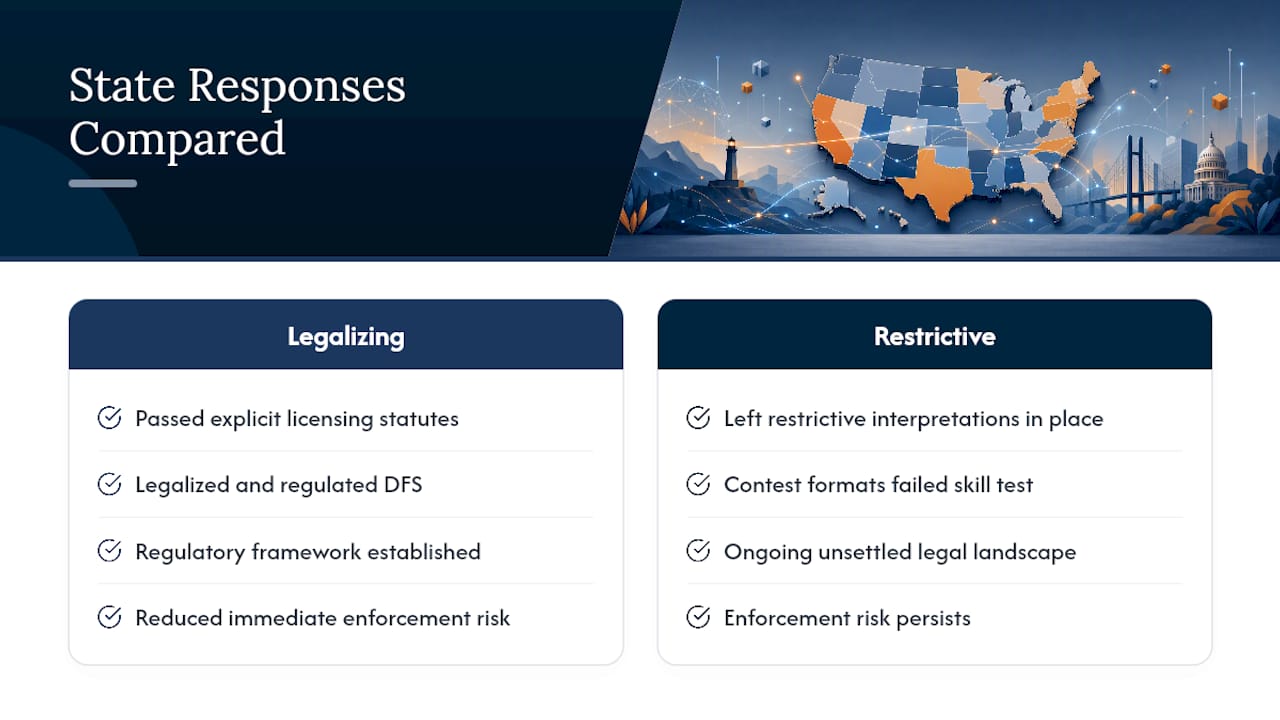
The common thread across those enforcement actions wasn't that fantasy sports are inherently illegal. It's that specific state regulators concluded specific contest formats, as actually designed and operated, failed that state's skill-versus-chance test. States responded in different directions afterward: some passed explicit licensing statutes that legalized and regulated DFS, while others left restrictive interpretations in place.
That divergence is still the operating reality today. Congressional research on the industry confirms the legal landscape remains unsettled in some states even a decade later, with legislatures periodically revisiting the question rather than treating it as permanently resolved. Enforcement risk isn't a historical footnote; it's an ongoing variable that shifts with each legislative session and each new attorney general.
The operator lesson isn't "avoid controversial states forever." It's "monitor them continuously," because a state's classification of your contest type can change with a single statute or opinion, and the operators who got burned historically were often the ones who hadn't built a process for catching that change in time.
Megasports Arena View: Lessons From Embedding Contests
We treat every state-law change or enforcement headline as a release-workflow trigger, not a background news item. When a state's posture shifts, geofence rules and terms of service update before paid entries resume there. A temporary suspension means the UI flags it, entries pause, and users get a plain-language notice the same day. Staying conservative until counsel confirms clearance has saved us from reversing course twice.
Megasports Arena: A Compliant, U.S.-Ready Embeddable Contest Platform
If building your own geofencing stack, age-verification flow, and 50-state legal review from scratch sounds like months of engineering and legal spend you'd rather avoid, there's a faster path. Megasports Arena runs embeddable fantasy and prediction contests with geofencing and age checks already built into the platform, so operators and publisher partners get a compliance foundation without building one from zero.

For platforms and website partners deciding how to structure entry mechanics and disclosures, our guide on how to write contest rules for fantasy sports walks through the exact language that supports a skill-predominant defense. You can see the mechanics in action on our active contests page, or head straight to Sports Rummy to try an embeddable, compliance-minded contest format for yourself and see whether it fits your site's audience.
Frequently Asked Questions
Is running a paid online skill contest legal in every U.S. state? No. Legality depends on each state's skill-versus-chance test, and a handful of states, including Hawaii, Idaho, Montana, and Washington, effectively bar paid daily fantasy sports regardless of skill emphasis.
Does the UIGEA fantasy-sports exemption make my contest automatically legal? No. It exempts qualifying contests from one specific federal payment-processing prohibition, but state gambling laws remain fully in force regardless of federal exemption status.
What's the practical difference between a sweepstakes, a lottery, and a contest? A lottery combines prize, chance, and paid consideration and is largely illegal to run privately. A sweepstakes removes consideration with a free entry option. A contest removes chance, rewarding skill or merit instead.
How often should we update our legal opinion? Whenever you change scoring mechanics, add a new state, or a state changes its law or issues a new regulatory opinion. Treat it as a living document, not a one-time purchase.
Are contests aimed at younger players subject to different rules? Yes. Age verification is mandatory for prize-based contests, and any contest data touching minors triggers additional privacy obligations beyond standard age gating, so verify age at signup and again before payout.
What should we do the moment a state issues a restrictive opinion? Suspend paid entry in that state through geofencing within hours, notify affected users and partners, and preserve all rule versions and logs from before the change for your records.
Sources
- Legal analysis of fantasy sports and the tests courts apply (Marquette Law Scholarship)
- Unlawful Internet Gambling Enforcement Act (U.S. Code § 5362) — fantasy-sports carve-out
- Daily Fantasy Sports: Industry Trends, Legal and Regulatory Issues, and Policy Options (Congressional Research Service)