
The fastest way to turn a one-time visitor into a repeat one is a daily mini-game paired with a leaderboard, embedded through a simple iframe, with a lead-capture step placed right before results. That combination is the closest thing to a formula in this space: interactive content lifts session duration by roughly 30 to 44 percent compared with standard articles, and leaderboard mechanics create the habit loop that drives return visits. Megasports Arena already packages this exact pattern into an embeddable format, so you're not building from scratch.
Your one-week starting point:
- Pick one daily quiz, trivia set, or mini-game tied to a sport your audience follows.
- Embed it with a standard iframe placeholder on a high-traffic page.
- Turn on a weekly leaderboard and require an email or account before showing final results.
Quick math: if your average article session runs 90 seconds, a multi-step quiz or prediction game pushing sessions to many minutes changes your ad viewability numbers overnight, not over a quarter.
Key Takeaways
Embedded games that pair a daily format with a leaderboard and a pre-results lead-capture step consistently outperform static content on both engagement and revenue.
| Point | Details |
|---|---|
| Lead with the right combo | Launch a daily mini-game or quiz, add a leaderboard, and gate results behind a quick opt-in. |
| Match format to goal | Use puzzles for habit, quizzes for shares and SEO, predictors for live-event spikes. |
| Keep streak windows short | A 2 to 7 day streak tied to real fixtures outperforms long generic loops. |
| Monetize at the right moment | Place ads and lead capture right before results, where intent peaks. |
| Pilot with Megasports Arena | Embed one Megasports Arena game, turn on its leaderboard, and measure return visits before scaling. |
Table of Contents
- Why User Onboarding Games Improve Engagement and Retention
- Which Game Formats Fit Which Goal?
- The Mechanics That Actually Drive Return Visits
- How Do You Embed and Launch a Game on Your Site?
- Monetization Setups That Pay Off Fastest
- What Should You Measure First?
- Megasports Arena Fits This Exact Playbook
- Put This Playbook to Work With Megasports Arena
- Sources
Why User Onboarding Games Improve Engagement and Retention
Games work because they change the unit of attention. An article gets read once. A game gets played, then checked on, then played again the next day. That return loop is the entire point of onboarding through play instead of onboarding through content.
The engagement research backs this up plainly. Interactive formats like quizzes and mini-games produce 30 to 44 percent longer sessions than standard pages, and multi-step assessments can significantly extend average time on page. Academic work on gamified mechanics also shows that points, badges, and leaderboards raise a visitor's willingness to recommend a site according to research published in the Journal of Consumer Research, provided the challenge level feels fair rather than random, according to research published in the Journal of Consumer Research.
There's a commercial payoff too, beyond time on site:
- Leaderboards and streaks create a reason to come back tomorrow, not just today.
- Longer sessions mean more scroll depth and more ad impressions per visit.
- Quiz answers and pool picks generate declared first-party data (favorite teams, prediction behavior) that's worth more to advertisers than guessed-at behavior.
None of this requires reinventing your content plan. It requires one well-placed game doing the work five articles used to do.
Which Game Formats Fit Which Goal?
Not every embeddable format earns its place on your site. Match the format to what you're actually trying to accomplish, because a fixture predictor and a daily trivia quiz solve completely different problems.
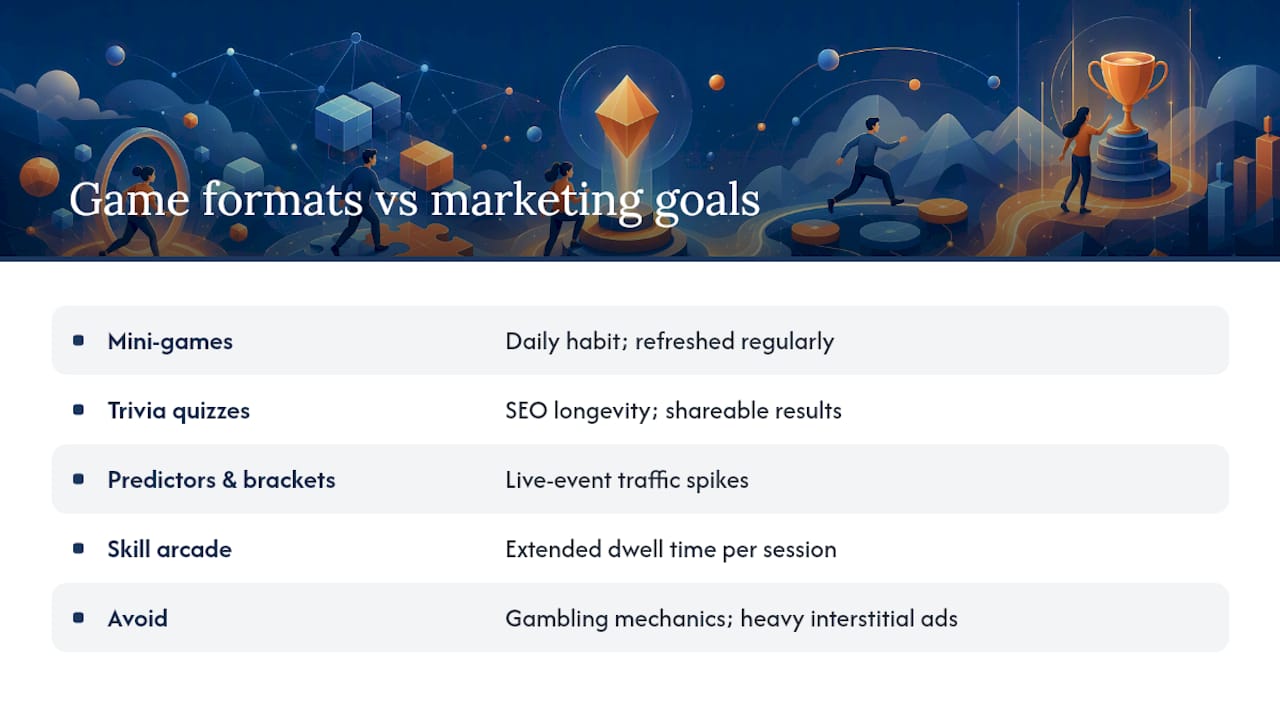
For daily habit and return visits, use short mini-games and puzzles refreshed on a schedule. A daily sports logic puzzle or word game gives visitors a reason to check back tomorrow morning, and it's the format most likely to build a genuine habit loop over weeks, not days.

For SEO longevity and social sharing, knowledge quizzes and personality-style tests do the heavy lifting. They rank for 18 to 24 months without a refresh when built around evergreen subject matter, and people share their results, which is free distribution you don't get from a game session alone.
For live-event spikes, fixture predictors and bracket-style contests are unmatched. Traffic clusters around kickoff, playoffs, or a tournament draw, and a well-timed predictor captures that surge instead of losing it to a competitor's live blog.
For extended dwell time, skill-based arcade mini-games hold attention longer per session than a quiz, useful when your ad inventory rewards raw time on page.
Skip anything that mimics real-money gambling mechanics (spinning wheels tied to cash-like rewards, countdown pressure timers) — it invites regulatory scrutiny you don't need. And keep interstitial ads light. An ad wall between every question kills the exact session length you're trying to build.
The Mechanics That Actually Drive Return Visits
Leaderboards and streaks aren't decoration. They're the mechanism that converts a single play into a habit, and small structural choices change how well they work.
- Set a streak window of 2 to 7 days. Shorter loops tied to a live fixture schedule outperform long, generic streaks because they map to how sports fans already think about time, game by game or week by week.
- Run both weekly and all-time leaderboards. A weekly reset gives new players a real shot at the top; an all-time board rewards your most loyal users. Running only one alienates half your audience.
- Layer in points, badges, and light progression. Nothing elaborate. A "5-day streak" badge or a milestone point total gives people something to protect once they've earned it.
- Keep rewards soft. Recognition and status beat cash-adjacent prizes for both legal simplicity and long-term player behavior.
Pro Tip: Run your leaderboard as an A/B test before committing site-wide. Turn it off for a control group of visitors for two weeks and compare return-visit rates. The difference is usually large enough that you won't need a statistician to see it.
Whatever mechanics you pick, write clear terms and conditions and plan basic moderation before launch, especially for anything with public usernames or comment threads attached.
How Do You Embed and Launch a Game on Your Site?
Getting a game live is closer to a content team task than an engineering sprint, if you plan the ad and privacy pieces up front.
- Choose your placement. Pick a high-traffic page or a dedicated hub page, then drop in a responsive iframe placeholder. This method works across WordPress, Drupal, and Adobe Experience Manager without custom development.
- Size the container responsively. Set a fluid width with a fixed aspect ratio so the embed doesn't break on mobile, which is where most fantasy sports traffic actually lives.
- Wire up ad monetization. Add an in-embed ad block and a JavaScript listener that fires a page ad refresh event when a player progresses through the game. This is a roughly one-hour ad-tech task with an ongoing revenue return.
- Place your lead-capture step before results, not after. This single placement choice matters more than the design of the form itself.
- Run a QA pass. Check load speed, screen-reader basics, and mobile tap targets, then assign someone to check public leaderboard names and comments weekly.
None of this requires a dedicated engineering team. A content lead and one developer for an afternoon covers most of it.
Monetization Setups That Pay Off Fastest
The revenue math on embedded games is unusually direct compared with standard content, because the game itself creates natural moments for both ads and data capture.
- In-embed ad blocks and interstitials placed right before results capture attention at the highest-intent moment in the session, when curiosity about the outcome is at its peak.
- Page ad refresh events tied to game progress increase the number of impressions served per visit without adding new ad units to the page.
- Lead capture before results converts at an average of 32.83 percent opt-in, a rate standard newsletter sign-up forms rarely touch.
- Declared data from quiz answers and picks (favorite team, prediction confidence) supports premium programmatic deals and direct sponsorship packages that inferred behavioral data can't match.
Sponsorship is the slower-building but highest-ceiling option. Once a game has a track record of return visits, a single team or league sponsor attached to the leaderboard becomes a sellable, recurring line item rather than a one-off placement.
What Should You Measure First?
Track a small set of numbers from day one, because early signal here shows up fast, usually within two to four weeks.
- Dwell time and completion rate. These tell you if the game format itself is working before you touch monetization.
- Return visits and daily active users. This is the real test of whether your streak and leaderboard mechanics are functioning.
- Opt-in percentage on lead capture and ad RPM. These translate engagement directly into revenue your commercial team can report.
- Run three A/B tests early: leaderboard on versus off, lead-gate versus no lead-gate, and interstitial ad present versus absent.
Expect return-visit lift to show up by week two if the leaderboard and streak mechanics are working; opt-in and RPM gains usually follow by week four once the lead-capture placement is dialed in.
Megasports Arena Fits This Exact Playbook
Megasports Arena packages daily puzzles, trivia, contest pools, and DIY custom pools with built-in leaderboards, so the mechanics covered above aren't something you build yourself. The platform includes analytics and a blog of implementation guides covering leaderboard design and daily trivia scheduling in more depth than fits here.
A workable pilot for a partner site:
- Embed one daily game (trivia, puzzle, or a fixture predictor) on your highest-traffic sports page.
- Turn on the leaderboard and set a 7-day streak window.
- Measure dwell time and return visits for two weeks before adding a second game.
For a deeper look at puzzle-specific implementation, the publisher's embed guide to sports logic puzzles walks through workflow details this section doesn't have room for.
Author perspective: why embeds beat one-off activations
Embedding a game once and letting it run beats building a fresh interactive piece every month. The upfront setup costs more time than a single quiz, but you stop paying that cost repeatedly. The real trade-off is moderation. Public leaderboards need someone watching them, and that's a smaller lift than most editorial teams expect. If you're weighing where to start, piloting with Megasports Arena removes the build decision entirely.
— peter
Put This Playbook to Work With Megasports Arena
You could build this stack piece by piece: source a quiz engine, hire someone to design a leaderboard, then bolt on ad refresh logic yourself. Megasports Arena skips that build entirely. It's a free-to-play library of sports fantasy games, trivia, pools, and puzzles that already comes with leaderboards, streak mechanics, and embeddable code ready to drop into your CMS.

That's the practical difference for a publisher reading this: no vendor selection process, no custom development sprint, just a working embed you can test this week. The sports rummy game is a straightforward first pilot, with a how-to-play page you can link directly from your embed wrapper and a live leaderboard already built for the streak and ranking mechanics covered above. Start by embedding the sports rummy play page on your highest-traffic page and watching your return-visit numbers over the next two weeks.
Sources
For deeper implementation detail beyond this playbook, these resources cover the mechanics and monetization tactics referenced above:
- Website performance hack: interactive content
- Mini-games retention playbook
- Publishers guide to content monetization with interactive content