
Match your risk to your pool: pick the most realistic high-leverage champion and set 2 to 4 contrarian picks based on your scoring format and field size. Small pools reward chalk. Large pools reward differentiation, since analytics-driven strategies consistently show that outlier brackets need real separation to win against a big field. Lock a champion first, then build contrarian slots around it. Practice contests on fantasy sports platforms can provide a low-cost way to test that plan before it counts.
Table of Contents
- What Makes Bracket Contest Strategy a Game Theory Problem?
- How Do Scoring Systems Change Where You Take Risk?
- Should You Play Chalk or Get Contrarian by Pool Size?
- What Is Leverage and Why Does It Decide Bracket Pools?
- Round-by-Round Rules for Upsets and Your Champion Pick
- Building Your Bracket: A Step-by-Step Checklist
- How Megasports Arena and Real Bracket Experience Back This Up
- How Do You Estimate Team Win Probabilities?
- Does Your Contest Format Change the Right Strategy?
- What Do Past Tournaments Tell You About Picking Brackets?
- How Many Brackets Should You Enter, and What Should They Cost?
- How Do Common Biases Wreck Otherwise Good Brackets?
- How Should You Set Your Tiebreaker Score?
- Perspective: When to Prioritize Fun Over Optimization
- Test Your Strategy Before the Games Start
- Sources
- FAQ
What Makes Bracket Contest Strategy a Game Theory Problem?
Winning a bracket pool has almost nothing to do with picking the most correct bracket. It has everything to do with beating the specific group of people in your pool. Those are different problems, and treating them as the same one is the most common mistake bracket players make.
Three variables drive every smart decision you'll make: the scoring system, the size of your pool, and what everyone else is likely to pick. Get those three right and the rest is detail work.
Here's a number that reframes everything. In a typical exponential scoring format, correctly picking the champion is worth 32 points, the same weight as picking all 32 first-round games correctly. Miss your champion and you can play a mathematically flawless first three rounds and still lose to someone who nailed one bold Final Four call. That's not bad luck. That's the format working as designed, and FantasyLabs has run the numbers to prove it.
How Do Scoring Systems Change Where You Take Risk?
Not all bracket pools score the same way, and your entire strategy should shift based on the format before you fill in a single game.
Exponential scoring (1, 2, 4, 8, 16, 32 points per round) rewards depth over precision. Since FantasyLabs points out, late rounds dominate the point total. Your champion and Final Four picks matter more than a clean first round.
Flat scoring (equal points every round) rewards volume. Getting 20 first-round games right is worth as much as your champion pick, so accuracy in the early rounds carries far more relative weight.
Upset-bonus formats add seed-differential points on top of a base score. These systems specifically pay you for correctly picking a 12 seed or an 11 seed to win, which changes the math on early upsets from a nice-to-have into a real point source. Know which format your pool runs before you touch a bracket. It changes almost every pick that follows.
Should You Play Chalk or Get Contrarian by Pool Size?
Pool size is the single most underrated variable in bracket strategy, and it works in a direction most players don't expect.
In a small pool under 50 entries, conservative and chalk-heavy brackets tend to perform best. With fewer entries, the field simply doesn't generate enough wild outlier brackets to beat a well-built favorites-heavy bracket, according to Syracuse University's analytics research. Differentiating for its own sake in a 20-person office pool usually just adds unnecessary risk.
Once a pool grows large, the math flips. More entries mean more brackets clustered around the same obvious favorites, so beating that crowd requires deliberate separation. The same research confirms that in large pools, picking undervalued teams becomes essential rather than optional.
Mid-size pools (50 to 150 entries) sit in between. Play mostly chalk through the first weekend, then add two or three calculated contrarian picks in the second week and Final Four. Large pools (250-plus) call for a bolder stance: three to five real differentiators, including at least one non-obvious Final Four team and possibly a champion outside the top two seed lines.
What Is Leverage and Why Does It Decide Bracket Pools?
Leverage is the gap between a team's real probability of winning and the percentage of the public pool that has picked them. It's the single most useful concept in bracket strategy, and most players have never heard of it.
Even if that team wins, you're splitting the pool with a third of the field. If that team wins, you're separating from almost everyone.
Here's a simplified example of how that math plays out across a typical top tier:
The OccupyFantasy strategy framework uses exactly this kind of comparison to isolate undervalued champions. The practical takeaway: skip the top favorite everyone else is circling, and skip the 15-seed fantasy longshot too. The sweet spot is a realistic 2 through 4 seed with real championship equity and a public pick rate well below its actual odds. That's where pools get won.
Round-by-Round Rules for Upsets and Your Champion Pick
The first round is where most bracket damage happens, but it's also where selective upsets pay off. History shows 12-over-5 and 11-over-6 results happen almost every year, and SB Nation's bracket research notes these are common enough to plan for, not just hope for. Pick one or two, not five. Most brackets fail by picking too many upsets, not too few.
In the Sweet 16 and Elite Eight, decide in advance whether you're riding an early upset winner deeper or cutting bait. In small pools, fold back to the favorite once your upset pick has served its purpose. In large pools, let a live upset ride if it still has a plausible path.
For the Final Four and champion, leverage should override gut instinct. Trace the bracket path of your champion pick: which seeds do they actually have to beat, and does the public agree with you too much? A pick with a clean path and low public exposure is worth more than a "safer" pick shared by half the pool.
Building Your Bracket: A Step-by-Step Checklist
Run through this before you submit anything:
- Confirm your pool's exact scoring system and total entry count.
- Estimate the skill level of your field. Office pools skew casual; paid contests skew sharper.
- Check public pick rates where available, even informally by asking around the group.
- Choose one realistic, high-leverage champion, not the safest name and not the longest shot.
- Set two to four contrarian picks scaled to your pool size, concentrated in the second weekend and Final Four.
- Set your tiebreaker score. A baseline of 144 total points is a reasonable starting figure, per Sports Illustrated's tiebreaker analysis, adjusted up for high-scoring finalist profiles or down for defensive ones.
- Reread every pick once more before locking it in.
Pro Tip: Build your bracket in two passes. Fill it out once on pure chalk, then go back and deliberately swap in your two to four leverage plays. You'll immediately see how much risk you're actually adding.
How Megasports Arena and Real Bracket Experience Back This Up
None of this works as theory alone. Some fantasy sports platforms offer practice contests, contest scheduling, and statistical handicapping tools to test a bracket strategy before an entry fee or bragging rights are on the line. Author Pete Korner has spent years covering bracket contests and pool dynamics across football, basketball, and baseball formats, and the checklist above reflects that pattern recognition, not guesswork.
Try it in practice: build one bracket on pure chalk in a free practice pool, then build a second using the leverage table above, and compare how each performs against the field once results roll in. Seeing the gap in a low-stakes setting teaches the concept faster than any explanation can.
How Do You Estimate Team Win Probabilities?
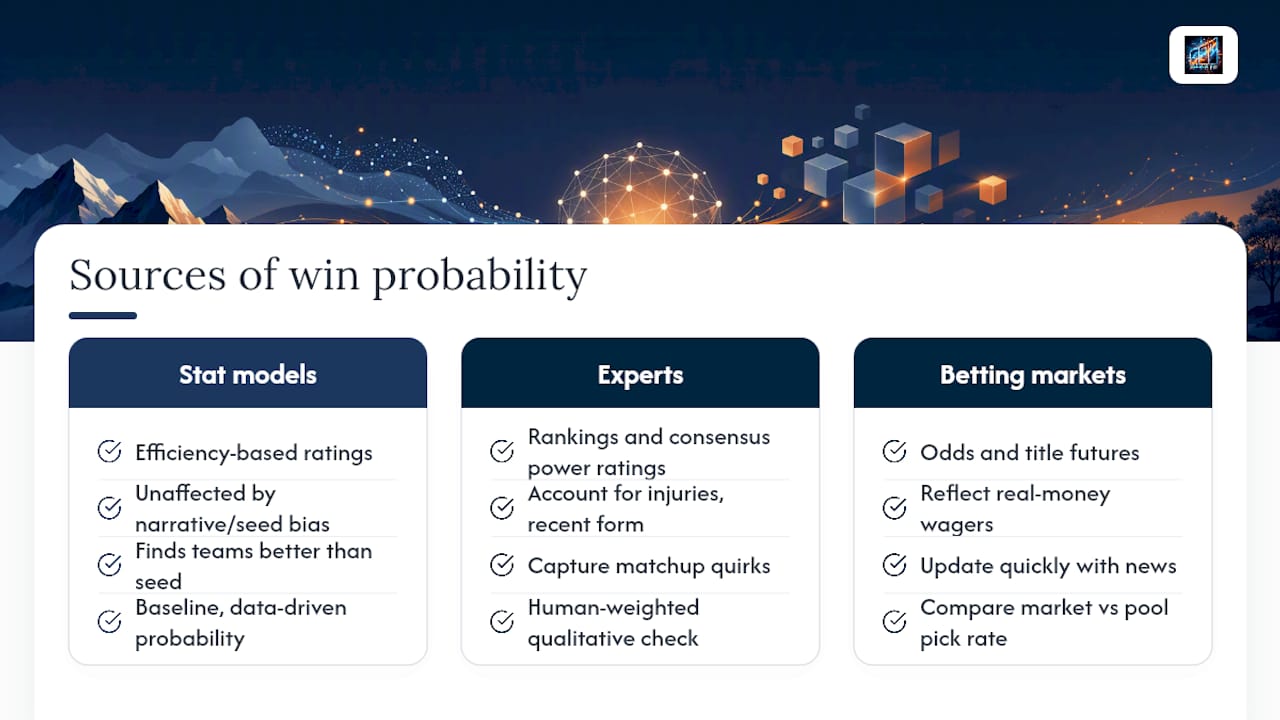
Leverage only works if the probability side of the equation is grounded in something real, not a hunch. You have three practical sources, and the smart move is to blend them rather than lean on just one.
Statistical models built on efficiency metrics, like adjusted offensive and defensive ratings, give you a probability estimate that isn't swayed by narrative or seed reputation. These models tend to catch teams that are better than their seed line suggests, which is exactly where positive leverage hides.
Expert rankings and consensus power ratings from national college basketball writers offer a second, more human-weighted check. They factor in injuries, recent form, and matchup quirks that a pure efficiency number sometimes misses.
Betting markets are arguably the sharpest public signal available. Odds and title futures reflect real money being wagered by people with financial incentive to be accurate, and they update quickly as new information comes in. Comparing a team's market-implied probability against its pool pick rate is one of the fastest ways to spot a mispriced team, a pattern the Action Network's strategy coverage has documented across thousands of pools each year.
No single method is complete on its own. A model might undervalue a team peaking at the right time; a market might overreact to one recent blowout. Cross-checking two or three sources against each other, then trusting the team where they agree, beats relying on any single number in isolation.
Does Your Contest Format Change the Right Strategy?
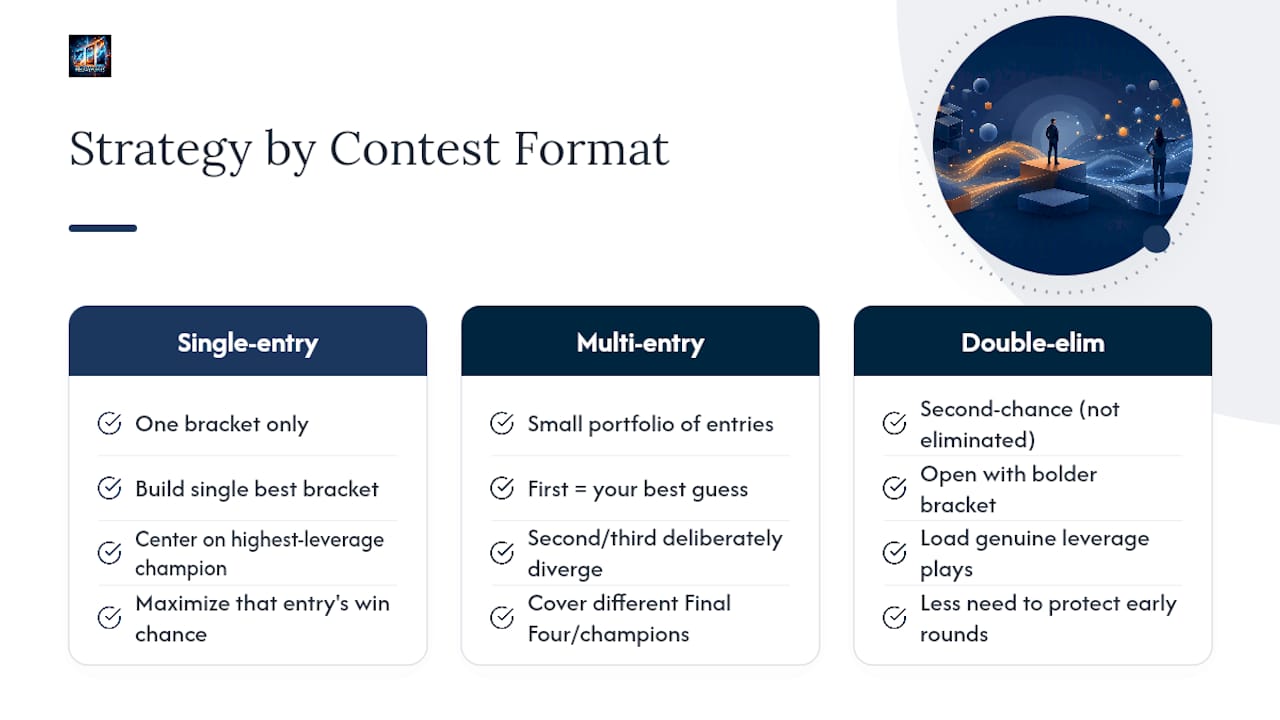
A single standard bracket pool is not the same game as a multi-entry contest, and playing them identically is a quiet way to leave value on the table.
In a single-entry pool, you get one shot, so the leverage and pool-size rules above apply directly. Build the single best bracket you can for that specific field.
Multi-entry contests, common in larger paid pools, change the calculus entirely. Instead of building one bracket, you're building a small portfolio. Your first entry can be your genuine best guess, built around your highest-leverage champion. Your second and third entries should diverge deliberately, covering a different Final Four team or a different champion seed line entirely. The goal isn't to maximize each individual entry's win probability. It's to maximize the probability that at least one of your entries lands near the top.
Double-elimination or "second chance" pools, where a poor first-round bracket doesn't eliminate you from later rounds, reward a bolder opening bracket. Since an early stumble doesn't end your run, there's less reason to protect against first-round variance and more reason to load up on genuine leverage plays from the start.
Confirm which format you're in before building anything. A portfolio approach built for a multi-entry contest, applied to a single-entry office pool, just spreads your conviction thin for no benefit.
What Do Past Tournaments Tell You About Picking Brackets?
History doesn't repeat itself game by game, but it repeats itself at the pattern level, and those patterns are worth building into your process.
Double-digit seeds reaching the Sweet 16 happens most years, not as a fluke but as a recurring feature of the tournament format. Twelve-seeds beating five-seeds show up often enough that betting against at least one is usually the wrong move, a pattern SB Nation's bracket analysis has tracked across multiple tournaments.
At the other end of the bracket, top overall seeds fail to reach the Final Four more often than casual fans assume, since a single bad shooting night against a hot opponent is enough to end a season. This is exactly why over-concentrating your bracket on the top seed line, especially in a large pool where everyone else is doing the same, tends to underperform relative to spreading some conviction toward a 2 or 3 seed with a cleaner path.
The lesson isn't that upsets are guaranteed or that favorites are traps. It's that both outcomes happen at a predictable enough rate that your bracket should have room for both, rather than betting the whole thing on chalk holding perfectly or chaos breaking out everywhere.
How Many Brackets Should You Enter, and What Should They Cost?
If your pool allows multiple entries, treat your total entry spending like a small budget, not an open tab.
Decide your total spend before you start filling out brackets, not after you get excited about a third or fourth entry idea. A common approach is to put the bulk of your budget into one carefully built bracket, then split a smaller remainder across two or three differentiated entries that each target a different champion or Final Four combination.
Diminishing returns set in fast. Your fifth or sixth entry in the same pool rarely adds meaningful new coverage, since you've likely already captured the realistic range of outcomes with three or four well-spaced brackets. Spending more just to spend more doesn't increase your odds proportionally.
If you're entering several separate pools with different entry fees, prioritize the ones where your analytical edge is real. A pool full of casual fans making largely random picks is where a leverage-based bracket has room to separate. A pool full of sharp, analytics-savvy friends is a tougher field to differentiate against, and your entry fee there is buying a smaller edge. Spend accordingly.
How Do Common Biases Wreck Otherwise Good Brackets?
Even players who understand leverage and scoring systems still sabotage their own brackets through a handful of predictable mental habits.
Recency bias pushes people to overrate a team that won its conference tournament impressively last week, even when that run came against weaker competition than the NCAA Tournament field. Home-state or alma mater bias leads fans to pick their own school deeper than the data supports, which is fine for fun but costly for a strategy bracket. Anchoring on seed number treats a 1 seed as automatically safer than a 3 seed, when the actual gap in win probability between them is often smaller than the seed difference implies.
The most expensive bias, though, is overcorrection: picking too many upsets because last year's bracket got burned by chalk, or picking zero upsets because last year's upset picks all busted. Both reactions ignore that the two outcomes have a roughly stable historical rate, and one bad year doesn't change the underlying odds. Building your bracket from a probability table rather than a gut feeling about last year is the single best defense against every bias on this list.
How Should You Set Your Tiebreaker Score?
Tiebreakers decide more pools than players expect, especially in large fields where dozens of entries can end up with an identical point total.
The most common heuristic is a combined final score around 144 points, roughly a 76 to 68 finish, which Sports Illustrated's analysis of finals scoring identifies as a reasonable statistical baseline. But treating 144 as a fixed number ignores who's actually playing in your predicted final.
Adjust that baseline based on your picked finalists' style. If both teams you have reaching the final play at a fast pace with efficient offenses, nudge your tiebreaker guess upward, toward the 150s. If either team is a grind-it-out defensive squad that wins with low-possession games, shift downward, into the 130s. This isn't guesswork. It's applying the same offensive and defensive efficiency data you used to pick your champion to one more decision.
Practicing this kind of score estimation, rather than defaulting to a memorized number, meaningfully reduces the odds you lose a pool on a tiebreak you could have called better.
Perspective: When to Prioritize Fun Over Optimization
Not every pool needs a leverage table. A 12-person family pool where the stakes are pride and a bit of trash talk should stay fun first. If you want both, split it: one bracket built on pure fandom and gut picks, and a separate entry built on the strategy above for the pools where winning actually matters to you. Try the analytical approach once. See how it feels.
— Pete Korner
Test Your Strategy Before the Games Start
There are other ways to sanity-check a bracket, comparing notes with friends, reading a dozen expert picks, or just trusting your gut on championship week. None of them let you actually see how a leverage-based approach performs against a real field before it counts.

Megasports Arena gives you a practical way to test the strategy in this article before your money or your bragging rights are on the line. The platform's betting tools help you compare matchups and check the kind of probability data that leverage calculations depend on, and the active contests hub lets you enter a live pool and see your champion pick, contrarian slots, and tiebreaker number play out against a real field. Megasports-arena is built to be the one place where fantasy-style bracket play and serious handicapping tools sit side by side, so you don't have to bounce between five different sites to build and test a bracket. Head to active contests and enter one this week to see how your leverage picks actually hold up.
Sources
- How to Win Your March Madness Bracket With Analytics‑Driven Strategies
- How to figure out a tiebreaker score for March Madness finals | Sports Illustrated
- NCAA Bracket Picks Optimizer: Build a Smarter Bracket, Win Your Pool | FantasyLabs
FAQ
Can AI Predict a Perfect Bracket?
No model has produced a verified perfect bracket, and the sheer number of possible outcomes makes it statistically improbable regardless of how good the data is. Statistical models and simulations can meaningfully improve your odds by estimating team probabilities more accurately than gut instinct, which is the practical value they offer.
What Are Some Good Bracket Strategy Ideas?
Match your risk to your scoring format and pool size, prioritize a realistic high-leverage champion over an extreme longshot, and limit yourself to two or four calculated contrarian picks rather than a bracket full of upsets. Set your tiebreaker around a 144-point baseline and adjust it based on your predicted finalists' scoring style.
What Is the Perfect Bracket Challenge?
The perfect bracket challenge refers to correctly predicting every single game in the NCAA Tournament without a single miss. It's a popular promotional idea for prize contests, but the odds against it are astronomically long, which is exactly why bracket contest strategy focuses on beating your pool rather than chasing perfection.
Has There Ever Been a 100% Correct Bracket?
No fully verified perfect bracket through the entire NCAA Tournament has ever been confirmed. The longest documented correct-picks streaks have ended well before the tournament's final rounds, reinforcing why leverage and pool-relative strategy matter far more than aiming for flawless accuracy.
How Do I Practice My Bracket Strategy Before the Tournament?
Entering a free practice contest lets you build and test a bracket without any stakes attached. Megasports Arena's active contests page is a straightforward way to try a leverage-based bracket against a live field before committing to a pool that actually counts.