
Cross sport challenges are fantasy or prediction contests that pool multiple sports onto one leaderboard, so a single lineup or picks slate might combine MLB hitters, NBA scorers, and NFL quarterbacks under one score. The format keeps fans engaged year round instead of losing them in the gaps between seasons. This is why platforms like Megasports Arena build entire game libraries around it. Research on fantasy participation backs the appeal: an Emerald study of 319 players found it raises loyalty without cutting into real-world sport-watching habits.
TL;DR:
- Multi-sport fantasy formats often require normalization or percentile scoring to compare different sports' stats effectively.
- Managing schedules, lockout times, and scoring rules is essential for optimizing performance in cross sport challenges.
- Spreading picks across multiple sports reduces variance and risk, leading to better long-term results over concentrating on a single sport.
- Embedding simple leaderboards or widgets increases engagement and extends fan interest beyond individual seasons or sports.
- Regulatory compliance requires regular review of contest rules, clear communication, and moderation to avoid legal or trust issues.
Table of Contents
- How Do Multi-Sport Fantasy Formats Actually Work?
- How Do You Join and Play a Cross Sport Challenge?
- What's the Best Strategy for Multi-Sport Fantasy Contests?
- What Does the Research Say About Fantasy Sports and Fan Engagement?
- How Can Publishers Embed Cross Sport Challenges?
- What Legal Rules Apply to Multi-Sport Fantasy Contests?
- What Compliance Mistakes Do Publishers Make With Embedded Contests?
- How Do Social Features Boost Engagement in Cross Sport Challenges?
- Author Perspective: What I'd Try First
- Try a Cross-Sport Contest on Megasports Arena
- Sources
How Do Multi-Sport Fantasy Formats Actually Work?
Three formats dominate cross sport challenges right now. Omnileagues run all season, pooling stats from several sports into one continuous standings race, similar to the Omnifantasy ruleset which structures a draft-based, season-spanning contest with explicit point values per sport. Draft-based multi-sport leagues work like a traditional fantasy draft, except the player pool spans leagues instead of one sport. Pick'em and contest pools ask for simple picks (winners, over/unders, stat thresholds) across a slate of games from different sports, which suits casual players who don't want a roster to manage all season.
The harder problem is scoring. A 30-point basketball game and a two-goal hockey game aren't naturally comparable, so platforms normalize the numbers using a few common methods:
- Normalized point systems convert raw stats (yards, goals, assists, strikeouts) into a shared point scale weighted by that stat's rarity in its own sport.
- Percentile or rank-based scoring measures how a player performed relative to others in the same sport that week, then compares percentiles across sports instead of raw numbers.
- Event-weighted scoring assigns extra value to marquee events, playoff games, or nationally televised matchups.
- Flex spots let a roster slot accept a player from any of several sports, which raises strategic complexity and usually raises payout tiers too.
Before entering any contest, check three things: the roster composition (how many slots per sport), whether the scoring formula is published in plain language, and how ties get broken. Industry coverage of the growth in multi-sport leagues points to stat normalization and AI-driven suggestions as the features now separating serious platforms from bare-bones ones.
How Do You Join and Play a Cross Sport Challenge?
Getting into a contest takes minutes. Winning it consistently takes a little more discipline. Here's the sequence that works:
- Create an account and read the scoring rules first. Skipping this step is the single biggest reason new players get blindsided by a tiebreaker or a scoring cap they didn't know existed.
- Pick a contest type that matches your time budget. Draft-based leagues demand weekly roster management; pick'em pools take five minutes and are done.
- Prep for the draft, if there is one. Look at each sport's schedule density for the contest window. A sport playing four games that week outweighs one playing one game, even with a weaker individual player.
- Track schedules across every sport in your lineup daily. Cross-sport play means juggling injury reports, lineup confirmations, and start times from leagues that don't share a news cycle.
- Set substitution reminders ahead of lockout windows, since each sport in the contest may lock rosters at a different time.
- Check the prize structure and payout tiers before you commit, especially in paid pools where tiebreakers can shift a payout bracket.
Pro Tip: Build a simple spreadsheet with one row per sport showing that league's lockout time. Cross-sport players lose more points to missed deadlines than to bad picks.
Time commitment varies wildly by format. A weekly pick'em pool takes ten minutes. A full-season omnileague with flex spots can take thirty minutes of daily management once you're juggling four sports' worth of injury news.
What's the Best Strategy for Multi-Sport Fantasy Contests?
Treat your roster like a portfolio, not a single bet. Spreading picks across sports whose schedules and outcomes don't move in lockstep reduces the odds that one bad week in one league tanks your whole standing. Concentrating every flex spot in a single sport might feel efficient, but it recreates the same single-sport risk a cross-sport format was supposed to solve.
A few tactics separate consistent players from the pack:
- Look for pattern overlap between sports. A team on a scoring surge in one league often signals a healthy roster and favorable matchups that carry into the next game, regardless of sport.
- Watch for off-season overlaps. The stretch when the NBA and NHL playoffs run alongside early MLB action creates the densest data window of the year, and the sharpest edges for players who track all three.
- Weight rest and travel schedules. Back-to-back games, long road trips, and short weeks depress individual stat lines in ways box scores don't always show until after the fact.
One background insight worth internalizing: allocating across sports the way an investor allocates across asset classes tends to reduce variance and improve a player's long-term standing, even if it caps the ceiling on any single lucky week. Consistency, not home runs, wins most season-long leaderboards.
What Does the Research Say About Fantasy Sports and Fan Engagement?
The CDX framework from ScienceDirect identifies five design elements that explain why fantasy formats hook fans: control, camaraderie, continuation, competition, and customization. Control comes from setting your own lineup. Camaraderie comes from league chat and rivalries. Continuation is the one cross-sport formats amplify most, since a multi-sport leaderboard gives fans a reason to stay engaged through every season instead of just one.
The empirical case is direct: fantasy-sports participation increases sport usage, consumption capital, loyalty, and word-of-mouth, and it does so without pulling players away from watching real games.
That's the core finding from the Emerald Publishing study of 319 fantasy participants, and it directly counters the old worry that fantasy play cannibalizes fandom. For players, it means the hobby reinforces rather than replaces watching. For publishers, it means an embedded fantasy game doesn't compete with your sports content. It feeds it.
How Can Publishers Embed Cross Sport Challenges?
Embedding a multi-sport contest is less about code and more about picking the right footprint for your audience. Start small: a single widget showing an active leaderboard usually outperforms a full seasonal integration, because it creates a repeat touchpoint with almost no friction for a first-time visitor.
The mechanics break down into three layers:
- Embed basics: a leaderboard widget, a contest schedule module, and a lightweight moderation queue for user-generated picks or comments.
- UX priorities: mobile-first layouts (most fantasy checking happens on a phone during a commercial break), one-tap social sharing for standings, and clear point or prize mechanics so new visitors understand the game in seconds.
- Measurement: track session time, repeat-visit rate, leaderboard interaction clicks, and newsletter sign-up conversion from the contest page specifically, not just site-wide averages.
Multi-sport formats carry a specific business case here: they extend engagement past a single sport's off-season, which industry analysis of fantasy app development ties directly to broader audience reach and richer user data for publishers. A step-by-step embed guide covers the technical side in more depth if you're evaluating your first integration.
What Legal Rules Apply to Multi-Sport Fantasy Contests?
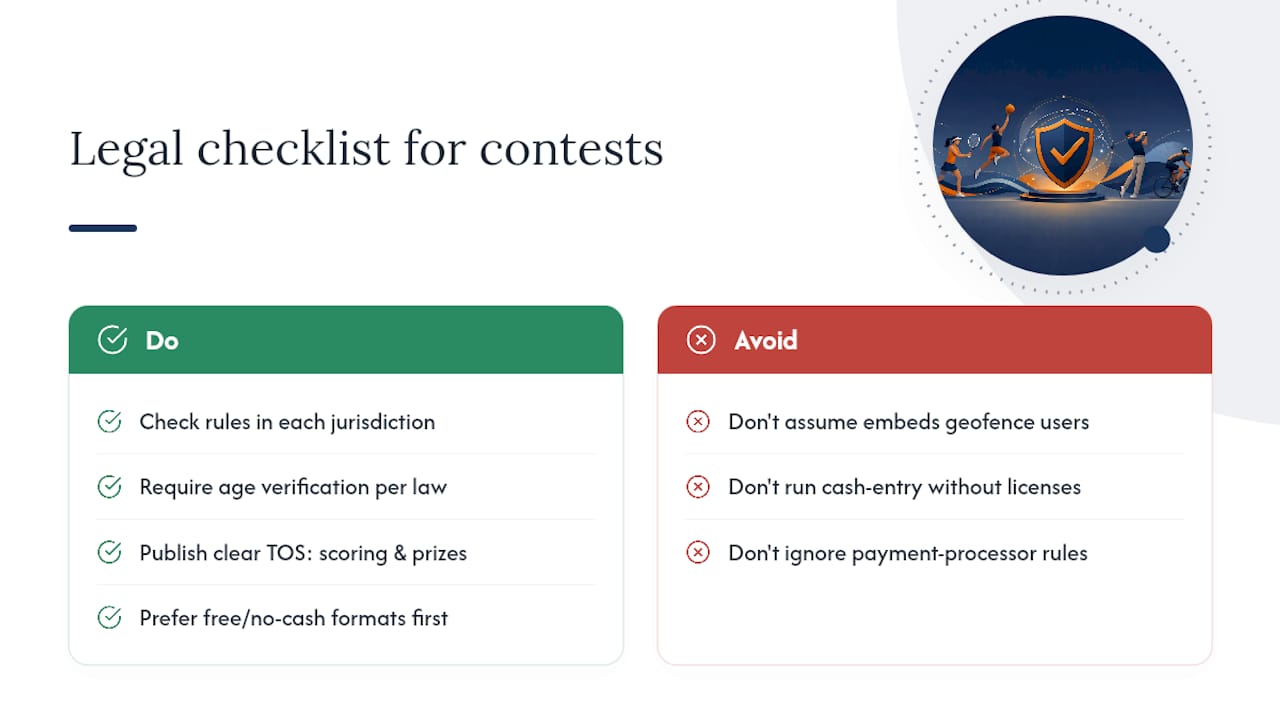
Fantasy sports sit in a different legal category than sports betting in most of the United States, largely because outcomes depend on statistical performance across a roster rather than a single game's result. That distinction matters, but it isn't a blanket green light. Rules vary by state, and a handful of states restrict or require licensing for paid daily fantasy contests specifically. Free-to-play formats, prediction pools with no entry fee, and skill-based scoring systems generally face fewer restrictions than cash-entry contests, which is one reason many multi-sport platforms lead with free play.
Anyone running a cross-sport contest with real money on the line needs to check the current rules in every state (or country) where entrants can register, not just the operator's home base. Age verification (typically 18 or 21 depending on the state) and clear terms of service disclosing scoring, prize structure, and eligibility aren't optional extras. They're the baseline a regulator or a payment processor will ask about first.
Jurisdictional restrictions also extend to advertising. A publisher embedding a paid contest widget on a general-audience site needs to confirm the contest operator geofences or otherwise blocks entrants from restricted states, rather than assuming the embed code handles it automatically. When in doubt, free prediction and pick'em formats with no cash entry sidestep most of this complexity entirely, which is part of why they've become the default for publisher-facing embeds.
What Compliance Mistakes Do Publishers Make With Embedded Contests?
The most common mistake is treating an embedded contest as "set and forget." A widget that looked compliant at launch can drift out of compliance if the underlying platform changes its prize structure, entry fees, or geographic availability, and the publisher never rechecks the terms.
A few other pitfalls show up repeatedly:
- Unclear rules on the publisher's own page. Even when the contest operator publishes full terms, a publisher who doesn't link to them or summarize eligibility clearly creates confusion and support tickets.
- No age gate on the embed itself, even when the underlying platform requires one, leaves the publisher exposed if a minor enters through the embedded widget.
- Ambiguous scoring communication. One recurring theme among people who run these contests well is that transparent, plainly worded normalization rules build trust fast, and vague ones erode it just as fast.
- Ignoring moderation for user-generated content. League chat, trash talk threads, and custom pool names need light moderation, or one bad actor can sour an entire embedded community.
- Assuming one region's rules apply everywhere. A contest cleared for one state's residents isn't automatically cleared for every visitor an embed can reach.
Treat the embed the way you'd treat any third-party ad unit: check it periodically, not just at launch.
How Do Social Features Boost Engagement in Cross Sport Challenges?
Leaderboards alone hold attention for a week. Community features are what bring players back for a season. Private leagues with custom names, head-to-head matchup pages, and league-specific chat all turn a solitary prediction game into something closer to a group hobby, which is exactly the camaraderie element the 5Cs framework highlights.
Simple mechanics move the needle more than complex ones. A shareable "my week in review" card that a player can post to social media does more for organic reach than a leaderboard buried three clicks deep. Rivalry tracking (head-to-head records between two friends across an entire season) gives players a reason to check in even when they're out of contention for the top prize. Recurring weekly micro-contests, layered on top of a season-long league, also give lapsed players an easy re-entry point instead of forcing them to wait for a new season to start.
Author Perspective: What I'd Try First
Start small on both sides of this. Players: pick a low-stakes pick'em pool for your next multi-sport weekend before committing to a full draft league. It's a faster way to learn how normalization scoring actually plays out than reading any rulebook.
Publishers: embed one leaderboard for a single event and measure session time for two weeks before scaling up. The data will tell you more than any projection. I'd point both groups toward a Megasports Arena contest as a low-friction place to test either approach.
— peter
Try a Cross-Sport Contest on Megasports Arena
Megasports Arena gives players a free way to compete across multiple sports on one scoreboard, without the entry fees or state-by-state eligibility headaches that come with paid daily fantasy contests.

Some platforms offer game libraries covering scheduling, active leaderboards, and clear how-to-play rules, all built for the kind of cross-sport format this article covers. Publishers can benefit from embeddable widgets designed to keep visitors on a page longer without building a fantasy engine from scratch, which is a practical trade-off for site owners weighing a custom build against something ready to plug in.
If you want to see the mechanics firsthand, start with sports rummy, check the how-to-play breakdown, and watch where you land on the live leaderboard. Publishers evaluating an embed can start with the same game page as a test integration before rolling out to a full contest calendar.
Sources
- Gamification through fantasy sports – Empirical findings from professional sport leagues | Sport, Business and Management | Emerald Publishing
- Multi-Sport Fantasy Leagues Gaining Popularity Across Games in 2025 » Gaming And Media
- Omnifantasy 2026 Rules - The Omnifantasy League