
The fastest no-code way to lift time on site and ad yield is to embed a ready-made sports fantasy or prediction widget on a page you already publish. No code website games are embeddable, pre-built sports fantasy and prediction tools, things like predictors, pick'em contests, and trivia quizzes, that you drop into an existing page with a snippet, not a rebuild. Publishers who add interactive game portfolios see a 65% average uplift in gaming revenue and a 4x increase in screen time per user compared to static pages.
Your first move: pick a quiz or predictor, paste it on your highest-traffic fixture page, and check session time a week later. Two things happen almost immediately:
- Visitors stick around for one extra interaction loop instead of bouncing after the headline.
- You get a rough read on which contest format your audience actually wants, before you invest in a bigger rollout.
Key Takeaways
Embedding a single ready-made sports fantasy widget on a high-traffic page is the fastest measurable way to raise session time and ad impressions without a development project.
| Point | Details |
|---|---|
| Match format to page | Use predictors on fixture pages, pick'em on hubs, trivia on recaps, and leaderboards for ongoing competition. |
| Embed in an afternoon | Most widgets need only an iframe or JS snippet plus a one-time ad-listener setup for refresh events. |
| Track five core events | Measure widget starts, completions, session time, ad impressions, and email captures from day one. |
| Run a two-track cadence | Pair daily quick contests with a weekly marquee contest tied to your biggest fixture. |
| Start with Megasports Arena | Its embed-ready games like Card Wars come with leaderboards, scheduling, and analytics built in, so you can pilot without a build. |
Table of Contents
- What Are the Best Formats for No Code Website Games?
- Quick Technical Embed Checklist: Iframe, JS Snippets, and Ad-Listener Setup
- How Do You Measure and Monetize an Embedded Game?
- How Often Should You Run Contests to Build Repeat Traffic?
- What Should You Avoid When Launching an Embedded Game?
- The Real Bottleneck Isn't the Game, It's the Follow-Through
- Megasports Arena: An Embeddable, No-Code Way to Start Today
- Further Reading and Primary Sources
- Frequently Asked Questions
- Sources
What Are the Best Formats for No Code Website Games?
Not every embeddable game fits every page. The format has to match how the reader is already using that page.
Predictors ask a single yes/no or score guess (who wins, by how much) and work best on fixture and preview pages, where the reader already has a game in mind. Pick'em contests run across a full week or slate of games and belong on team hub pages or newsletters, where repeat visits are the point. Trivia quizzes are the easiest entry point for casual readers and slot naturally into recap articles or homepage features. Leaderboards turn any of the above into a public, ongoing competition rather than a one-off interaction. Mini puzzles, crosswords or logic-based sports puzzles, work well as a daily habit-builder independent of any single game.
Megasports Arena's Card Wars is a concrete example of a card-based fantasy contest built for homepage or hub placement, and its companion Card Wars leaderboard shows how a public standings page keeps players coming back to check their rank. Dealer No Deal offers a lighter-weight, session-based format that suits pages where you want a quick engagement loop without asking for a season-long commitment.
Quick Technical Embed Checklist: Iframe, JS Snippets, and Ad-Listener Setup
Getting a game live rarely requires a site redesign. Most embeddable widgets ship as an iframe placeholder or a JS snippet that you paste into an existing content block. Here's the sequence that gets you from zero to live in an afternoon.
- Choose the placement. Pick a page with existing traffic, ideally a fixture preview, recap, or team hub, and decide where the widget block sits relative to your main content.
- Paste the snippet. Drop the iframe or JS code into that placeholder. Most platforms give you both options; the iframe is simpler, the JS snippet usually renders faster and adapts better to your page's styling.
- Check sizing and responsiveness. Test the embed on mobile width first, since most sports traffic arrives on phones, then confirm it scales cleanly on tablet and desktop.
- Wire up event listeners. A single ad-tech listener refreshes adjacent ad slots when a reader interacts with the widget, a one-time setup that pays off in extra impressions every session.
On WordPress, use a custom HTML block rather than a shortcode plugin, since it gives you direct control over the snippet. Drupal sites typically embed through a Twig template override on the content type. Headless setups (Next.js, Gatsby) should treat the widget as a client-side component and lazy-load it below the fold.
Pro Tip: Defer the widget's script tag and lazy-load the iframe. Games are rarely above-the-fold priority content, and deferring them protects your Largest Contentful Paint score, which search engines and readers both notice.
How Do You Measure and Monetize an Embedded Game?
Five numbers tell you whether a widget is earning its space on the page: widget starts, completed runs, average session time, ad refresh impressions, and email captures. Starts versus completions matters most early on, since a big gap usually means the format is confusing or the load time is too slow.

The 65% revenue uplift and 4x screen-time increase reported across interactive game portfolios is a useful ceiling to aim for, not a guarantee. Your actual lift depends on traffic quality, placement, and how well the format matches the page.
Set up your event plan before launch, not after:
- Fire a
widget_startevent on load and awidget_completeevent on submission. - Map both to your analytics platform (GA4 custom events) and to your ad server (Google Ad Manager) so a completion event can trigger a refresh call on adjacent slots.
- Track email capture as a separate conversion event if the widget offers an opt-in for results or reminders.
Single-task widgets, a quick input followed by an immediate result and a clear next step, tend to convert better than multi-step tools and give ad ops higher-signal intent data to sell against.
How Often Should You Run Contests to Build Repeat Traffic?
Cadence is what turns a widget from a novelty into a habit. Publisher playbooks consistently point to a two-track schedule: daily quick contests paired with a weekly marquee contest tied to a prime fixture.
- Run a short daily pick'em or trivia round that takes under two minutes to complete.
- Build a bigger weekly contest around your highest-traffic game of the week, with a leaderboard and a modest sponsored prize.
- Layer in streak rewards, a badge or points bump for playing multiple days running, since streaks are what turn casual players into daily visitors.
- Make results shareable. A player who can post their leaderboard rank does your marketing for you.
Academic research on gamified sports platforms backs this up directly: a gameful experience positively affects behavioral intentions, and customer-brand engagement, the sense of actually competing and belonging, is what mediates the jump from casual play to loyalty. Leaderboards and personalization aren't decoration here; they're the mechanism.
Pro Tip: Moderate community features lightly but consistently. A simple profanity filter plus a spot-check of top leaderboard entries each week catches most abuse before it becomes a visible problem.
What Should You Avoid When Launching an Embedded Game?
Most launch failures trace back to a handful of avoidable mistakes:
- Slow-loading embeds that hurt page speed and get abandoned before the first interaction.
- Skipping the ad-listener setup, which quietly leaves impression revenue on the table.
- No moderation plan for open leaderboards or comment-style features, which lets bad actors spoil the experience fast.
- Poor accessibility, unlabeled buttons and no keyboard navigation, which locks out a real slice of your audience.
Mitigate each one directly: run a performance test before launch, budget one hour for the ad-tech listener, add basic content classifiers with human spot-checks, and use semantic, accessible markup from the start. On data, keep it simple: own your first-party data, get clear consent before collecting emails, and avoid asking for anything beyond what the contest actually needs.
The Real Bottleneck Isn't the Game, It's the Follow-Through
Most advice on embeddable games oversells the widget and undersells the operations around it. Picking a format is the easy part. What actually determines whether a game moves your numbers is whether someone owns the cadence, checks the analytics weekly, and fixes the ad-listener setup before launch instead of after.
The conventional advice treats "add a quiz" as a one-time project. It isn't. A widget that runs once and gets forgotten will show a flat engagement line within two weeks. The publishers who see real uplift are the ones running a two-week pilot, tracking completed runs and impression deltas, and deciding to scale only once the data backs it up.
If you take one thing from this guide, prioritize the measurement plan before the design choice. A mediocre predictor with clean event tracking will teach you more, and earn you more, than a beautiful quiz nobody bothered to instrument.
Megasports Arena: An Embeddable, No-Code Way to Start Today
Megasports-arena gives you the option this whole guide has been describing: embed-ready games, live leaderboards, scheduled contests, and an archive of past results, all matched to your site's branding without a development sprint. On day one, you get an iframe or JS snippet, a working sample leaderboard, and basic analytics out of the box, no back-and-forth with a dev team required.

Compare that to building a custom prediction tool in-house: weeks of design and QA versus an afternoon of copy-paste. If your team has been weighing a bigger build against just trying something now, this is the lower-risk path. Head to the sports rummy play page to see a live game in action, then check the how-to-play guide for onboarding flow before you embed your first widget.
Further Reading and Primary Sources
See the gamification retention research, the gameful experience study, the embed playbook, and Megasports Arena.
Frequently Asked Questions
Do I need a developer to add a no code sports game to my site? No. Most embeddable widgets run on a single iframe or JS snippet you paste into an existing content block. The only task that occasionally needs engineering time is wiring up an ad-refresh event listener, and that's typically a one-hour setup.
Which game format should I start with if I only have time for one? A short predictor or pick'em on your highest-traffic fixture page is the safest first bet. It asks little of the reader and gives you a fast read on whether the format earns repeat visits before you invest in a full weekly contest.
How long before I see a measurable lift in engagement? A two-week pilot tracking daily active users, completed runs, and ad impressions is usually enough to see a clear signal. Industry data on interactive game portfolios points to uplifts as high as 65% in revenue and 4x in screen time, though your own results will depend on traffic and placement.
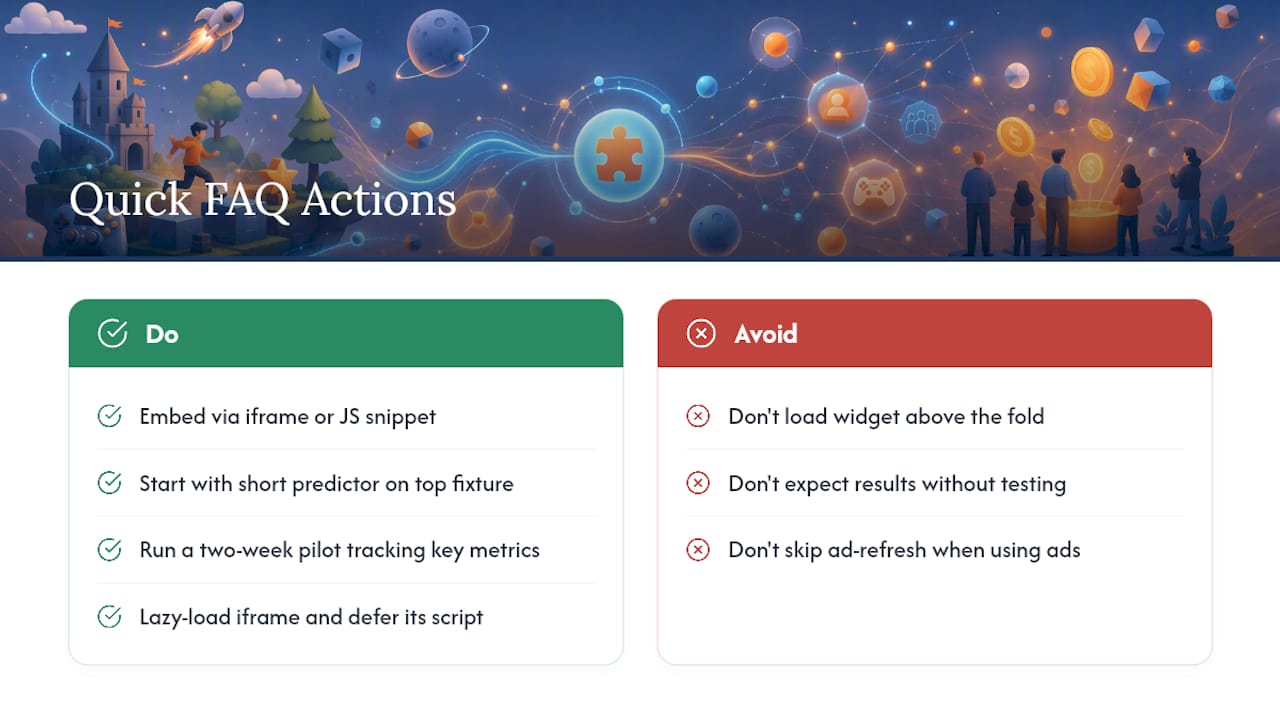
Will an embedded game slow down my page? It can, if you load it above the fold without deferring the script. Lazy-loading the iframe and deferring its JavaScript keeps your Largest Contentful Paint score intact while still letting the widget load once a reader scrolls near it.
Sources
- Retention goals: gamification — iGamingBusiness
- Gamification and the gameful experience in sports-branded apps — Journal of Product & Brand Management
- Mini-Games Solve the Publisher Problem That More Content Never Will — Riddle
- Interactive Widgets: A New Era in Content Engagement — Coruzant