
Interactive sports news, in its most useful form, is not an article at all. It is a playable fantasy pool, a match predictor, or a trivia widget that a fan clicks into instead of scrolling past. Publishers who want more time on site and repeat visits should embed HTML5 (H5) games and leaderboards directly into existing pages, and platforms like Megasports Arena already package this kind of content for free.
TL;DR:
- Embedding outcome-dependent games tied to live scores can significantly increase user sessions and registrations, with outbound registration rates reaching 60%.
- Using real-time data feeds for outcome-dependent games enhances trust and engagement by automatically updating scores and leaderboards during live events.
- Accessibility issues such as screen reader compatibility, color contrast, and keyboard navigation are common failures in sports widgets, requiring proactive testing before launch.
- Implementing a minimal setup with one predictor, one trivia game, and a leaderboard can provide clear engagement signals within a month for most publishers.
- Platforms like Megasports Arena offer pre-built, customizable games and leaderboards, significantly reducing the technical effort needed for publishers to deploy interactive sports content.
Table of Contents
- What counts as interactive sports content today?
- Do sports games actually move engagement numbers?
- How do you add a sports game widget to your site?
- What are the realistic monetization options?
- What should a minimum viable launch look like?
- Are interactive sports games accessible to all users?
- How does real-time data keep games current?
- Can fans customize their own interactive experience?
- Which platforms show this model actually works?
- How Megasports Arena gives publishers a turnkey path
- What I've learned from watching publishers run these games
- Sources
What counts as interactive sports content today?
Interactive sports content splits into two broad categories, and the distinction matters more than most publishers realize when they're picking a format.
Outcome-dependent games track real results. Predictors, team pickers, and match-based bingo cards ask fans to guess a score, draft a lineup, or fill a card as a game unfolds. These formats spike hard around live events and pull fans back day after day during a season, because the payoff (bragging rights, leaderboard rank, a prize) depends on something happening in the real world.
Outcome-independent games don't need a scoreboard. Quizzes, Wordle-style word puzzles, and general trivia work anytime, which makes them the better tool for filling the gaps between seasons or after a league's playoffs end. A basketball trivia widget still gets played in July.
Layered on top of either category, leaderboards and streak mechanics turn a one-off play into a habit. Daily challenges build short-term streaks, weekly leaderboards create a recurring reason to return, and seasonal campaigns (a full-season fantasy pool, for instance) hold attention for months. Delivery usually comes in one of four forms:
- Iframe embeds — fully isolated, simple to drop in, minimal styling control
- JavaScript widgets — load into a page element and inherit more of the site's look
- H5 games — browser-native, no download, work across desktop and mobile
- API-driven quizzes — pull fresh questions or data on each load, useful for daily rotation
Most publishers mix formats: a season-long predictor for engagement depth, a daily trivia widget for volume, and a leaderboard tying both together.
Do sports games actually move engagement numbers?
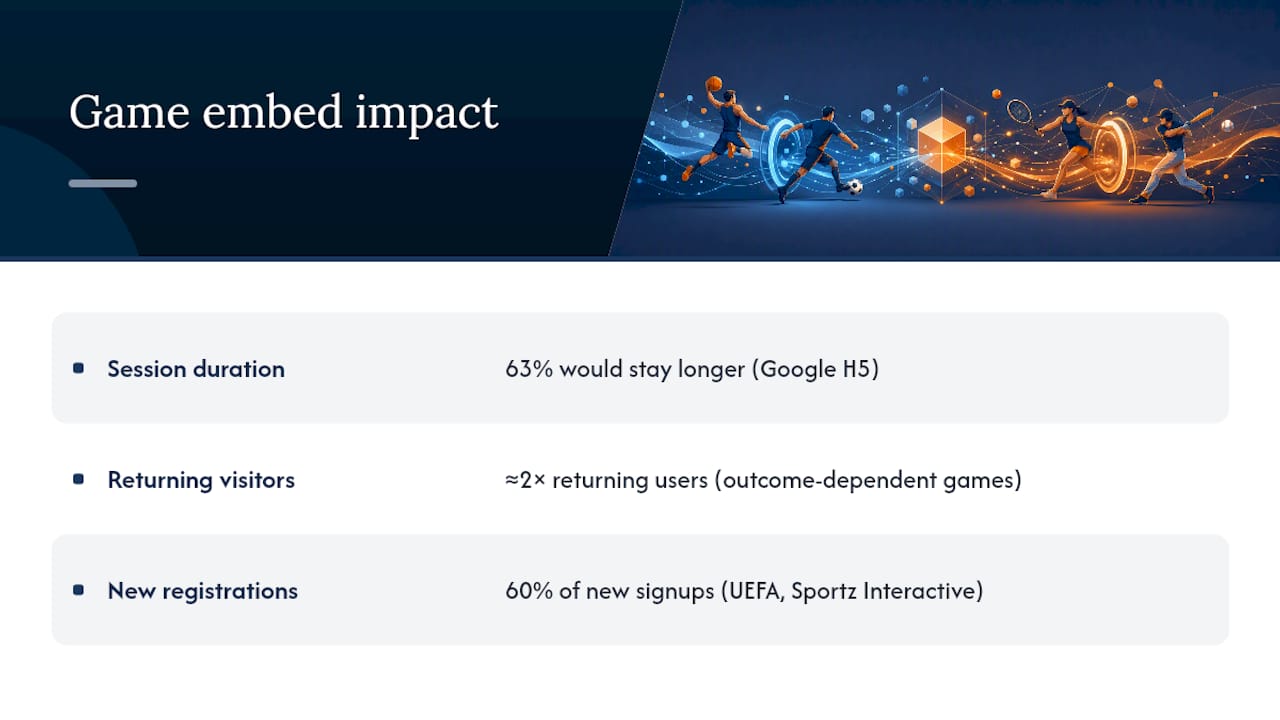
They do, and the gains show up in the exact metrics publishers already track. Google's research on H5 games found that 63% of people say they'd spend more time on a non-gaming site if it had an H5 game, and two-thirds said in-game ads didn't hurt the experience at all.
The number that matters: 63% of users report they'd stick around longer on a site specifically because it has a playable game embedded, according to Kantar research commissioned for Google's H5 gaming report.
Registration lift is the other big draw. Sportz Interactive's work with UEFA shows fantasy games driving 60% of new user registrations on the UEFA Champions League site, a first-party data win that matters more every year as third-party cookies fade. The same research found outcome-dependent games roughly doubling returning-user rates compared with games that don't hinge on a live result.
For a publisher deciding whether a game embed is working, three numbers tell the story: session duration on pages with the widget versus without it, the returning-visitor rate over a rolling 30 days, and new registrations attributable to the game itself. If none of those three move within the first month, the format or placement needs a rethink before the whole idea gets written off.
How do you add a sports game widget to your site?
Getting a game live takes less engineering time than most editorial teams expect, but skipping the planning steps causes most of the headaches later. Here's the order that works.
- Pick the placement first, not the game. Decide whether the widget lives in a dedicated game hub, inside individual articles, or in a rotating slot on the homepage. A hub concentrates traffic; in-article placement catches readers already engaged with a specific team or story.
- Choose your embed method. An iframe gives you clean isolation from your site's CSS, which is safer if your CMS theme is fragile. A JavaScript widget blends better visually but needs more testing across browsers. H5 games need neither a download nor a plugin, which is why Google flags them as the lowest-friction option for casual play.
- Set up domain authorization. Most widget providers require you to whitelist your domain before the embed renders, then let you configure colors and behavior in a live preview before copying the final HTML, CSS, and JavaScript fragments into your template, a workflow documented clearly by Sportmonks.
- Use CMS placeholders instead of hardcoding. A single embed placeholder that auto-rotates content lets you swap a daily quiz for a weekend predictor without a developer touching the page again, a pattern detailed in Riddle's engagement playbook.
- Run the pre-launch checklist. Confirm mobile load time, fire analytics events on game start and completion, and check for ad-slot conflicts if your site runs its own programmatic inventory alongside the widget's ads.
If you're embedding a scheduled puzzle rather than a live-score game, the CMS setup differs slightly. Megasports-arena's embed guide for sports logic puzzles walks through the placeholder pattern for editorial teams without dedicated developer support.
Pro Tip: Test the embed on a throttled mobile connection before launch, not just on office WiFi. A game that loads instantly on your desk can take eight seconds on a phone with weak signal at a stadium, which is exactly where a lot of sports engagement happens.
What are the realistic monetization options?
Free-to-play games monetize through the audience they build, not through entry fees, and that audience tolerates ads better than most publishers assume.
- Rewarded ads perform well inside games specifically: 70% of users in Google's H5 survey said they'd click a rewarded ad if it offered something back, like an extra life or bonus points.
- Interstitials between game rounds work but need frequency caps. Push too many and you erase the retention gains you built the game to capture.
- Sponsorships tie naturally to seasonal moments: a co-branded predictor for a playoff run or a trivia series sponsored by a regional brand tends to outperform a generic banner ad.
- Prize structures need a legal gut check. A sweepstakes with no purchase required runs very differently from a paid-entry contest under U.S. state law, and the rules differ by state. If you're offering prizes of real value, read Megasports-arena's contest rules guide for U.S. fantasy sports publishers before launch, and loop in counsel for anything beyond a low-value giveaway.
Keep ad load light early. A publisher's first game should feel like a bonus, not a second website to sit through.
What should a minimum viable launch look like?
You don't need ten games to test whether interactive content works for your audience. One predictor, one quiz, and a leaderboard tying them together is enough to read real signal within a month.
- Track session time on pages with the embed against a control set of similar pages without it.
- Watch returning-user rate over 30 days; outcome-dependent formats should show movement here first.
- Measure registration lift, especially if the game requires an account or email to save progress or compete on the leaderboard.
- If a sponsor is attached, track sponsor click-through rate inside the game unit separately from your site's normal ad CTR.
Worthwhile A/B tests at this stage: placement (hub page versus in-article), the call-to-action wording on the embed itself, how often a rewarded ad interrupts play, and whether the leaderboard is visible by default or requires a click to expand. Tag each of these with distinct analytics events so a lift in session time can actually be attributed to the game rather than to an unrelated traffic spike. Megasports-arena's breakdown of leaderboard gamification mechanics is a useful reference for structuring that leaderboard visibility test specifically.
Are interactive sports games accessible to all users?
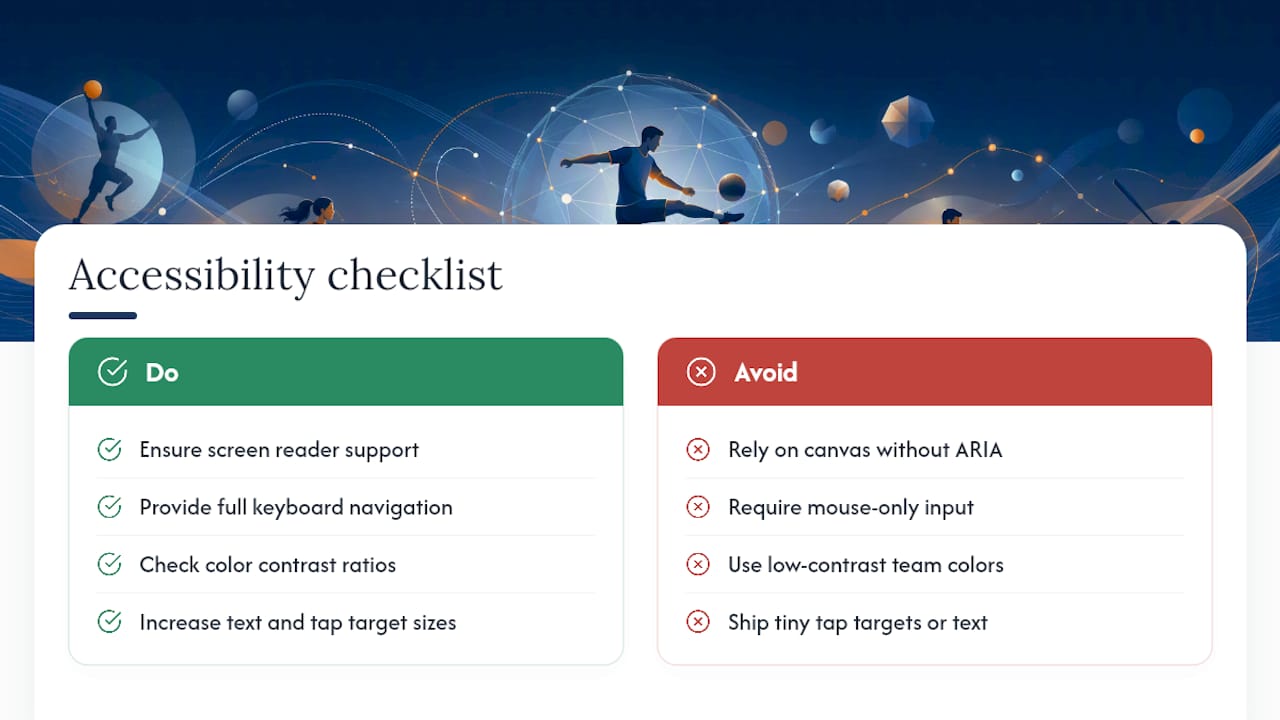
Accessibility is where a lot of otherwise strong embeds quietly fail, and it's worth building the checklist before launch rather than patching it afterward.
Screen reader compatibility comes first. An H5 game built purely on canvas rendering without ARIA labels is invisible to a screen reader, which locks out fans using assistive technology entirely. Keyboard navigation matters just as much: a predictor or trivia widget that only responds to mouse clicks or touch taps excludes anyone who navigates by keyboard, including many users with motor impairments.
Color contrast deserves specific attention in sports widgets, since team branding often leans on saturated colors that clash. A leaderboard rendered in a team's dark navy on black background might look sharp on a marketing mockup and fail basic contrast ratios for readability. Text size and tap-target size matter too. Fantasy pickers with tiny checkboxes are hard to use for anyone with limited fine motor control, and older sports fans in particular skew toward larger text preferences.
Captioning and alt text apply even to game widgets. If a trivia question references an image (a player photo, a stadium shot), that image needs alt text describing its relevant content, not just a filename.
None of this requires rebuilding a game from scratch. Most reputable H5 game and widget providers build to at least partial Web Content Accessibility Guidelines (WCAG) compliance already, but publishers should confirm that directly with a provider rather than assume it, especially for anything embedded via a raw iframe with limited configuration.
How does real-time data keep games current?
A predictor that shows yesterday's odds or a leaderboard that hasn't updated since last night's games loses trust fast, and sports fans notice within seconds.
Live score feeds and stats APIs are what keep outcome-dependent games honest. When a predictor locks picks at kickoff and then resolves them automatically once the final score posts, the game runs itself without an editor manually updating results. That automation is the difference between a game that scales to dozens of games a week and one that needs a staffer checking scores by hand.
Leaderboards benefit the same way. A leaderboard that refreshes in near real time during a live event, rather than batching updates once a day, keeps competitive fans checking back multiple times during a game, which is exactly the repeat-visit behavior publishers want. The technical lift for this typically runs through the same widget provider handling the game itself. Sportmonks, for example, structures its widget configuration around live data feeds that update the embedded display without a page reload.
The tradeoff is technical: real-time data feeds cost more and require more robust error handling than static or daily-batch content. A trivia quiz doesn't need live data at all, which is one more reason to run outcome-independent formats when you don't have the infrastructure budget for a live feed yet, and add outcome-dependent games once that pipeline exists.
Can fans customize their own interactive experience?
Personalization is where interactive sports content starts to feel less like a generic widget and more like something built for the individual fan, and it's increasingly what separates games people play once from games they play every week.
Team-based filtering is the simplest layer: a fan picks a favorite team once, and the predictor, trivia deck, or leaderboard view defaults to content about that team going forward. This alone cuts the friction of digging through irrelevant matchups.
Difficulty settings do similar work for trivia and puzzle formats. A casual fan and a die-hard stat-tracker want different question depth, and letting either self-select (rather than forcing one difficulty on everyone) keeps both segments playing longer. Custom DIY pools, where a fan builds their own prediction contest and invites friends, push personalization further still by letting the format itself bend to a private group's rules rather than a publisher's default setup.
The fantasy sports market's continued growth is being driven in part by exactly this kind of mobile-first, AI-assisted personalization, as platforms increasingly tailor question sets, matchups, and difficulty to individual play history rather than showing every fan the same static widget.
Which platforms show this model actually works?
The clearest proof point comes from major sports organizations that built fantasy and prediction games directly into their official properties. UEFA's fantasy game, tied to the Champions League, became a registration engine in its own right: Sportz Interactive's case data shows it responsible for 60% of new site sign-ups, with some deployments doubling unique users across two seasons.
That pattern isn't limited to leagues with broadcast rights and massive marketing budgets. Smaller publishers running scheduled mini-games through embed placeholders have reported similar recurring-visit patterns once a game becomes a habitual part of a reader's routine, according to the Riddle engagement playbook, which documents daily and weekly refresh cycles as the mechanism behind that repeat behavior. The common thread across every successful deployment: the game is tied to something happening in the sport right now, whether that's a live match, a season opener, or a rivalry week, rather than sitting as generic, dateless content on the page.
Trivia-first platforms prove the inverse case works too. Sites built around general knowledge and trivia formats sustain traffic through off-seasons precisely because they don't depend on a live scoreboard, giving publishers a reason to run at least one outcome-independent format alongside their seasonal predictors, a balance Megasports-arena covers in more detail in its look at trivia format alternatives.
How Megasports Arena gives publishers a turnkey path
Building all of this from scratch, live data feeds, leaderboard logic, mobile optimization, and accessibility compliance, is a real engineering lift for most sites. Megasports-arena solves that by handing publishers pre-built, free-to-play games ready to embed instead of build.
The catalog covers multiple formats so you're not locked into one engagement style. Sports Match and Sports Hash run as outcome-dependent picks tied to live games, while Sports Rummy offers a card-based format that plays well independent of any single match result, giving you both the seasonal-spike format and the steady, year-round option in the same lineup. Every game comes with a built-in leaderboard, so the repeat-visit mechanic that Sportz Interactive's UEFA data points to is already wired in, not something you build separately.
For publishers, the model is straightforward: link to or embed a Megasports-arena game, and the platform handles the game logic, the live scoring, and the leaderboard updates. Fans play for free, and your site captures the engagement lift, longer sessions, more return visits, without a development sprint. Start by trying Sports Rummy directly to see the format in action, or check the Sports Rummy leaderboard to see how the competitive layer displays before deciding where to embed it on your own site.
What I've learned from watching publishers run these games
The publishers who get real traction with sports games are the ones who treat them as an editorial beat, not a one-time widget install. A predictor tied to nothing happening this week is just a form. A predictor tied to Sunday's slate, promoted the way you'd promote any other piece of content, is a habit.
The mistake I see most often is publishers launching a game, checking traffic once, and moving on when the numbers don't spike immediately. Games build engagement on a curve, not a cliff. Give a leaderboard four to six weeks before judging it.
Three things worth doing this week: pick one outcome-dependent format and one trivia format so you're covered in season and out. Set up analytics events on game start and completion before launch, not after. And check your embed on a slow mobile connection, because that's where most sports engagement actually happens.
If you're ready to test this on your own site, Megasports Arena's game pages are built to embed with minimal setup. Try one and watch what happens to your return-visitor rate.
— peter
Sources
- Boost revenue & engagement with H5 games - Think with Google APAC
- Let the Games begin! How can global sports orgs win the Game of fan engagement?
- Mini-Games, Leaderboards & the New Engagement (Riddle playbook)
- How to use Sportmonks widgets in your web application