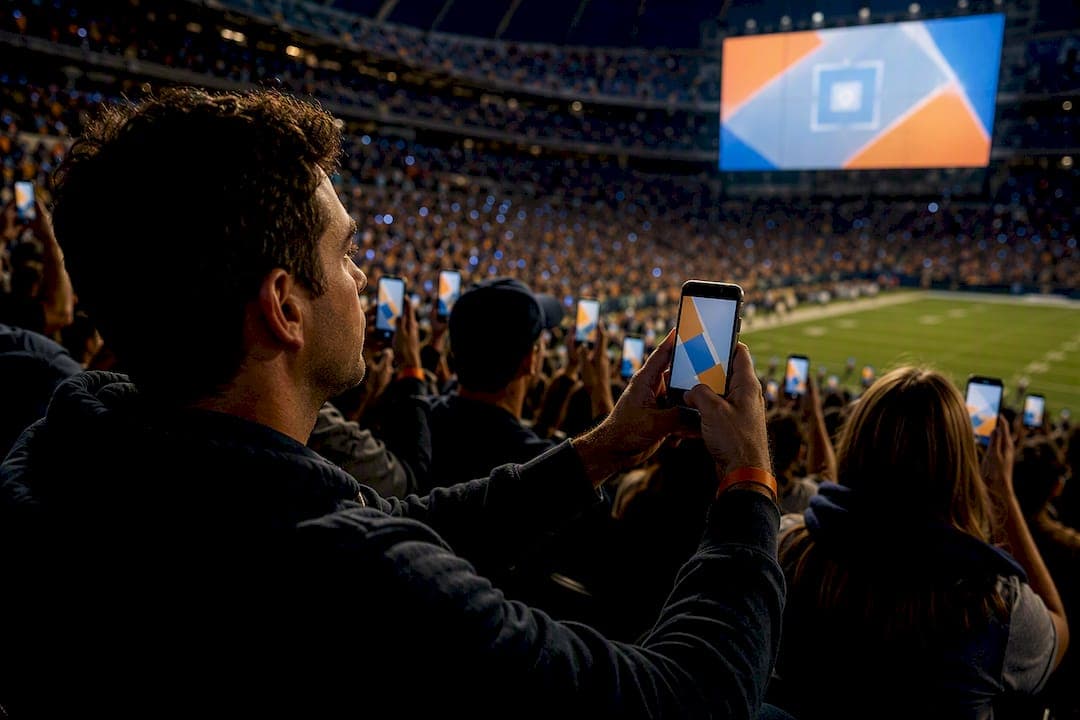
Run a live prediction contest or a halftime poll before you build anything bigger. Prediction and fantasy contests, live polls and quizzes, stadium-wide QR quick plays, and recurring leaderboards are the four formats with the clearest track record: NBA in-app prediction challenges hit 65% participation among active app users in a 2024 season pilot, and the Bundesliga's fantasy game attracted a large number of registered players in one season. Start small. An embeddable predictor or halftime poll, like the templates Megasports Arena builds for publishers, is the fastest way to test whether fan engagement games actually change behavior before you commit budget to anything bigger.
TL;DR:
- Starting with small, embed-driven prediction or halftime polls is the fastest way to test if fan engagement activities influence behavior before investing heavily.
- Stadium-wide QR quick plays and synchronous stadium contests generate high peak participation by leveraging the in-game attention window and simplicity of mechanics.
- Engagement metrics like participation rate, return rate, and CRM capture should be tracked from the beginning to measure success and optimize ongoing activity.
- Embed games should load quickly on mobile devices and be compatible across all platforms, with minimal friction and no need for native app development.
- Legal, privacy, and compliance considerations, including age restrictions and explicit consent, are essential for prize-based activities to avoid legal issues and build trust.
Table of Contents
- Fan Engagement Games Worth Building First
- How to Deploy a Fan Engagement Game Without Overbuilding
- Measuring Whether Your Fan Engagement Games Actually Work
- Turning Fan Games Into Sponsor Revenue
- Templates You Can Reuse This Season
- Making the Most of Halftime and In-Stadium Moments
- Embedding Games on Your Site Without a Dev Sprint
- Personalization and Segmentation That Actually Lift Engagement
- Mobile and Multi-Platform Compatibility
- Legal Considerations and Compliance for Fan Engagement Games
- What to Prioritize This Season
- Try a Ready-Made Game Before You Build One
- Sources
Fan Engagement Games Worth Building First
Not every gamification tactic deserves equal investment. Some formats are near-zero effort and pay off within a single match. Others need a season of planning. Here's how to rank them.
-
Prediction and fantasy contests. A short match predictor (pick the final score, name the first scorer) takes minutes to play and works as a repeatable weekly hook. Season-long fantasy, by contrast, demands more setup but buys deeper loyalty. Bundesliga's fantasy participants watch more matches and spend more on merchandise than fans who never touch the game, according to fan engagement research from Bright Byte. Run predictors weekly; save fantasy leagues for full-season campaigns.
-
Live polls and quizzes. In-app polls during broadcast breaks and stadium-screen trivia between innings give fans a 30-second decision point. NBA's in-broadcast prediction challenges demonstrate that well-timed prompts during natural pauses can drive significant real participation.
-
Stadium-wide synchronous quick plays. QR-triggered, no-download games that thousands of fans play at the same moment produce outsized peak participation and social amplification, since everyone in the building is playing (and posting) at once. Keep the mechanic dead simple: scan, tap, win or lose, share.
-
Leaderboards and recurring community challenges. A season-long leaderboard tied to weekly predictor accuracy keeps fans opening the app between matches, not just during them. This is the format that turns a one-off activation into a habit.
-
Loyalty points and reward mechanics. Points earned from participation, redeemable for merchandise discounts, ticket upgrades, or exclusive content, give fans a reason to keep playing even in weeks when the team is on a bye or the season's outcome feels decided.
-
Social and user-generated content games. Caption contests, "guess the player" photo challenges, and share-to-unlock mechanics work best with a light guardrail: cap entries per user and moderate submissions before they go live, so the fun doesn't turn into a spam problem.
Pro Tip: Pick one format from this list and one KPI before your next home game. Trying to launch four new games at once is how engagement programs die in committee, not in the stands.
How to Deploy a Fan Engagement Game Without Overbuilding
Most of the friction in launching sports fan activities isn't creative, it's operational. Decide your delivery method first: an embed widget on your existing site or app is the fastest path, a native app build is the slowest and most expensive, and SMS-based games work well for older or lower-bandwidth audiences but cap out on visual richness. For most marketers, embedding wins on speed.
Keep entry frictionless. QR-scan-to-play or a one-tap in-app entry, with minimal identity capture (email or existing account only), converts far better than any flow that asks for a full sign-up before the fun starts.
Before you go live, run through this checklist:
- Assign a moderator to watch for inappropriate submissions in real time.
- Assign a separate prize handler so redemption doesn't create concourse lines.
- Run a legal and compliance check on prize value and eligibility rules.
- Set a fulfillment timeline for prizes so winners aren't waiting weeks.
- Test the embed in staging first, then verify CDN load and analytics tagging before the live match.
- Build in an alternative entry path (non-QR, non-app) for fans without smartphones or with accessibility needs.
Halftime stadium plays specifically need about a one-week production lead for content and testing, plus a two-person day-of operations team, one on tech and one on prize handling, with an automated redemption flow so winners aren't stuck in line.
Measuring Whether Your Fan Engagement Games Actually Work
Track four numbers from day one: participation rate (entries divided by eligible audience), repeat return rate (how many players come back for the next contest), time-on-platform during game windows, and CRM capture rate (how many players hand over an email or account link). Set a baseline in your first two events, then compare against a rolling cohort window rather than a single game.
By the numbers: NBA's in-game prediction challenges reached 65% participation among active app users during a 2024 season pilot, one of the clearest data points showing how high engagement can climb when the prompt lands during a natural broadcast pause.
Report weekly during the season and roll up a season summary for sponsors and leadership. Worthwhile A/B tests include push notification timing (pre-game vs. halftime), reward presence vs. no reward, and question difficulty. For commercial attribution, link CRM data from game entries directly to ticket renewals and merchandise purchases; disconnected tools that don't talk to your ticketing platform rarely translate engagement into revenue.
Turning Fan Games Into Sponsor Revenue
Sponsor-branded trivia and polls with a tracked call-to-action button turn a fun moment into a measurable lead. Coupon-based redemption, where a correct answer or contest entry unlocks a sponsor discount, gives sponsors a real conversion number instead of a vague impression count.
- Track CTA clicks separately for every sponsor-branded question or poll.
- Swap a visible prize for a sponsor coupon in an A/B test; a matched two-event test typically shows a measurable conversion lift that justifies a bigger sponsor package.
- Report participation and lead capture numbers back to sponsors as the deliverable, not just reach.
- Package opt-in segments (with proper privacy consent) as a sellable audience for future sponsor campaigns.
Templates You Can Reuse This Season
Megasports Arena's own five-step embed guide for publishers works as a practical checklist, not just a reference. Three templates carry over across sports and venues:
- Quick predictor: one question, instant result, reusable every match day.
- Halftime stadium play: QR-triggered, synchronous, built for the concourse and the seats at once.
- Season leaderboard: cumulative scoring across a full schedule, designed to keep fans checking back weekly.
| Template | Setup effort | Best use case |
|---|---|---|
| Quick predictor | Low | Weekly match-day hook |
| Halftime stadium play | Medium | In-venue peak moments |
| Season leaderboard | Medium to high | Season-long retention |
Track your own participation percentages and week-over-week app opens against these templates. Real numbers, not borrowed ones, are what convince a sponsor or a general manager to fund the next round.
Making the Most of Halftime and In-Stadium Moments
The halftime window is the single highest-attention, lowest-distraction moment you get all game. Fans are seated, phones are out, and there's nothing else competing for their focus for roughly 15 to 20 minutes. That's exactly why QR-triggered stadium-wide plays outperform almost any other single tactic for peak participation.
The mechanic matters less than the speed. A "guess the next play" quick vote, a synchronized trivia round flashed on the jumbotron, or a scan-to-spin prize wheel like Wheel of Sports all work because they resolve in under a minute and give an immediate result. Drag the mechanic out past two minutes and you lose the room.
Prize structure needs a plan before kickoff, not during halftime. Digital prizes (loyalty points, discount codes) fulfill instantly and never create a concourse line. Physical prizes (merchandise, tickets) need a claim window and a staffed redemption point, or you'll spend more staff hours managing the winners than you spent building the game.
Don't skip the social layer. A stadium-wide activation that ends with a shareable result card, "you ranked in the top 200 of 40,000 fans", turns an in-venue moment into free reach on every attendee's social feed. That's the social amplification effect that makes synchronous stadium plays worth the production lead time, even for a mid-season, non-marquee matchup.
Embedding Games on Your Site Without a Dev Sprint
The technical bar for embedding a fan engagement game on your own site is lower than most marketing teams assume. A well-built embed is a snippet, not a build project. You drop a script tag or iframe into an existing page, no app store submission, no backend database to maintain, and the game runs inside your existing traffic instead of asking fans to leave your site for a third-party app.
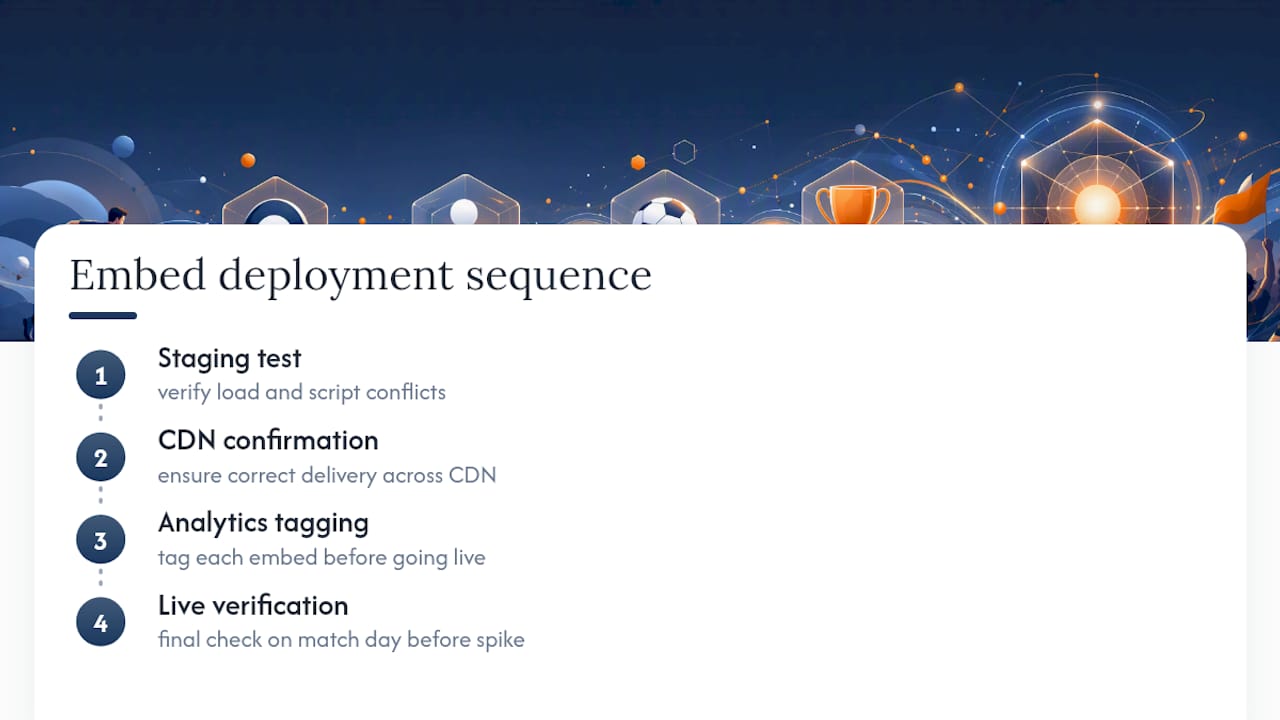
The sequence that actually works: test the embed in a staging environment first, confirm it loads correctly across your CDN, tag it for analytics before it ever goes live, then do one final live verification pass on match day before traffic spikes. Skipping the staging step is the single most common reason an embedded game breaks mid-launch, usually a script conflict with existing site code that nobody catches until thousands of fans hit the page at once.
Embed-first deployment also changes the math on how many concepts you can test. Instead of committing engineering hours to one big platform, you can run a predictor this week, a trivia embed next week, and a leaderboard the week after, all without a new development cycle for each one. That speed is the real argument for embeddable games over a custom-built app: publishers testing multiple concepts in parallel learn faster than teams committed to one big platform bet.
If you're running games across multiple site sections, tag each embed distinctly in your analytics setup from day one. Trying to retrofit tracking after three months of mixed data is a bigger headache than tagging correctly the first time.
Personalization and Segmentation That Actually Lift Engagement
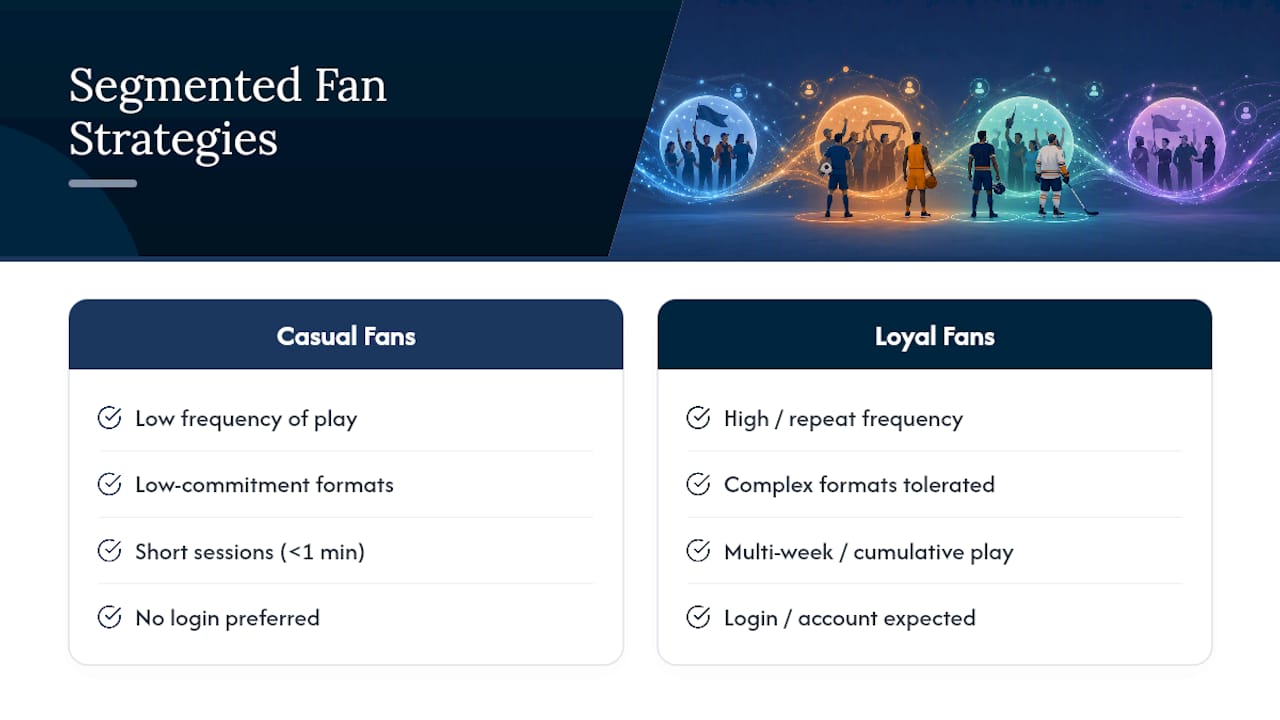
A predictor that asks the same question to a die-hard season-ticket holder and a casual fan who found your site through a search result is leaving engagement on the table. Segment by behavior, not just demographics: frequency of play, favorite team or player selections, and past prize redemption history all predict what kind of game hooks a given fan.
Casual fans respond better to low-commitment, instant-gratification formats: a single-question poll, a quick trivia round, something that resolves in under a minute with no login required. Season-ticket holders and app power users tolerate more complexity, multi-week fantasy leagues, cumulative leaderboards, point-based loyalty tiers, because they've already shown they'll come back.
Segmentation also shapes your reward strategy. Offering the same generic discount code to every player regardless of engagement history undervalues your most loyal fans and overvalues one-time players. A tiered structure, bigger rewards unlocked after a run of consistent participation, does more to build repeat return rate than a flat prize pool ever will.
Where personalization gets tricky is data collection. You don't need a full CRM profile to segment meaningfully. Even a simple flag ("has this fan played three or more times this season?") is enough to split your push notification strategy into two tracks: a re-engagement nudge for lapsed players and a "climb the leaderboard" nudge for active ones.
Mobile and Multi-Platform Compatibility
Most fans will hit your game on a phone, often on stadium Wi-Fi that's slower than home broadband during a packed match. Build for that reality first. A game that loads in three seconds on a strong connection but times out on congested stadium Wi-Fi loses the exact audience you built it for.
Design the interface for one-thumb play. Fans are holding a drink, a phone, and sometimes a kid's hand at the same time; a quiz that requires precise multi-tap sequences or small text will lose entries to frustration, not disinterest. Keep buttons large, keep questions short, and keep the whole interaction under two minutes wherever possible.
Cross-platform consistency matters more than platform-specific polish. A fan who plays a predictor on their phone during the game and checks the leaderboard on a laptop the next morning expects the same login, same score, same interface logic. Embeds that run identically across iOS, Android, and desktop browsers avoid the maintenance burden of building and syncing separate native apps.
Legal Considerations and Compliance for Fan Engagement Games
Prize-based games trigger legal review the moment real value changes hands, regardless of how casual the mechanic looks; for inspiration on fan apparel and lifestyle tie-ins see game day outfits from Lion Streetwear. Sweepstakes and contest laws vary by state and, if you operate internationally, by country; what qualifies as a legal "game of skill" versus a regulated "game of chance" often depends on whether winning requires a decision from the player or is purely random. Confirm this distinction with legal counsel before launch, not after a complaint.
Age eligibility needs an explicit rule, especially for anything involving alcohol-brand sponsors or cash-value prizes. Data privacy compliance matters just as much: any email, account link, or demographic data captured during entry falls under whatever privacy framework applies to your audience's location, and that consent needs to be explicit at the point of entry, not buried in a terms-of-service link nobody reads.
Official rules, no-purchase-necessary language where required, and a clear odds-of-winning disclosure protect you as much as the fan. Build a standard legal template once, with your counsel, and reuse it across every future game rather than drafting rules from scratch each time.
What to Prioritize This Season
Skip the elaborate platform build. Start with one low-friction game that captures CRM data, an embedded predictor or a halftime poll, and get it running this month. Reuse that same embed across three or four different activations before you build anything new; the 25 Fan Engagement Ideas playbook makes the same case for treating engagement as a 365-day calendar, not a single big launch. Measure fast, kill what doesn't move participation, and put revenue-linked activations, sponsor CTAs, renewal-page games, ahead of novelty for its own sake.
— peter
Try a Ready-Made Game Before You Build One
Some platforms provide embeddable fantasy, prediction, and trivia games with leaderboards and templates already built, allowing you to skip the engineering sprint entirely and start with a live, tested product. Instead of scoping a custom predictor from zero, you can launch something fans are already playing.

Start with the sports rummy live-play demo to see the mechanic before you commit to anything. If leaderboard-driven retention is your priority, the sports rummy leaderboard shows how the recurring-challenge format plays out over a season, and the how-to-play guide walks through setup in plain language. If you'd rather see a shorter, prize-wheel style activation for a stadium screen, check the Wheel of Sports demo. Pick one, embed it on a single page this week, and measure the participation rate before you decide what to build next.
Sources
- Fan Engagement Platforms for Sports Teams: What Works in 2026
- 25 Fan Engagement Ideas That Actually Move the Needle in 2026 | Life Inside