
The fastest, lowest-risk way to host sports contests on your site is to embed a ready-made, JWT-secured iframe or web component from an established fantasy-game platform, such as Megasports Arena, rather than building one from scratch. Run a two-week pilot, watch your entry rate as the first signal, and expect a measurable jump in daily visits if the format fits your audience.
TL;DR:
- Embedding a JWT-secured fantasy game widget enables rapid deployment and measurable user engagement without extensive custom development.
- Starting with a simple iframe for quick launch and gradually upgrading to SDK-based controls optimizes control without delaying initial testing.
- Using daily micro-contests combined with weekly marquee events, along with sponsor-funded prizes, drives consistent repeat visits.
- Legal compliance is simplified by avoiding cash prizes initially, focusing instead on recognition rewards and sponsor partnerships to minimize regulatory hurdles.
- Monitoring key metrics such as entry rate, retention, and engagement from day one ensures early insights into contest success and guides format adjustments.
Table of Contents
- What's the Fastest Way to Host Sports Contests on Your Site?
- Two-Week Pilot Checklist to Launch a Contest Fast
- iFrame vs. SDK vs. API: Which Integration Pattern Fits?
- Which Contest Formats and Prize Models Keep Visitors Coming Back?
- What Compliance and Moderation Steps Do U.S. Publishers Need?
- Which Metrics Actually Prove a Contest Is Working?
- What Publishers Actually Learn From Running Embedded Contests
- How Megasports Arena Helps You Launch Contests Without the Build
- What to Read Next Before You Build
- Sources
What's the Fastest Way to Host Sports Contests on Your Site?
Publishers who want to run sports contests without hiring a development team have two real options: build a custom platform with live-data feeds and payment rails, or embed an existing widget. Building from scratch means integrating providers like Opta or Sportradar for live stats plus a payment stack for prizes, which pushes cost and timeline well beyond what most publishers can justify. Embedding skips all of that.
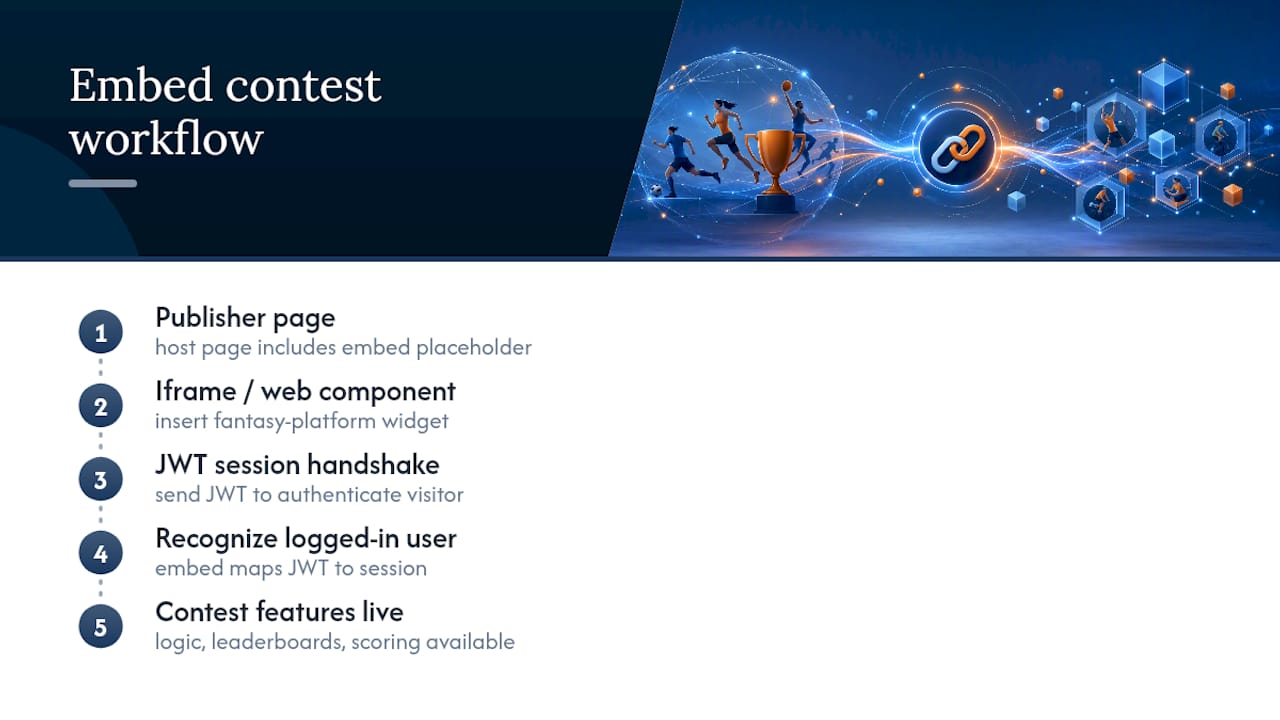
An iframe or web component from a fantasy platform gives you contest logic, leaderboards, and scoring out of the box. You add a JWT-based session handshake so the embedded game recognizes your logged-in visitors, and you're live. Guides on building fantasy sports sites confirm that modular embeds paired with first-party analytics deliver measurable retention gains while keeping engineering costs low. That's the whole case for embedding over building: you trade a few weeks of integration work for months of custom development.
Two-Week Pilot Checklist to Launch a Contest Fast
You don't need a roadmap to test this. You need two weeks and a narrow scope.
- Pick a pilot format. Start with a daily micro-contest (a quick pick'em or poll) plus one weekly marquee contest to anchor the cadence.
- Choose your embed method. An iframe URL launcher gets you live fastest; a web component gives richer, more native-feeling UX if your dev team has a few extra days.
- Decide the prize model up front. Sponsor-funded prizes or recognition-only rewards (badges, leaderboard credit) avoid cash-payout complexity during the pilot.
- Wire up authentication. Use a JWT token for logged-in users and a guest quick-entry path for everyone else, so signup friction doesn't kill your entry rate.
- Instrument analytics before launch, not after. Track entry rate, daily active users, and retention from day one.
- Soft-launch to your most engaged readers first, then widen access once you've caught any breaks in the entry flow.
This sequencing matters more than the tools you pick. Playbooks built around daily micro-contests and weekly marquee events consistently show this cadence outperforming one-off, high-stakes contests for early retention, mostly because it gives lapsed visitors more chances to come back in.
iFrame vs. SDK vs. API: Which Integration Pattern Fits?
The integration pattern you choose depends on how much control you need over the visitor experience versus how fast you need to ship.
A simple iframe URL launcher is the right call when you just need the contest live on a page with minimal custom styling. Point an iframe at the game URL, pass a session token in the query string or via postMessage, and you're done. This is the pattern most publishers should start with.
A chatty iframe or web component paired with a JavaScript SDK is worth the extra build time when you need two-way communication: passing score updates back to your page, syncing user state, or triggering events on your own analytics stack. Xtremepush's integration docs show this pattern well, with iframe IDs and SDK-level event hooks handling parent-child communication between your site and the embedded game.
On the backend, a handful of endpoints handle almost everything: a session check, a FetchPunterDetails call to pull user profile data, and Debit/Credit and Rollback endpoints if you're tracking any point-based currency. Sportradar's iGNITE integration toolkit documents this exact endpoint set and recommends the parent/child SDK pattern specifically for secure session propagation.
A few technical details save real headaches later:
- Generate a unique
frameIdper embed instance to avoid session collisions on pages running multiple widgets. - Configure CORS explicitly rather than relying on wildcard origins, especially once you add a JWT layer.
- Pass
activeLocaleand currency codes at initialization, not after load, so localized scoring doesn't flicker on first render. - Test your mobile template separately. Contest UIs that look fine on desktop often clip leaderboards on smaller screens.
Pro Tip: Preloading the SDK on your homepage or lobby page, before the visitor even clicks into the contest, cuts perceived load time dramatically and lets you personalize the experience the moment the game opens.
Which Contest Formats and Prize Models Keep Visitors Coming Back?
Format choice drives repeat visits more than almost anything else in this setup. Daily fantasy lineups reward deep engagement but ask a lot of a casual visitor's time. Pick'em contests (straight win/lose or against-the-spread picks) hit a sweet spot: low effort, clear stakes, and quick resolution. Head-to-head matchups add a social layer that keeps two users checking back on the same contest. Mini-games and polls carry the lowest friction of all and work well as a daily habit-builder that a marquee weekly contest can't sustain by itself.
A few practices consistently drive repeat entries:
- Combine daily micro-contests with one weekly marquee event, and reset leaderboards on a visible, predictable schedule.
- Offer one-click entry for logged-in users and social sign-in for new visitors. Every extra form field costs you entries.
- Start prizes as badges, site credit, or sponsor-funded rewards before introducing anything cash-based. This keeps compliance simple while you prove the format works.
- Keep scoring math visible and show entry streaks. Visitors who can see they're on a streak return specifically to protect it.
Sponsor-funded prize pools also open a monetization angle early, since a local business or advertiser gets contest-level visibility without you touching payout logistics. That's worth exploring before paid entry ever comes onto the table.
What Compliance and Moderation Steps Do U.S. Publishers Need?
Cash prizes change everything legally, so the pilot phase should avoid them entirely if possible. Recognition-based or sponsor-funded prizes sidestep most of the regulatory weight while you're still testing format and demand.
A workable baseline checklist:
- Confirm age eligibility (typically 18+) before allowing entry into any contest with a prize attached, cash or not.
- Geo-fence cash-prize contests, since sweepstakes and skill-game rules vary by state. Sponsor-funded or recognition prizes avoid this entirely for a pilot.
- Publish clear terms: entry rules, prize description, odds or scoring method, and payout process, all visible before entry, not buried in a footer link.
- Route any cash payouts through a process that flags tax-reporting obligations rather than treating them as an afterthought.
- Set up a moderation pipeline with automated filters for obvious abuse and a human reviewer for anything a bot can't judge, especially community tips or comment threads tied to the contest.
- Build in duplicate-account detection and basic rate limits from day one. Rollback endpoints for reversing bad transactions matter more once real prizes are on the line.
Pro Tip: A documented moderation and launch checklist built before launch, not after your first flagged post, saves you from scrambling once a contest actually gets traction.
Which Metrics Actually Prove a Contest Is Working?
Five numbers tell you almost everything: daily active users, entry rate (entries divided by visitors who saw the contest), entries per user, day-1 and day-7 retention, and click-throughs from any contest-linked newsletter. Track them from launch, not after week three.
Run these tests early:
- Compare entry friction: one-click entry for logged-in users versus a full signup form for new visitors.
- Test prize type: sponsor-funded reward versus pure recognition (badge, leaderboard rank) to see which drives more repeat entries.
- Test contest cadence: daily-only versus daily-plus-weekly-marquee.
Publishers instrumenting core events, entry, leaderboard update, and prize claim, with server-side analytics get a clearer read on long-term retention than those relying on cookie-based tracking alone, since server-side event capture holds up better as personalization needs grow.
For monetization, keep it light early: a sponsor-funded prize pool or a native ad placement near the contest UI, not inside it, both work without disrupting the experience. Save premium paid contests for once your moderation and fraud controls are proven. And never gate the core contest behind an ad interstitial. That single decision kills more entry rates than any format choice ever will.
What Publishers Actually Learn From Running Embedded Contests
The net benefit of embedding is straightforward: higher visitor retention for a fraction of the engineering effort a custom build demands. A publisher running a daily pick'em alongside a weekly marquee contest typically sees entry rate stabilize within the first ten days, once the format and prize model settle into a predictable rhythm.
Two patterns show up again and again. First, contests with visible streaks retain better than contests that reset scoring silently. Second, sponsor-funded prizes outperform cash prizes in early pilots, not because the prize matters less, but because the friction of a cash payout process quietly suppresses entries. If you're starting from zero, pick one simple format, secure the session handshake properly, and measure entry rate before you touch anything else.
— peter
How Megasports Arena Helps You Launch Contests Without the Build
A fantasy and prediction games platform can provide publishers a library of ready-to-embed games, helping to avoid the months of custom development a live-data-and-payments build would otherwise demand. These platforms often cover multiple sports and include embed widgets, contest scheduling, leaderboards, and rewards points to facilitate contest management.

For a publisher weighing a from-scratch build against an embed, the practical case is simple: These games typically arrive with scoring, leaderboards, and session handling already managed, enabling a pilot launch in days rather than months. You get contest scheduling and archived results alongside sponsor-friendly prize structures without writing a line of backend logic. A compact widget like Wheel of Sports works well as a sidebar pilot if you want to test entry rates before committing to a full leaderboard integration. For something with more contest depth once your pilot proves out, the Sports Rummy play page shows a fuller format in action. Check either page, grab the embed code, and get a contest live before your next content sprint ends.
What to Read Next Before You Build
Three resources round out what's covered here. The Xtremepush integration docs walk through SDK event hooks in detail. The community-driven fantasy content playbook covers moderation sequencing. And Tresor.tech's fantasy sports build guide lays out the full-build alternative if you ever outgrow embeds.
Sources
- accjack — Xtremepush docs
- iGNITE integration toolkit — Sportradar docs
- Community-driven fantasy content playbook — Blogweb
- Tresor