
The fastest way to prevent contest cheating is a layered approach: real-time detection, enforceable rules, and human review working together instead of any single filter carrying the load. That means graph-based detection to catch linked accounts, SHA-256 lineup commitment hashes to lock in entry timing, and a trained reviewer checking anything a machine flags but can't confidently resolve. This approach should be treated as an operational discipline, not a one-time setup, and the steps below give a practical roadmap that starts with actions implementable immediately.
TL;DR:
- Limiting entries per device and household IP, enforcing server-side lock times, and publishing clear rules can significantly reduce fraud within the first week.
- Layered detection strategies combining identity verification, device signals, behavioral analytics, and payment monitoring create a more effective fraud prevention system.
- Graph-based detection scales for large platforms by identifying coordinated accounts through shared attributes and activity patterns, with real-time and batch analysis complementing each other.
- Commitment hashes provide a cryptographic proof of lineup timing, preventing late swaps and backdating exploits during contests.
- Combining automated scoring with human review for mid-confidence cases ensures accurate enforcement while maintaining player trust and engagement.
Table of Contents
- What to Enable Right Now to Stop Contest Cheating
- The Layered Detection Model: Identity, Device, Behavior, and Payments
- Graph-Based Detection for Multi-Accounting and Collusion
- Proving Lineup Timing with Commitment Hashes
- Turning Detection Into Action: The Enforcement Playbook
- A 12-Month Roadmap for Reducing Contest Fraud
- Where Human Review Fits in Automated Enforcement
- Teaching Players the Rules Before They Break Them
- Securing Player Data and Contest Traffic
- What Post-Contest Data Reveals About Fraud Patterns
- When to Bring in Third-Party Fraud Detection Tools
- Operator Perspective: Integrity Without Killing the Fun
- Try an Embeddable Contest Built for Integrity
- Sources
- FAQ
What to Enable Right Now to Stop Contest Cheating
You don't need a data science team to close the biggest holes. Most contest fraud exploits gaps that a few configuration changes shut down within a day.
Start with these:
- Turn on signup throttles and limit entries per device and per household IP range.
- Enforce lock times at the server level, not the client, so no lineup submission slips through after kickoff.
- Add step-up verification (a phone or ID check) that triggers automatically on withdrawal requests over a set threshold.
- Run nightly pairwise lineup overlap reports comparing entries against expected patterns for that slate.
- Suspend or pause vulnerable contests briefly after breaking lineup news, when late-swap collusion risk spikes.
Beyond the numbered steps, two things belong on every operator's public-facing checklist:
- Publish contest rules and appeal instructions somewhere a player can find them in under 30 seconds.
- Log every rule change with a timestamp so enforcement decisions can be defended later.
None of this requires new infrastructure. It requires deciding, this week, that these switches get flipped.
The Layered Detection Model: Identity, Device, Behavior, and Payments
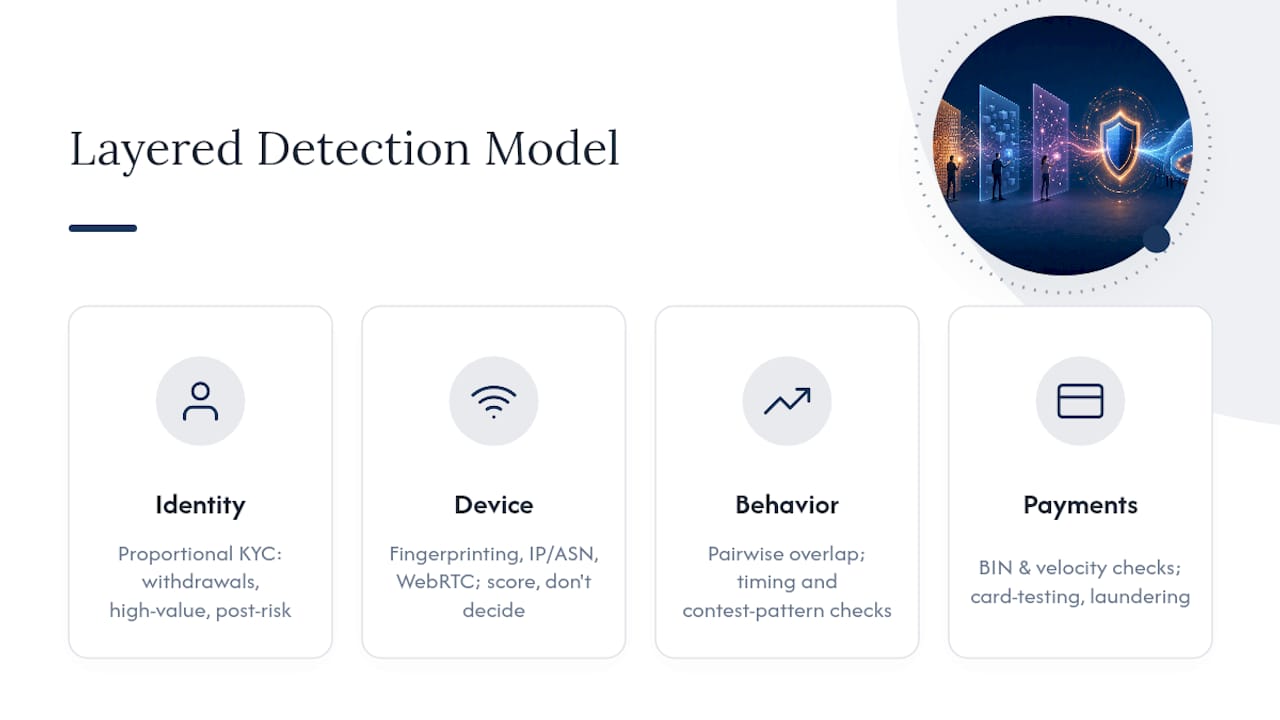
No single signal proves cheating. A shared IP address might mean two roommates, not one operator running six accounts. The strength of layered detection is that weak individual signals become strong together.
Identity verification works best when it's proportional. Full KYC on every signup kills conversion for a free-to-play platform, so most operators reserve identity checks for withdrawal, high-value entries, or after a risk score crosses a threshold.
Device and network signals catch a different pattern: canvas and WebGL fingerprinting, WebRTC leaks, and IP/ASN lookups flag proxy or VPN use. False positives are real here. Shared office networks, VPN-using privacy-conscious players, and mobile carrier NAT pools all trigger the same flags as genuine multi-accounting, so this layer should score risk, never issue a verdict alone.
Behavioral analytics are cheap and effective. Pairwise lineup overlap against an expected baseline is one of the most defensible fraud signals available, and it runs nightly without a third-party vendor. Entry timing correlation and repeated contest-selection patterns across supposedly unrelated accounts round out this layer.
Payments and promo graphs matter more each year. Card-testing and payout laundering through fantasy platforms are rising fast as fraudsters treat DFS deposit bonuses as an attack surface, so BIN analysis and deposit velocity checks deserve the same attention as gameplay signals.
Combine all four layers into one risk score rather than a binary flag, and log the inputs behind every score so decisions can be reconstructed months later.
Graph-Based Detection for Multi-Accounting and Collusion
Once a platform has more than a few thousand active players, spreadsheets stop catching coordinated fraud. Graph-based detection scales where manual review can't.
The model is simple to describe: nodes are accounts, edges are shared attributes. An edge might represent a shared payment instrument, a linked device fingerprint, common promo code usage, or unusually high lineup similarity between two "unrelated" accounts. Systems combining real-time traversal with batch enrichment can flag clusters as they form and then reprocess overnight with heavier computation for higher-confidence results.
Practically, that means two speeds of detection running side by side:
- Real-time: cached graph traversal checks new signups and entries against existing clusters within milliseconds, using pre-computed thresholds for auto-action.
- Batch: nightly or daily jobs recalculate cluster scores with the full dataset, catching slower-forming collusion rings that real-time checks miss.
High-confidence cluster scores can be auto-blocked; scores in a mid-confidence range route to manual review rather than automatic bans.
Pro Tip: Keep a wide human-review band, not a narrow one. Auto-blocking only the highest-confidence clusters and routing everything else to a trained reviewer prevents costly false positives and generates the labeled outcomes you need to retrain your models.
Running this well takes data retention policy, enough compute to traverse the graph on demand, and a privacy review of what you're storing and for how long.
Proving Lineup Timing with Commitment Hashes
Late lineup swaps after news breaks are one of the oldest exploits in fantasy sports, and one of the hardest to prove after the fact without a technical safeguard.
A SHA-256 commitment hash solves this cleanly. Before a contest locks, the platform generates a cryptographic fingerprint of the submitted lineup. That hash proves the lineup existed at that exact moment, without needing to reveal the lineup contents publicly until settlement.
The API pattern is straightforward: a commit endpoint hashes and stores the lineup at submission, a public verify endpoint lets anyone confirm a hash was recorded before lock time, and a settlement patch reveals the underlying lineup once scoring begins. Anchoring the hash to a public registry makes the proof independently checkable; an internal-only registry is faster to build but asks players to trust the platform's own records.
| Approach | Verification | Best fit |
|---|---|---|
| Public registry anchoring | Anyone can verify independently | Platforms with automated or bot-driven entries |
| Internal trusted registry | Verifiable only by the platform | Smaller operators, lower dispute volume |
| Server-side timestamping only | No cryptographic proof | Early-stage platforms with low fraud risk |
Commitment hashes beat heavyweight verifiable-credential systems for one simple reason: fantasy lineups get submitted thousands of times per slate, and a lightweight, publicly verifiable hash scales where a full credential envelope doesn't.
Turning Detection Into Action: The Enforcement Playbook
Detection means nothing without a policy that survives a player's appeal email. Build the escalation ladder before you need it, not while a support queue is on fire.
- Silent flag: the account is scored but plays normally while data accumulates.
- Step-up verification: the player is asked to confirm identity or payment ownership before further withdrawals.
- Manual review: a trained reviewer examines the full evidence trail.
- Temporary suspension: entries are paused pending investigation, with contest-specific rules applied to affected pools.
- Account termination: reserved for confirmed violations with a documented audit trail.
Your published rules should cover a one-account policy, explicit lock times, an anti-automation clause, and clear promo terms. Writing these rules well before launch reduces disputes dramatically, because players can't argue with a policy they agreed to in advance.
Two things separate a defensible enforcement program from a chaotic one:
- Retain evidence and logs in enough detail to reconstruct a decision for a chargeback dispute or regulator inquiry months later.
- Give voided players a clear explanation, a defined appeal window, and a realistic timeline, since deciding void behavior before launch prevents both exploit risk and player anger.
A 12-Month Roadmap for Reducing Contest Fraud
Fixing everything at once isn't realistic for most teams. Sequence the work by what actually reduces losses fastest.
Days 0 to 7: Cap entries, throttle signups, publish your rules, turn on basic device checks, and start running nightly lineup overlap reports. This is the cheapest fraud reduction you'll ever get.
Months 1 to 3: Build out payment and promo abuse graphs, add step-up verification flows, and staff a manual-review queue with defined SLAs.
Months 3 to 12: Deploy full graph-based detection, roll out a commitment-hash scheme for lineup timing, and automate policy enforcement with audit tooling that satisfies both internal review and outside inquiry.
Track these KPIs monthly, not quarterly:
- Fraud loss rate as a percentage of prize pool exposure.
- False-positive rate on flagged accounts.
- Time-to-detect from first suspicious signal to action.
- Appeals volume and resolution time.
- Detection coverage across contest types.
Rising payment fraud velocity in the DFS space means that the payment layer deserves earlier priority than most teams give it.
Where Human Review Fits in Automated Enforcement
Automated scoring is only as good as the escalation policy behind it. A model that auto-blocks every borderline case will eventually ban a legitimate player, and that mistake costs more in trust than the fraud it prevented ever cost in prize money.
The workable structure has three bands. High-confidence scores, typically clusters or accounts scoring above the top threshold, get auto-blocked immediately because the evidence is overwhelming. Low scores pass through with no friction. Everything in between, the mid-confidence band, goes to a human reviewer with full context: the graph edges, the payment signals, the behavioral history, and the specific rule potentially violated.
This middle band is where most of the actual judgment happens. A reviewer might see two accounts sharing a device fingerprint and immediately recognize a shared household router rather than a multi-accounting scheme. A human-in-the-loop workflow catches these cases that a pure algorithm would either miss or wrongly punish.
Every reviewed case should feed back into the detection model. If a reviewer overturns a flag, that outcome becomes training data. If a reviewer confirms fraud, the pattern that triggered the flag gets weighted more heavily going forward. Escalation policy should specify who can approve a termination, how long a review can take before it must resolve, and what evidence gets attached to the final decision. Skipping that documentation is how platforms lose disputes they should have won.
Teaching Players the Rules Before They Break Them
Most contest violations aren't malicious. A player enters a second account because a friend used their laptop, or resubmits a lineup after a locked deadline without realizing the server already rejected it. Clear, early education prevents a large share of enforcement headaches.
Rules that live only in a footer link don't get read. Surface the one-account policy, lock times, and prohibited conduct at the moments players actually make decisions: during signup, right before lineup submission, and again at withdrawal. A short, plain-language summary above the full legal text does more work than either alone.
Consequences need the same visibility as the rules themselves. A player who doesn't know that repeat late-swap attempts lead to suspension has no reason to stop. Spell out the escalation ladder publicly, not just internally, so a warning actually reads as a warning rather than a surprise ban.
Timing matters too. A reminder sent the moment breaking news might trigger a late-swap temptation, right before a lock deadline, prevents more violations than the same message buried in a terms-of-service page. This is exactly where notification tooling earns its keep, alerting players to lock times and lineup changes before they make a costly mistake rather than after.
Consistent enforcement backs up the education. If the stated one-account policy gets waived quietly for a big spender, every other rule on the page loses credibility, and players learn the real rule is whatever gets enforced, not whatever gets published.
Securing Player Data and Contest Traffic
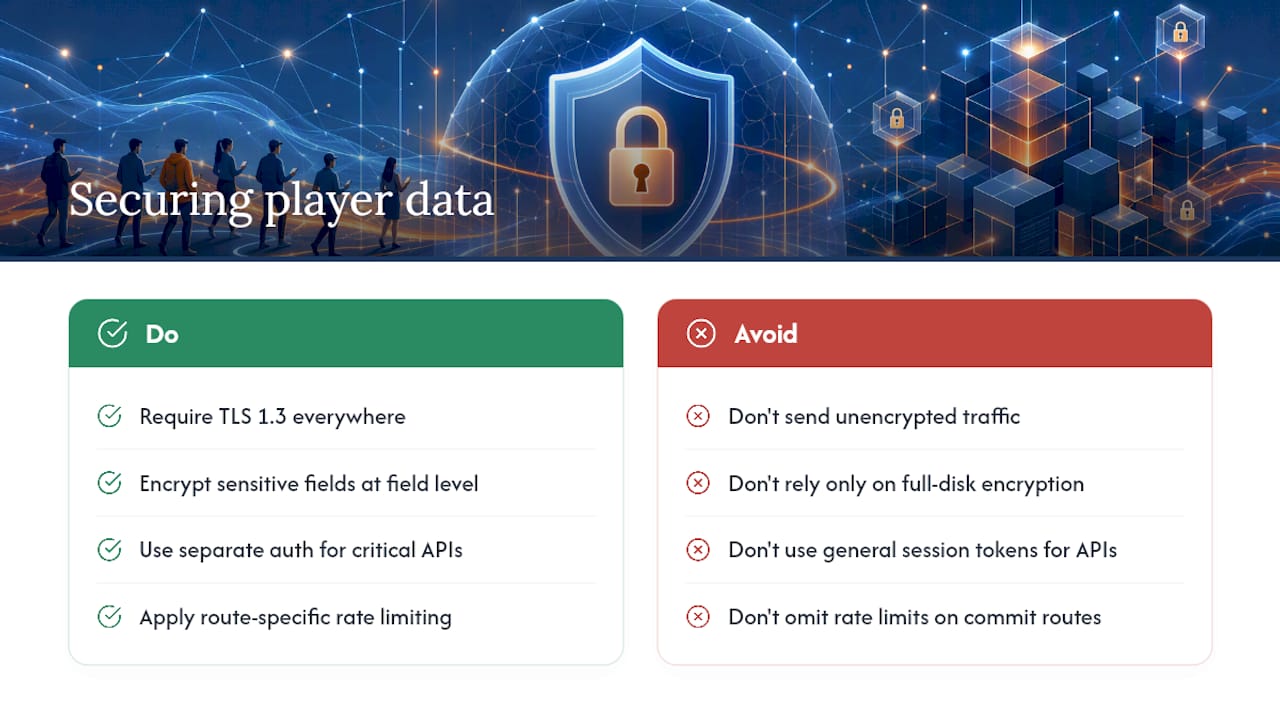
Fraud detection depends on trustworthy data, and that starts with how data moves and where it's stored. A platform that encrypts nothing in transit hands attackers an easy way to intercept lineup submissions, payment details, or session tokens.
TLS 1.3 for all client-server traffic is the baseline, not an upgrade. Anything less leaves lineup data and payment tokens exposed on networks the platform doesn't control, particularly on public Wi-Fi where a meaningful share of mobile play happens.
At rest, sensitive fields, payment instrument identifiers, government ID numbers collected for KYC, and device fingerprint data, need field-level encryption, not just full-disk encryption on the database server. Full-disk encryption protects against a stolen hard drive; it does nothing against a compromised application layer with database access.
API endpoints handling lineup commits, verification, and settlement need their own authentication layer separate from the general session token, since these are exactly the endpoints an automated cheating script targets first. Rate limiting on these specific routes catches scripted abuse that normal traffic monitoring misses because the request pattern looks like a human clicking quickly, not an obvious bot signature.
Segmenting pricing or oracle feeds from settlement feeds adds a reconciliation control most platforms skip. Keeping these feeds independent means a single compromised or manipulated feed can't both set the odds and validate the outcome, which closes off a specific and lucrative attack vector against contest integrity.
What Post-Contest Data Reveals About Fraud Patterns
The most useful fraud signals often surface after a contest closes, not during it. Real-time detection catches obvious violations; post-contest analytics catch the subtle patterns that only become visible once you can compare an entire slate against itself.
Run a full lineup similarity matrix across every entry in a closed contest, not just the pairwise checks used for real-time flags. Collusion rings sometimes spread their coordinated entries across three or four accounts specifically to stay under a pairwise threshold that would trigger a real-time alert, but a full matrix comparison catches the pattern a pair-by-pair check misses.
Payout distribution analysis matters just as much. If a small cluster of accounts consistently finishes in the top percentile across dozens of contests with statistically improbable consistency, that's a pattern worth a graph-based review even if no single contest triggered a flag. Behavioral overlap metrics that look clean in isolation often reveal a clear pattern once aggregated across a season.
Feed every confirmed fraud case, and every overturned false positive, back into the detection thresholds. A platform that never revisits its own historical data is relying entirely on real-time signals to catch problems that sometimes only reveal themselves in aggregate, weeks or months after the contests in question have already paid out.
When to Bring in Third-Party Fraud Detection Tools
Building every detection layer in-house isn't realistic for most operators, and it isn't necessary. Payment fraud detection, in particular, benefits from specialized vendors who see fraud patterns across many platforms, not just one.
Third-party services add the most value in two areas: payment risk scoring, since a dedicated fraud vendor sees card-testing patterns across thousands of merchants and catches attack signatures a single platform never would in isolation, and device fingerprinting, where established fingerprinting providers maintain larger reference databases of known bad devices than most fantasy platforms can build alone.
Integration should feed a third-party risk score into your own composite score rather than letting an outside vendor make the final call. A vendor's payment risk score is one input among several, not a verdict. Keep the final decision, and the audit trail behind it, inside your own system so you can defend it during a dispute or regulator inquiry without relying on a vendor's internal logic that you don't fully control.
Cost is the real tradeoff here. Per-transaction fraud-scoring fees add up fast on a free-to-play platform with high entry volume and thin margins, so most operators reserve third-party checks for withdrawal events and high-value transactions rather than every single deposit.
Operator Perspective: Integrity Without Killing the Fun
The uncomfortable truth about contest security is that every friction point you add to stop cheaters also slows down honest players. Lock times, step-up verification, and manual review queues all cost you something in engagement, and pretending otherwise is how operators end up either too soft on fraud or so aggressive they drive away casual fans.
Notifications and clear tiebreaker rules quietly do a lot of the heavy lifting here. Players who know exactly when a lineup locks and how a tie gets broken raise fewer disputes, and fast, transparent messaging turns enforcement from an adversarial fight into a routine process. The active contest features that make lock times and standings visible in real time aren't just UX polish. They're a fraud-reduction tool that happens to also improve the experience.
— peter
Try an Embeddable Contest Built for Integrity
Most operators trying to solve contest fraud from scratch spend months building fingerprinting, graph detection, and lineup commitment schemes before a single contest goes live. Some platforms offer embeddable games that come with contest scheduling, leaderboards, and rewards mechanics structured around published rules and clear lock times, providing operators with a fraud-resistant contest framework without building the enforcement layer from scratch.

If you run a sports content site and want a contest format with fair-play mechanics already baked into the structure, the sports hash embeddable game is a practical starting point. It's built for exactly the operators this article is written for: teams that want engaged players without inheriting a fraud problem on day one.
Pair it with the guide to writing contest rules before launch so your enforcement policy is ready the moment your first contest fills.
Sources
For teams ready to build detection systems in-house, three areas of external reading pay off immediately: the FENCE research on real-time multiple-ID detection covers graph construction at scale, the dev.to walkthrough on lineup backdating gives working commitment-hash API patterns, and provably-fair verification concepts from gaming fairness systems like Dropskin's translate directly to lineup commitment design.
- FENCE: Fairplay Ensuring Network Chain Entity for Real-Time Multiple ID Detection at Scale In Fantasy Sports (arXiv)
- Help
- DFS Fraud Detection: Multi-Accounting, Collusion & Stale-Line Arbitrage | Interexy
- Dev
FAQ
What is the single most effective way to prevent contest cheating?
No single control does it alone. Combining device and behavioral signals into a risk score, backing it with published rules, and routing borderline cases to human review catches more fraud than any one tool.
How do commitment hashes stop lineup manipulation?
A SHA-256 hash locks in proof that a lineup existed at a specific moment before contest lock, making post-kickoff backdating provable and blockable.
Should every flagged account be banned automatically?
No. High-confidence clusters can be auto-blocked, but mid-confidence flags need human review to avoid costly false positives that erode player trust.
What's the fastest fix an operator can make this week?
Enforce server-side lock times, cap entries per device, and start running nightly lineup overlap reports against expected variance. All three take days, not months.
Does Megasports Arena help operators manage contest integrity?
Some fantasy sports platforms offer embeddable contest games with scheduling, leaderboards, and notification tools structured around published rules, providing operators a fair-play framework without building detection systems from scratch.